Part 3 recap: My son had just admitted that this was not the first time his cousin had hurt him.
I looked at my sister and realized she was still waiting for me to reassure her.
I didn’t.
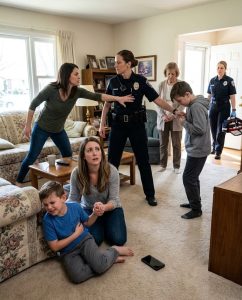
“My son is going with the medics,” I said. “And I’m telling them exactly what happened.”
My mother whispered my name like I had betrayed her.
The twelve-year-old started crying then—not loudly, just the frightened kind of crying he had apparently been holding back while the adults decided what version of the afternoon would be safest for them.
“I hit him,” he told the officer. “I got mad. I didn’t think he was hurt that bad.”
His mother tried to interrupt again, but the officer stopped her and let him finish.
The boy said that after my son complained that his chest hurt, the adults started arguing about whether an ambulance would bring police. That was when the conversation stopped being about two kids who had fought and became a conversation about preventing consequences.
My son was being moved carefully onto a stretcher when he reached for my sleeve.
“Mom?”
“I’m right here.”
His eyes moved toward my mother, then back to me.
“Do I have to stay here again?”
That question hurt more than anything my sister had said.
“No,” I told him. “Not unless you feel safe and I know you’re safe.”
My mother covered her mouth.
My sister stared at me as if I had just destroyed something.
Maybe I had.
But it wasn’t my son’s job to preserve a family arrangement that required him to stay quiet when he was hurt.
As the responders started toward the door, the officer asked my son one final question before we left.
“Has your cousin ever hurt you like this before?”
My son hesitated.
Then he tightened his hand around mine and whispered, “Not this bad.”
The officer did not press him for details in the middle of the room.
He only nodded once and told me that the most important thing right then was getting my son evaluated and keeping him somewhere he felt safe.
I followed the stretcher toward the front door.
Behind me, my mother said, “Please don’t leave like this.”
I stopped with one hand on the doorframe.
For most of my life, that sentence would have worked on me.
Don’t leave angry.
Don’t embarrass the family.
Don’t make a permanent decision over one bad afternoon.
There was always some version of it whenever somebody crossed a line and wanted forgiveness before they had even admitted where the line was.
But my son had just asked whether he had to come back.
That was the only question that mattered to me anymore.
I turned around.
My mother’s face was wet now.
My sister stood several feet behind her, one hand on her son’s shoulder. The boy had stopped crying, but he was staring at the floor as if he wished he could disappear into it.
I felt angry at him.
Of course I did.
My eight-year-old was being taken out of that house with a rib injury because a twelve-year-old had lost his temper and hit him hard enough to leave him gasping.
But looking at my nephew, I also saw something I had not been willing to see a few minutes earlier.
He was a child surrounded by adults who had immediately taught him the wrong lesson about what happened next.
Not tell the truth.
Not check whether his cousin needed help.
Not apologize.
Protect the adults from consequences.
My sister had told him to say my son fell.
My mother had taken my phone when I tried to call 911.
And somewhere in those eleven minutes of open audio, they had apparently believed the real emergency was that someone outside the family might hear them.
I looked at my mother.
“When he told you breathing hurt, what did you do?”
She opened her mouth and closed it again.
“I thought he was scared,” she finally said.
“That’s not what I asked.”
Her eyes dropped.
My sister answered for her.
“She checked on him.”
I turned toward her.
“You already told the officer you only saw part of what happened.”
She stiffened.
It was a small contradiction compared with everything else, but I watched it land between us.
She had been shifting her story depending on what she needed the next sentence to accomplish.
First she barely knew what had happened.
Then she knew enough to call it roughhousing.
Then she knew enough to explain what our mother had done after my son complained about pain.
The officer was still close enough to hear us, but he did not interrupt.
My sister saw me looking at him and lowered her voice.
“You’re trying to turn us into monsters.”
“No,” I said. “I’m trying to understand why my injured kid had to ask permission to be helped.”
She flinched at that.
Not because I had shouted.
I hadn’t.
Maybe that was why the words landed.
The stretcher moved onto the porch, and I went with it.
My son reached for me again.
I took his hand.
The ride to get him checked felt much longer than it was.
He barely talked.
Every few minutes I asked whether he needed anything, and every time he shook his head.
Then, quietly, he asked, “Is Grandma mad at me?”
That question made something in me settle.
Not soften.
Settle.
He was lying there hurt, and he was still worried that telling the truth had made an adult angry.
I moved closer so he did not have to raise his voice.
“You did nothing wrong by telling me you were hurt.”
He looked at me for a few seconds.
“Even if he gets in trouble?”
“Even then.”
I did not tell him his cousin was a bad kid.
I did not tell him Grandma was evil or that his aunt did not love him.
He was eight.
He did not need my anger handed to him as another thing to carry.
What he needed was one rule he could trust.
If you are hurt, you are allowed to ask for help.
If someone tells you to hide an injury so adults will not get upset, you tell me.
Every time.
While he was being evaluated, I sat close enough that he could see me whenever he opened his eyes.
My phone had been returned to me before we left the house.
It kept lighting up on the chair beside me.
Mom.
Then my sister.
Then Mom again.
I let the calls stop on their own.
A message from my mother appeared.
Please call me before you decide anything.
I stared at those words longer than I should have.
Before you decide anything.
As if the decision had not already been made the moment she pulled my phone away while my son struggled to breathe.
As if she still believed the important choice belonged to me alone and not to the child who had asked whether he was safe in her house.
A second message came through.
I love him. You know that.
That one hurt differently because I believed her.
I did believe she loved him.
That was what made the whole thing harder.
People like simple stories where love and danger live on opposite sides of the room.
Real families are not always that convenient.
My mother loved my son.
She had also decided, in a moment when he needed an adult to protect him, that keeping control of the situation mattered more than getting him immediate help.
Both things could be true.
And loving him did not erase what she had done.
My sister sent a longer message later.
She said her son was devastated.
She said he had never meant to seriously injure his cousin.
She said I needed to remember that he was only twelve.
On that point, I agreed with her.
He was twelve.
Which was exactly why I could not understand why she had put the burden of covering everything up on him.
He had already admitted he hit my son.
He had already said he did not realize how badly he had hurt him.
Then the adults gave him another problem to manage: what story to tell if authorities came.
My anger at my nephew did not disappear, but it changed shape.
He was responsible for hurting my son.
My sister and mother were responsible for what they did after they knew my son was hurt.
Those were not the same responsibility, and I refused to let the adults blur them together anymore.
When my son was more comfortable, he finally told me a little more about what he had meant by “not this bad.”
I did not interrogate him.
I asked simple questions, and when he stopped, I stopped.
He said his cousin had shoved him before.
He said there had been times when playing turned rough and he did not want to keep going.
Once, he said, he had told Grandma he wanted me to pick him up early.
She told him the boys needed to learn how to work things out.
Nothing he described sounded like another injury as serious as the one that had brought us there that day.
But the pattern bothered me because of what it had taught him.
He had already learned that saying “I want to go home” might be treated like an overreaction.
He had already learned to calculate whether his discomfort was important enough to interrupt the adults.
That explained the question on the stretcher.
Do I have to stay here again?
He had not been asking only about that afternoon.
He had been asking whether I would finally believe his sense of safety over everybody else’s convenience.
I sent my mother one message that evening.
He will not be staying at your house without me.
I read it twice before pressing send.
No accusation.
No threat.
No long explanation she could argue with sentence by sentence.
Just a boundary.
Her reply came almost immediately.
You’re punishing me.
I put the phone face down.
That was the old family language again.
A boundary became punishment if someone disliked it.
A consequence became cruelty if it changed a routine they enjoyed.
My son’s visits had been convenient for everyone.
My mother got time with her grandsons.
My sister sometimes had both boys together without having to make other arrangements.
The cousins had a relationship that, from the adults’ point of view, was easier to call close than to examine carefully.
If I stopped sending my son there alone, the arrangement changed for all of them.
That did not make the boundary wrong.
The next time my sister called, I answered.
She did not say hello.
“Are you really cutting Mom off?”
“I didn’t say that.”
“You said he can’t stay there.”
“Without me.”
“That’s the same thing and you know it.”
“No. It isn’t.”
There was a long pause.
Then she said, “You’re making one terrible day define all of us.”
I looked across the room at my son.
He was tired, pale, and watching something quietly with the volume low.
“One terrible day didn’t make this decision,” I said. “What happened when he asked for help did.”
My sister immediately went back to the fight.
She said the boys had been arguing.
She said her son admitted what he did.
She said children make mistakes.
Again, I agreed with part of what she was saying.
Children do make mistakes.
That was not why I could not trust the house anymore.
“The twelve-year-old told the truth before either of you did,” I said.
She went quiet.
“He told the officer he hit him. He told him you told him to say there had been a fall. He is the child in this situation, and somehow he was the first person in your house willing to stop protecting the story.”
Her voice cracked when she answered.
“I was scared.”
There it was.