PART 4 (THE END)
For several seconds, I could only stare at Nicole’s name beneath the photograph.
Daniel leaned closer.
“That can’t be your sister.”
“It says Nicole.”
“But Nicole is younger than you.”
Exactly.
My sister Nicole was thirty-five.
I was thirty-nine.
The photograph was dated three years before my birth.
The baby in Ellen’s arms could not be my sister.
Unless the name meant something else.
I called my mother.
She answered immediately.
“Sarah?”
“What happened to Nicole?”
Silence.
Then a chair scraped across a floor on her end of the line.
“What are you talking about?”
“Ellen sent me a photograph.”
My mother inhaled sharply.
“There’s a baby in it. The name on the back is Nicole.”
Mom said nothing.
“Who was she?”
For nearly ten seconds, there was only the sound of breathing.
Then Mom said, “I should have told you yesterday.”
“Who was Nicole?”
“She was Ellen’s daughter.”
The answer rearranged everything again.
“My sister is named after Ellen’s daughter?”
“Yes.”
“What happened?”
Mom’s voice softened.
“She became ill shortly after birth.”
I closed my eyes.
“How old was she?”
“Three months.”
I didn’t ask for details.
I didn’t need them.
A family had lost a child.
That fact was enough.
“Why name your daughter after her?”
“When your Nicole was born, Ellen and I were still writing occasionally.”
Mom paused.
“We asked her first.”
“She knew?”
“Yes.”
That changed the shape of my sister’s name.
It was no longer evidence of erasure.
It had once been an act of remembrance.
“What did Ellen mean when she said I wasn’t the only child she lost when everyone stopped speaking?”
“She meant your sister.”
“But Nicole was alive.”
“She never met her.”
I leaned against the kitchen counter.
“Why not?”
“Because by the time Nicole was old enough for a visit, your father knew I had kept contact with Ellen.”
The years of silence suddenly looked even larger.
Not one lost relationship.
Several.
Sisters.
An aunt.
A niece.
A father who once cared for someone and later pretended she never existed.
A mother who wanted security badly enough to mistake silence for stability.
“Does Nicole know any of this?”
“No.”
I nearly laughed.
Not because it was funny.
Because of course she didn’t.
My younger sister, who had stood in the kitchen with her arms crossed and said someone had to teach Ava respect, was also living inside a family story she had never been allowed to read.
“Tell her.”
Mom became quiet.
“You should tell her.”
“No.”
I surprised myself with the certainty in my voice.
“You and Dad tell her.”
“What if she’s angry?”
“She will be.”
“What if she doesn’t forgive us?”
“That isn’t yours to control.”
The sentence might have been written for all of us.
Mom breathed out.
“You’re right.”
“I know.”
This time, the words didn’t sound arrogant.
Just clear.
Nicole called that evening.
She didn’t say hello.
“Did you know?”
“Since this morning.”
“You contacted Ellen?”
“Yes.”
“Mom says she’s our aunt.”
“She is.”
“And I’m named after her daughter.”
“Yes.”
Nicole became quiet.
Then she said something very small.
“Why didn’t anyone tell me?”
My anger toward my sister shifted.
It didn’t disappear.
But it became less simple.
The woman who had defended my father two nights earlier had spent her entire life learning the same survival rules I had.
The difference was that I escaped into a profession that rewarded independent judgment.
Nicole stayed close to home.
She worked in Dad’s office for eight years after college.
Bought a house six streets from our parents.
Had Thanksgiving with them every year.
Her entire social world overlapped with theirs.
“Because our family has a strange idea of protection,” I said.
Nicole gave a sad laugh.
“Mom said something similar.”
“How are you?”
“I don’t know.”
That was probably the healthiest answer she could have given.
Then she said, “Sarah, about Ava.”
I waited.
“I was wrong.”
The apology came without explanation.
“I shouldn’t have said what I said.”
“No.”
“I keep replaying it.”
I didn’t rescue her from that discomfort.
“I saw Dad angry, and I did what I always do.”
“What’s that?”
“Made him right as quickly as possible so everyone could calm down.”
That was exactly it.
Nicole sniffed.
“I thought I was keeping things from getting worse.”
“So did Mom for forty years.”
“I know.”
A long silence passed.
Then Nicole said, “I’m sorry.”
This time I answered.
“Thank you.”
Not it’s okay.
It wasn’t.
But thank you was possible.
“Can I see Ava?”
“Not yet.”
Nicole absorbed that.
“Okay.”
“Send her a drawing.”
“What?”
“She’s obsessed with giraffes right now.”
Nicole laughed through her tears.
“I can draw a giraffe.”
“Good.”
It was a small beginning.
Small beginnings had created most of our family’s problems.
Perhaps they could also create repairs.
I spoke with Ellen for the first time two days later.
We used video.
She appeared on my laptop screen wearing blue-framed glasses with a bookshelf behind her.
For several seconds, neither of us spoke.
Then she smiled.
“Oh.”
That single word broke something open in my chest.
“What?”
“You look like Maggie at twenty-five.”
I laughed unexpectedly.
“Everyone says I look like Dad.”
“Around the eyes, perhaps.”
She leaned closer.
“But that expression is Margaret.”
“What expression?”
“The one that says you’ve already decided whether I’m making sense.”
I smiled.
“I might have that.”
“You definitely have that.”
The conversation lasted ninety minutes.
We did not unpack forty years.
We didn’t try.
Ellen told me stories.
My mother once hitchhiked six miles after missing a bus because she refused to be late for a concert.
My father had owned a yellow motorcycle.
George had been terrified of dogs.
My grandfather Thomas sang terribly but enthusiastically in church.
The dead were not transformed into saints or villains.
The living weren’t either.
They became people.
That was the unexpected gift Ellen gave me.
Context without excuse.
Understanding without obligation.
“I want you to know something about Richard,” she said near the end.
“What?”
“He loved your mother.”
I blinked.
“I never doubted that.”
“Good.”
Ellen smiled.
“For years, I worried Margaret believed she had stolen someone from me. She didn’t.”
“You were engaged.”
“We were nineteen.”
“You were planning a wedding.”
“At nineteen, I was also planning to own six horses.”
I laughed.
“I have zero horses.”
“So you don’t resent them?”
“I resented the way things happened.”
She considered her words.
“But sometimes people confuse a painful ending with a wrong ending.”
That stayed with me.
“Did you ever marry?”
“Yes.”
Her smile changed.
Softer.
“His name was Michael.”
“Was?”
“He died six years ago.”
“I’m sorry.”
“We had thirty-one good years.”
“Children?”
“No.”
She paused.
“After my daughter died, I discovered I couldn’t have another.”
There was sadness in her face, but it did not consume her.
“I spent my career surrounded by children. That was enough in some ways and never enough in others.”
I understood what she meant without pretending to understand the experience itself.
“Would you want to meet Nicole?”
Ellen’s eyes filled instantly.
“Does she want to meet me?”
“I haven’t asked.”
“Then ask her.”
No entitlement.
No claim.
Another lesson in what boundaries could look like.
“And Mom?”
Ellen looked away briefly.
“I don’t know.”
That answer surprised me.
“I love Margaret.”
“But?”
“Love does not automatically make people ready for each other.”
Fair.
“What would make you ready?”
Ellen smiled sadly.
“Perhaps hearing her tell me why she wants me back in her life instead of why she feels guilty.”
I wrote that sentence down later.
Ava recovered quickly.
Within a week she was begging to return to preschool.
Her doctor cleared her for normal quiet activity and told us to watch for symptoms.
She returned carrying Captain Waffles in her backpack despite school rules about toys.
Her teacher made an exception.
Our house returned to something resembling routine.
Breakfast.
Shoes missing.
Daniel searching for his keys while holding them.
Laundry.
Ava singing songs with incorrect lyrics.
Life did not wait for family history to resolve itself.
That helped.
Two weeks after the birthday party, my father began counseling.
He told me in a text.
Started today. Not asking for anything. Thought you should know.
I stared at the message.
Then wrote:
Okay.
That was all.
Three weeks later:
Session three. Harder than expected.
I wrote:
Most useful things are.
He replied:
Probably.
My father had never typed the word probably in an argument with me.
It was progress.
Tiny.
Unimpressive.
Real.
Mom began counseling separately.
That surprised me more.
Nicole stopped working at Dad’s company.
Not dramatically.
She simply realized she had wanted to leave for years.
She accepted a position managing operations for a medical supply firm across town.
Dad didn’t like it.
Then, according to Nicole, he caught himself.
“I started giving her reasons to stay,” he told me later.
“What did you do?”
“Stopped talking.”
I smiled.
“That must have been difficult.”
“Extremely.”
Humor returned before trust did.
That seemed healthy somehow.
Two months passed before I allowed my parents to see Ava.
The first visit happened in a public park.
Daniel came.
I came.
Nicole came.
My father arrived carrying nothing.
No presents.
No attempt to purchase forgiveness.
He stood near a picnic table while Ava played with chalk.
She saw him.
Stopped.
Then looked at me.
That look nearly ended the visit before it started.
“You don’t have to talk to Grandpa,” I said.
Ava nodded.
Dad heard.
He stayed where he was.
After several minutes, Ava drew a purple giraffe on the pavement.
Grandpa watched from a distance.
Finally she said, “It’s Captain Waffles.”
Dad smiled.
“I like his hat.”
Ava looked at the drawing.
“He’s a captain.”
“Of course.”
She considered my father.
Then pointed to another piece of chalk.
“You can make a tree.”
Dad looked at me.
Not for permission to control.
For permission to participate.
I nodded.
He sat several feet from Ava and drew the worst tree I had ever seen.
Ava stared at it.
“That looks like broccoli.”
Daniel covered his mouth.
Nicole laughed.
Dad looked at his drawing.
“It does.”
“You’re bad at trees.”
“I may need practice.”
Ava handed him another piece of chalk.
“Do another.”
That was how reconciliation began.
Not with a speech.
With a terrible chalk tree.
The meeting with Ellen happened six months later.
By then, she and Mom had exchanged four letters.
Actual letters.
Paper.
Apparently some habits deserved preserving.
Mom showed me the first one before mailing it.
Dear Ellen,
I have started this letter twelve times.
The first eleven versions were explanations.
This one is an apology.
I missed you.
I was angry because you saw parts of my life that I was afraid to see myself.
When you challenged my choices, I heard criticism instead of concern.
Then I punished both of us by turning distance into permanence.
I want you in my life because you are my sister.
Not because I want relief from guilt.
If you do not want the same thing, I will accept that.
But I hope someday we can sit together and talk about ordinary things again.
Love,
Maggie
Ellen replied.
Yes.
Let’s begin with ordinary things.
They decided to meet halfway.
A small town in New Mexico.
Nicole wanted to go.
Mom wanted me there.
Dad volunteered to stay home.
“I think this should belong to the sisters first,” he said.
That was perhaps the wisest thing I had ever heard him say.
So Daniel and Ava stayed with him for three hours at our house while I joined Mom and Nicole for the meeting.
Six months earlier, I would have considered that impossible.
Trust is not restored because someone wants it.
It returns through evidence.
My father had spent half a year offering evidence.
Keeping boundaries.
Attending counseling.
Never asking Ava to reassure him.
Never asking me when everything would go back to normal.
Perhaps because he finally understood there was no normal worth returning to.
We found Ellen at a café beside a bookstore.
Mom saw her through the window.
She stopped walking.
Nicole touched her arm.
“You okay?”
“No.”
Mom laughed nervously.
“But I’m going inside anyway.”
That was courage.
Not the absence of fear.
Movement beside it.
Ellen stood when we entered.
For a few seconds the sisters simply looked at each other.
Forty years vanished and remained simultaneously.
I saw similarities I hadn’t noticed on a screen.
The angle of their shoulders.
The shape of their hands.
The way both pressed their lips together when trying not to cry.
“Hi, Maggie,” Ellen said.
Mom covered her mouth.
“Hi.”
Then they hugged.
Nothing cinematic happened.
No applause.
No perfect speech.
Ellen’s glasses bumped Mom’s cheek.
Mom laughed while crying.
Nicole cried immediately because Nicole cries at commercials involving dogs.
I cried because apparently I had inherited more from the Whitmore women than I realized.
We spent four hours together.
They talked about books.
Michael.
Dad.
Ellen’s daughter.
My grandfather.
Mom’s abandoned graduate program.
At one point Ellen asked, “Do you still want to be a librarian?”
Mom laughed.
“I’m sixty-two.”
“That wasn’t my question.”
Mom became quiet.
“I don’t know.”
“Find out.”
Six weeks later, my mother began volunteering at the county library twice a week.
Three months after that, she enrolled in a part-time archival studies certificate.
She claimed it was “just for fun.”
Nobody argued.
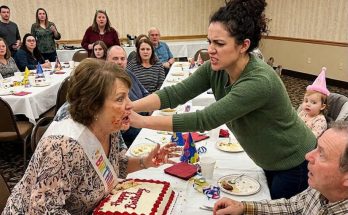
A year after my father’s sixtieth birthday, we held another birthday dinner.
Not at my parents’ house.
At ours.
Smaller.
Quiet.
No giant family gathering.
No performance of togetherness.
Just people who had learned how expensive pretending could become.
Ava was four.
She had forgotten most of the incident, or at least stopped speaking about it.
Dad never did.
He became extraordinarily careful around her.
Sometimes too careful.
One afternoon, she climbed onto a chair and he looked at me before helping her down.
“Dad,” I said.
“What?”
“You can catch your granddaughter without filing a request.”
He laughed.
“I’m learning.”
That became his phrase.
I’m learning.
Not I know.
Not listen to me.
Not because I said so.
I’m learning.
At dinner, Ellen sat beside my mother.
That alone would have been unimaginable a year earlier.
George came too.
Nicole brought a man named Marcus she had been dating for five months and warned everyone not to ask when they were getting married.
Dad nearly asked.
I watched him stop himself.
Progress.
After cake, Ava climbed into my lap.
“Mommy?”
“Yes?”
“Can Grandpa read my book?”
I looked across the room.
Dad had heard.
He waited.
I asked Ava, “Do you want him to?”
She nodded.
“Then ask him.”
She ran toward him carrying a picture book about an elephant who refused to go to sleep.
Dad sat on the couch.
Ava climbed beside him.
Not because anybody told her family should forgive.
Not because adults wanted a beautiful ending.
Because during the previous year, he had become safe enough for her to choose.
That distinction meant everything.
He began reading.
Ava corrected him whenever he skipped a line.
Ellen watched from across the room.
“So,” she said quietly, “did he ever tell you about dancing in the grocery store parking lot?”
Dad looked up.
“Absolutely not.”
Mom laughed.
“I remember that.”
“You weren’t there.”
“Ellen told me.”
Dad stared at both sisters.
“You two have reunited purely to damage my reputation.”
“Obviously,” Ellen said.
Ava looked confused.
“Grandpa dances?”
“Not anymore,” Dad replied.
Ellen raised an eyebrow.
“Coward.”
Everyone laughed.
Dad stood.
“What song was it?”
Ellen blinked.
“You remember?”
“Of course I remember.”
He took his phone from the table.
A few seconds later an old song began playing through the speaker.
Dad stood in the center of my living room.
Then, awkwardly, deliberately, he danced.
It was terrible.
Ava screamed with laughter.
Nicole joined him.
Then Mom.
Ellen resisted for approximately five seconds before joining too.
Daniel held out his hand to me.
“Colonel?”
“I don’t dance.”
“You command soldiers.”
“Different skill set.”
Ava shouted, “Mommy!”
I looked at my family.
Not healed.
Healing.
There was a difference.
Some relationships had new boundaries.
Some had new beginnings.
Some wounds remained private.
Some regrets would never disappear.
My father could not undo the fear he had created.
My mother could not recover forty lost years with her sister.
Ellen could not meet the niece who had been named in memory of her daughter as a child.
Nicole and I could not rewrite the household that taught us two different ways to survive conflict.
But there was something unexpectedly freeing about accepting that repair did not require pretending damage had never happened.
It only required that tomorrow not repeat yesterday.
So I took Daniel’s hand.
And I danced badly in my own living room.
Later that night, after everyone left, I found my father’s birthday card on the kitchen counter.
Inside he had written only three lines.
Sarah,
Thank you for teaching me that being given another chance does not mean being given the old relationship back.
Sometimes it means being trusted to build a better one.
Love,
Dad
I folded the card and placed it in the drawer where I kept things I wanted Ava to see someday.
Not because it proved my father had changed forever.
People do not graduate from change.
They practice it.
I kept it because someday my daughter might make mistakes.
Someday I would too.
And I wanted her to understand something I had learned far later than I should have.
Family is not measured by how perfectly people avoid hurting one another.
It is measured by whether people can tell the truth when hiding would be easier.
Whether apologies become changed behavior.
Whether boundaries are respected without punishment.
Whether love leaves room for choice.
Ava wandered into the kitchen wearing pajamas covered in stars.
“Mommy?”
“I thought you were asleep.”
“I need water.”
I poured her a small glass.
She drank half, then leaned against me.
“Was Grandpa funny when you were little?”
The question caught me off guard.
I thought of Ellen’s letter.
The yellow motorcycle.
The parking-lot dancing.
The father I knew.
The boy he had once been.
The man he was trying, imperfectly, to become.
“Sometimes,” I said.
Ava smiled sleepily.
“He’s funny now.”
I kissed the top of her head.
“Yes.”
Then she reached for my hand.
“Come tuck me in.”
I followed her upstairs.
Past the family photographs Daniel had hung along the staircase.
There was a new one among them.
Taken in New Mexico.
Mom and Ellen stood together outside the bookstore, arms linked, laughing at something outside the frame.
Beside it was another photograph.
Dad sitting on our driveway with Ava, both of them covered in sidewalk chalk.
Two ordinary images.
No one looking important.
No one controlling the room.
No secrets behind the smiles.
I stopped for only a second.
Then Ava tugged my hand.
“Come on, Mommy.”
“I’m coming.”
And I was.
Not backward.
Not into the family we had been.
Forward.
Into the one we were finally choosing to become.