At exactly 6:00 a.m. on a cold Thursday morning, Lauren started pounding on my front door hard enough to make the hallway photographs shake.
“Evelyn! Open this door!”
Her voice tore through the quiet street before the sun had fully come up.
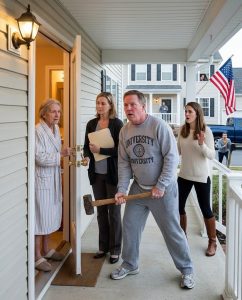
The porch light was still on, throwing a pale yellow circle around her cream sweater, black leggings, and the leather boots I had bought her for Christmas two years earlier.
She had not even put on a coat.
That told me she had left in anger, not planning.
I stood behind the living room curtain in my robe and slippers, holding the fabric open with two fingers.
The house smelled like old coffee and cold morning air seeping around the doorframe.
My mug sat untouched on the dining room table.
The person across from it had not touched hers either.
Lauren hit the door again.
The brass chain jumped against the frame.
“I know you’re in there!” she shouted. “Open it!”
I watched her shove her key into the lock.
It slid in easily.
Then it stopped.
She twisted harder.
Nothing moved.
That was when the anger on her face shifted into something sharper.
Not confusion.
Entitlement.
“You changed the locks,” she said through the glass panel.
I did not answer.
For most of my life, silence had been mistaken for weakness.
That morning, silence was the only thing keeping the truth in order.
Behind me, a chair creaked softly.
“Let her speak first,” the woman at my dining room table said.
Her voice was calm enough to steady my hands.
She had arrived at 5:12 a.m. with a leather bag, a manila folder, and the kind of face people get when they have already read the worst part and are only waiting for everyone else to catch up.
She did not rush me.
She did not tell me I should have done this sooner.
She simply placed three pages in front of me and asked if the signature at the bottom of the deed copy was mine.
It was.
The house was mine.
It had always been mine.
My late husband and I bought it when Michael was seven years old, back when the driveway still had cracks we could not afford to fix and the kitchen cabinets stuck in the summer humidity.
I had worked two jobs for three years after my husband died.
I had paid the mortgage late twice and cried both times in the parking lot of the bank.
I had raised Michael in that house.
He knew which porch board squeaked.
He knew where his father had carved a tiny line in the laundry room doorway to mark his height every September.
He knew I kept the Christmas ornaments in the attic above the hall closet.
He also knew I trusted him.
That was the part I had misunderstood.
Trust feels like love until someone starts treating it like access.
Lauren hit the door again.
Across the street, Mr. Callahan stepped onto his porch with a paper coffee cup in his hand.
He looked at my house, then at Lauren, then down into his cup like the coffee might tell him what to do.
The curtain next door moved.
Somewhere behind Lauren, a dog began barking.
“You can’t lock us out of our own house!” Lauren screamed.
Our own house.
I had heard her say it before.
At Sunday dinner, when she complained the guest room was wasted on my sewing table.
At Thanksgiving, when she said the kitchen would look brighter if someone finally got rid of my old oak hutch.
At Michael’s birthday, when she stood in my backyard holding a red plastic cup and told her friend, not quietly enough, that the place had “good bones” if it were ever updated.
I had laughed it off then.
Women of my generation are trained to laugh off warnings because we do not want to make a scene.
Then we wonder why the scene arrives with a sledgehammer.
The woman at my table opened the folder again.
“You called the locksmith at what time?” she asked softly.
“Four fifty-eight,” I said.
“And he finished?”
“Five twenty-eight.”
She wrote that down.
The locksmith invoice was already on the table.
So was the copy of the deed.
So was the county clerk receipt showing the property records search from the day before.
And beside them was the police non-emergency report number I had written on the back of an envelope at 11:43 p.m.
I had not slept much after that.
You do not sleep after you hear your son tell his wife, through a phone he thought had ended the call, that his mother was “too old to fight paperwork.”
You sit very still.
You replay the words until they stop sounding impossible.
Then you make coffee before dawn and do the thing you should have done the first time they asked for a spare key.
Lauren stopped pounding long enough to pull out her phone.
Her thumb moved fast.
The woman in my dining room watched through the gap in the curtain.
“She is calling him,” she said.
I knew that.
I had known Michael would come.
I had just not known which version of my son would arrive.
Three minutes later, headlights swept across the front windows.
A dark blue pickup stopped crooked at the curb.
The driver’s door flew open.
Michael climbed out wearing gray sweatpants and the university sweatshirt he slept in when he was too tired to pretend he was fine.
His hair was flattened on one side.
His face was red before he reached the sidewalk.
For one second, he looked like the boy I had loved beyond reason.
Then he walked around to the bed of the truck.
When he turned back toward the house, he was carrying a sledgehammer.
The breath left my body in a thin, cold line.
Lauren rushed down the porch steps toward him.
“She won’t open it,” she said. “She changed everything.”
Michael looked up at the front windows.
“Mom!” he shouted. “Open the door before this gets out of control!”
The irony almost made me laugh.
I was not the one standing on a lawn at dawn with a demolition tool.
The woman beside my table stood slowly.
The leather bag clicked shut.
“Do not open it because he tells you to,” she said.
My hand was already shaking.
Not because I believed Michael would hurt me.
Because I no longer knew what he believed he was allowed to do.
That is a different kind of fear.
It does not scream.
It rearranges your memories.
Suddenly, every little moment becomes evidence.
The time Lauren asked where I kept my insurance papers.
The afternoon Michael insisted it would be “easier” if I added him to a few accounts.
The evening he got annoyed when I said I liked paying my own bills by check because it helped me remember what was due.
The joke about how stubborn I was.
The joke about how the house was too much for me.
The joke about how one fall could change everything.
Michael climbed the porch steps and rested the head of the sledgehammer on the boards.
Mr. Callahan across the street stopped with his cup halfway to his mouth.
The curtain next door froze.
A jogger at the corner slowed and pretended to tie her shoe by the mailbox.
Nobody wanted to be watching.
Everybody was.
“You have thirty seconds,” Michael called. “After that, I’m coming in.”
Lauren folded her arms.
She looked satisfied.
That expression hurt more than the hammer.
She looked like my locked door was an inconvenience, not a boundary.
She looked like my fear was proof I needed managing.
She looked like she had already moved in inside her mind.
For one ugly heartbeat, I wanted to open the door and scream.
I wanted to list every lunch I had packed, every bill I had quietly covered, every birthday check I had written when Michael said things were tight.
I wanted to ask him if he remembered being twelve and crying in the garage because he missed his father, and how I sat on the concrete floor beside him until the cold went through my knees.
I wanted to ask when his love turned into appraisal.
But rage is expensive when people are waiting for you to spend it in front of witnesses.
So I stood still.
The woman beside me walked to the hallway.
Michael lifted the sledgehammer with both hands.
“Mom!” he yelled again.
I reached for the deadbolt.
That was when the calm voice behind me said, “Leave it. I’ll handle this.”
The lock turned.
The door opened.
Michael froze.
The sledgehammer did not fall.
It dipped just enough for the metal head to scrape the porch rail.
Lauren’s mouth opened, but no words came out.
The woman stepped onto the threshold with the manila folder held against her chest.
She was not tall.
She was not loud.
But she carried herself like someone who knew the difference between a family argument and a recordable event.
“Before either of you says another word,” she said, “you should understand that this is being documented.”
Michael’s face changed.
Not anger this time.
Recognition.
Lauren looked from him to her.
“Who are you?”
The woman did not answer Lauren first.
She looked at my son.
“Mr. Harris, put the sledgehammer down.”
Michael swallowed.
The old part of me waited for him to obey because an adult had spoken.
The mother in me waited for him to lower it because I was his mother.
He did neither.
He kept holding it, but his grip loosened.
The woman opened the folder.
“Your mother has confirmed ownership of the property,” she said. “The locks were changed with her authorization. She has also documented last night’s call and this morning’s attempted forced entry.”
Lauren snapped, “Forced entry? He hasn’t done anything.”
The woman turned her head just enough to look at the hammer.
Lauren looked at it too.
That was the first time she seemed to understand how it looked from the sidewalk.
Mr. Callahan still stood across the street.
The jogger was no longer pretending very well.
The neighbor’s curtain stayed open.
The whole block had become a witness stand.
Michael lowered the sledgehammer another inch.
“Mom,” he said, softer now, “this is ridiculous. We were worried about you.”
That sentence almost got me.
Not because I believed it.
Because I had wanted to believe it for months.
I wanted to believe the extra phone calls were care.
I wanted to believe the questions about my bills were concern.
I wanted to believe Lauren’s comments about the guest room were clumsy, not hungry.
The woman beside me slid one page out of the folder.
“Evelyn,” she said quietly, “do you want me to read the first line out loud?”
Michael’s mouth tightened.
Lauren turned sharply toward him.
“What line?”
He did not answer.
The page in the woman’s hand was not the deed.
It was not the locksmith invoice.
It was not even the police report number.
It was a printed statement from the night before, time-stamped and signed, with Michael’s name typed in a place no son wants to see his name typed while standing on his mother’s porch with a sledgehammer.
Lauren took one step back.
“Michael,” she said, and this time her voice was smaller. “What is that?”
He looked at me.
For the first time that morning, he looked like he remembered I was not just an obstacle between him and a house.
I was his mother.
“Please don’t,” he whispered.
The woman waited.
She did not enjoy it.
That mattered to me.
Cruel people rush toward humiliation.
Careful people make room for the truth and let it stand on its own.
I looked at my son, the hammer hanging lower now, his hands still wrapped around the handle.
Then I looked at Lauren, whose confidence had drained out of her face like water.
“Read it,” I said.
Michael closed his eyes.
The woman read only the first sentence.
That was enough.
It was not a confession in the way people imagine confessions.
It was worse because it was practical.
It described a plan to pressure me into signing temporary authority over my finances, then use the house as leverage for a loan Michael had not told me about.
Lauren made a small sound.
Not a scream.
A break.
“You said she agreed,” she whispered.
Michael’s eyes opened.
He looked at his wife like she had betrayed him by understanding him too late.
“Lauren,” he said.
“You said she agreed,” she repeated.
The sledgehammer finally touched the porch floor.
The sound was dull and heavy.
Mr. Callahan crossed the street then, slowly, not like a hero, but like a neighbor who had decided the line had moved too far.
“Everything all right over here, Evelyn?” he asked.
No one answered right away.
That was when I understood how long I had been answering for everyone else.
I had explained Michael’s moods.
I had softened Lauren’s sharpness.
I had told myself they were stressed, busy, young enough to still be selfish, though they were not young anymore.
I had translated disrespect into worry because worry was easier to forgive.
I stepped forward until I was standing beside the woman with the folder.
“No,” I said. “Everything is not all right.”
Michael flinched.
It was the smallest movement.
I still saw it.
He had expected documents.
He had expected resistance.
He had not expected me to stop protecting him from consequences.
The woman asked him to move away from the door.
This time, he did.
Lauren stood on the porch with her arms wrapped around herself, the key still in her hand, useless now.
For months, she had treated that key like a promise.
That morning, it looked like what it had become.
Evidence.
The police did come, though not with sirens.
The woman called the non-emergency number and gave the report reference I had written down the night before.
Michael sat on the porch step with his head in his hands while Lauren stood near the railing, crying without making much noise.
I did not comfort either of them.
That was harder than I expected.
A mother can be done with being used and still feel the old instinct rise in her body like a reflex.
When Michael was little, a scraped knee could undo me.
At forty-six, his pain still reached for me.
But this time, I let it pass through without obeying it.
The officers took statements.
They photographed the sledgehammer.
They wrote down the time of the call, the neighbor names, and the fact that the locks had been changed by the homeowner.
The woman stayed beside me the entire time.
When one officer asked if I wanted Michael removed from the property, I looked at my son.
His face had crumpled in a way that almost made him look twelve again.
“Yes,” I said.
One word.
Not shouted.
Not cruel.
Just finished.
Lauren stared at me as if I had slapped her.
Maybe people who live on your patience think boundaries are violence.
Maybe a locked door feels like betrayal to people who planned to walk through it.
Michael stood when the officer told him to.
He did not argue then.
The fight had gone out of him once the story no longer belonged only to him.
That is what records do.
They take the private fog of family and turn it into lines other people can read.
By 8:17 a.m., the pickup was gone.
The sledgehammer was gone too.
Lauren left in the passenger seat, staring straight ahead.
She never looked back at the house.
Mr. Callahan stayed on the sidewalk until I gave him a small nod through the open door.
Then he lifted his coffee cup like a quiet salute and went home.
Inside, the house felt too loud.
The refrigerator hummed.
The hallway clock ticked.
My cold coffee still sat on the table beside the folder.
The woman closed it gently.
“You did well,” she said.
I laughed once, but there was no humor in it.
“I changed the locks on my own son.”
“No,” she said. “You changed the locks on what he was willing to do to you.”
That sentence stayed with me.
Not because it made the morning easier.
Because it made it clear.
In the weeks that followed, there were messages.
Michael sent apologies that began with love and ended with explanations.
Lauren sent one long text about misunderstanding, stress, debt, and how family should not involve outsiders.
I did not respond to that one.
Family had involved outsiders the moment my son raised a sledgehammer on my porch.
The paperwork continued.
The county clerk copy went into a new folder.
The police report was added behind it.
The locksmith invoice stayed on top.
Not because I wanted to live like a suspicious woman.
Because I had spent too many years living like a generous one without keeping proof.
Michael eventually came alone.
He parked at the curb, not in the driveway.
He did not touch the door.
He stood on the porch and waited until I opened it with the chain still fastened.
His eyes filled when he saw that chain.
Mine did too.
“Mom,” he said, “I don’t know how I got there.”
I believed him in one way.
People rarely notice the exact step where need becomes greed.
They just keep walking until someone locks the door.
I told him I loved him.
I also told him he could not come inside.
Both things were true.
That is the part nobody teaches you about self-respect.
It does not always feel like power.
Sometimes it feels like standing in slippers behind a chained door while your child cries on the porch.
Sometimes it feels like refusing to turn pain into permission.
The house is quieter now.
The guest room is still my sewing room.
The oak hutch is still in the kitchen.
The old height marks are still in the laundry room doorway, including the highest one, the September before Michael stopped wanting me to kiss the top of his head in public.
I do not look at those marks every day.
But when I do, I let myself remember the boy without handing the house back to the man.
People tell you family means trust.
They are right.
But trust without boundaries is not love.
It is an unlocked door.
And that morning, before the sun came up, I finally learned the difference.