Against orders.
Against duty.
A test no military marriage survives for long.
“You should’ve told me.”
“I should have.”
“And I should’ve listened before it got that bad.”
He nodded.
Then I said, “But I’m not taking responsibility for the loan.”
“You shouldn’t.”
That was the first time he said it.
“I was wrong.”
I waited.
“I used your absence to tell myself your things were available.”
My eyes burned.
“That’s what your father did too.”
“I know.”
He looked toward the townhouse.
“You always had this place.”
“Yes.”
“I think I hated that.”
“Why?”
“Because no matter what happened to us, you had somewhere that was yours.”
That surprised me.
Nathan had interpreted my independence as an exit door.
I had interpreted it as safety.
Both could be true.
“I’m sorry our marriage ended this way.”
“So am I.”
He stood.
Then, after seven years as my husband and nearly one year as the man divorcing me, he finally said the sentence his father should never have been allowed to say for him.
“I’m sorry I made your service sound like proof you didn’t love me.”
My throat tightened.
“I did love you.”
“I know.”
Past tense hurt.
But truth often does.
I was promoted to lieutenant colonel the following year.
Evelyn came to the ceremony.
Martin did not.
That was fine.
Nathan sent a text.
Congratulations. You earned it.
I stared at it for a while.
Then replied:
Thank you.
Nothing more.
No reopening doors just because someone finally learned how to knock.
Three years later, Martin and I ended up at the same hospital when Evelyn had a minor heart procedure.
I sat in the waiting room.
He arrived carrying two coffees.
For a moment, we just looked at each other.
Then he held one out.
“Black?”
“You remembered.”
“I remember more than you think.”
I took it.
He sat two chairs away.
After a while, he said, “I read page four sometimes.”
I turned.
“What?”
He stared into his coffee.
“The copy from your packet.”
“You kept it?”
“Yes.”
“Why?”
“Because that was the exact moment I realized I had spent years calling myself a provider while using somebody else’s house to provide.”
I said nothing.
He continued.
“I hated you for exposing me.”
“I know.”
“Then I realized the document existed before you handed it to me.”
That was the closest Martin Price ever came to philosophy.
“You didn’t create what was on the page,” he said. “You just made me read it.”
I nodded.
“Yes.”
He swallowed.
“I’m sorry.”
Years earlier, I might have wanted more.
A public apology.
Repayment of every insult.
Some dramatic admission that I had been right.
By then, I understood apologies are not verdicts.
They are openings.
What you build after them depends on the people involved.
“Thank you.”
That was enough.
Evelyn’s procedure went well.
When she came out, groggy and annoyed, the first thing she said was, “You two aren’t fighting, are you?”
Martin and I both answered, “No.”
She narrowed her eyes.
“Suspicious.”
I laughed.
So did he.
Life is strange that way.
People hear this story and always focus on the restaurant.
Nine months deployed.
Seventy-two hours home.
My father-in-law announcing that his family didn’t need a daughter-in-law who missed important events.
Nathan staring at his phone.
The divorce papers.
Me signing.
Then the envelope.
They love page four.
The moment Martin Price saw ninety-two thousand dollars from a loan against my house sitting in his business account.
I understand why.
A clean reversal is satisfying.
But page four was never the real reason my marriage ended.
The marriage was already over when Nathan decided his father could speak for him.
The financial betrayal only made the ending impossible to misunderstand.
And missing Evelyn’s birthday was never the real problem either.
I had been physically absent.
That mattered.
Military families pay for service too, usually without ribbons.
Nathan had been lonely.
Evelyn had missed me.
There were dinners I skipped.
Anniversaries celebrated by video.
Christmas mornings compressed into twelve-minute calls.
Pretending those things cost nothing would be dishonest.
But absence is not abandonment.
Duty is not indifference.
And love cannot require one person to prove loyalty by violating every other promise they have made.
The Army did not destroy my marriage.
Silence helped.
Resentment helped.
Pride helped.
Nathan’s refusal to speak before his father spoke for him helped.
My own habit of assuming competence at work meant I knew how to communicate at home probably helped too.
There was enough responsibility to go around.
But the forged authority?
The money?
The ambush at the restaurant?
Those were choices.
And I finally learned not to confuse understanding someone’s pain with volunteering to absorb the consequences of what they did with it.
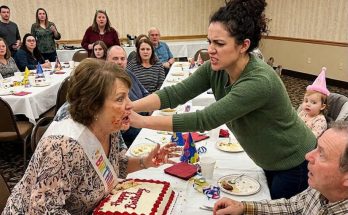
Years later, Evelyn celebrated her seventy-second birthday at a little Italian place.
She invited me.
I went.
Martin was there.
So was Nathan, with the woman he eventually married.
No tension.
Well, not much.
Evelyn raised her glass.
“I would like to make one rule before anyone speaks.”
Everyone looked at her.
“If Claire misses my birthday because the Army sends her somewhere again, nobody is allowed to divorce her.”
The table erupted.
Even Nathan laughed.
I nearly choked on my water.
Then Evelyn looked at me.
Her expression softened.
“You called me that year.”
“I remember.”
“At an ungodly hour.”
“You were awake.”
“Because you told me to be.”
“I wanted to see you open the flowers.”
She smiled.
“I still remember what I told you.”
I did too.
Come home safe.
That’s my present.
Evelyn lifted her glass.
“You did.”
My throat tightened.
“Yes.”
I had come home safe.
Just not to the marriage I thought was waiting for me.
For a long time, I thought that meant the deployment took something from me.
Now I see it differently.
Coming home revealed what had already changed while I was gone.
That hurt.
But it also freed me from spending another decade trying to earn a place in a family that treated my duty as selfishness and my property as available inventory.
I signed the divorce acknowledgment that night because I was not going to beg a man to remain married to me.
Then I handed his father seven pages because I was also not going to leave quietly while they handed me their debt.
Martin went white on page four.
I remember that.
But the page that mattered most to me was page two.
My original power of attorney.
The real one.
The document where I had carefully written exactly how much authority I trusted my husband to hold while I was gone.
He had exceeded it.
In money.
In marriage.
In every way that mattered.
The lesson was not that trust makes you foolish.
I still trust people.
I still love people.
I still deploy.
The lesson was simpler.
Trust does not mean surrendering the right to look at what someone did while you were away.
And family does not get to convert your absence into permission.
I missed a birthday because I was serving overseas.
I called.
I sent flowers.
I came home.
That should have been enough for anyone willing to love the life I actually had instead of demanding one that made them more comfortable.
Years later, on another cold night in Iowa, I drove past Granger’s Steakhouse.
For a second, I remembered that table.
Nathan’s phone.
Martin’s folder.
Evelyn staring into her water.
Me, exhausted from nine months overseas, thinking the worst thing that could happen after deployment was learning my marriage had ended.
I know better now.
The worst thing would have been staying after I learned why.
So I kept driving.
Toward my own house.
My own key.
My own life.
And for the first time in years, nobody was waiting there to tell me which part of myself I had to surrender to belong.
The end.