My Son Walked Six Blocks to His Grandmother’s House and Never Arrived—Weeks Later, I Found the Jacket He Was Wearing Hidden in Her Trash, and What I Discovered Inside Finally Revealed the Truth About What Happened to Him
Read Full Story
Part 2 — “The Truth She Buried Beneath a Lid”
Diane stood in the doorway in the same housedress she always wore, her hands shaking against the frame, her face the color of old paper.
For three years after my husband Garrett left us, Diane had been the one constant. She called every Sunday. She took Noah for overnights. She sent birthday cards with crisp twenties folded inside. She sat at my kitchen table and told me she was ashamed of her son for walking out on his family.
I had trusted her.
I had trusted her enough to let my child walk to her house alone.
Now I was standing on her porch holding his jacket, and she was crying before I’d said a word.
“Where is my son, Diane?”
She stepped back from the door. Not to close it. To let me in.
I followed her inside. The house smelled the same — lavender and coffee and the lemon cleaner she used on everything. Noah’s overnight bag — the Spider-Man backpack he’d been carrying when he left our apartment — was not visible anywhere.
Diane sat in the kitchen chair with her hands folded in her lap. I stood across from her with the jacket pressed against my chest like a shield.
“Tell me everything,” I said. “Right now.”
Diane closed her eyes.
“He got here.”
Three words. Three words that rewrote everything I had believed for weeks.
“Noah arrived at my door at approximately 5:45 that Friday. He was happy. He told me he walked the whole way himself. He was proud of himself.”
My chest cracked open.
“He came inside. He put his backpack down. He asked if I had made the mac and cheese he liked.”
“Then what happened?”
“Then Garrett came out of the back bedroom.”
I stopped breathing.
Garrett. My ex-husband. The man who had walked out on us two years ago without a forwarding address, without a custody agreement, without a single phone call to the son he left behind.
“Garrett was here?”
Diane nodded.
“He showed up two days before. He said he’d been living in Tulsa. He said he had cleaned up his life, gotten steady work, found an apartment. He said he wanted to see Noah.”
“And you didn’t call me.”
“He told me not to.”
“He told you. And you listened.”
Diane’s face contorted.
“He’s my son, Lydia. He was crying. He said he missed his boy. He said if he could just see him one time, just hold him, he’d do whatever it took to make things right.”
“So you let Noah walk into your house and find his father waiting.”
“Noah was thrilled. He ran to Garrett. He hugged him so hard they both nearly fell over.”
I pressed the jacket harder against my body. My vision was blurring.
“Then what.”
“Garrett told Noah he had a surprise. He said they were going on a trip — just for a few days. He said he had a place in Tulsa with a room set up for him. He said it would be like a vacation.”
“And Noah agreed?”
“He’s ten, Lydia. His father was standing in front of him for the first time in two years. Of course he agreed.”
“And you let him go.”
Diane pressed her hands against her face.
“Garrett changed his clothes. He said he didn’t want Noah to be recognized. He put him in new clothes — things he’d brought in a duffel bag. He told me to get rid of what Noah had been wearing.”
“So you threw your grandson’s clothes in the dumpster.”
“Yes.”
“And when I called you at seven o’clock, frantic, asking where my son was—”
“I lied.”
The kitchen was silent except for the clock on the wall. The same clock that had been ticking on every visit, every overnight, every Sunday call. The same kitchen where Noah had eaten mac and cheese and done his homework at the table and believed his grandmother would never hurt him.
“He didn’t have a phone,” I said. “Garrett took his backpack?”
“He left the backpack. He took Noah’s tablet and phone out of it. He said he didn’t want Noah contacting you until they’d had time together.”
“Time together. He kidnapped my son, Diane. And you helped him.”
“It’s not kidnapping — he’s his father—”
“He has no custody. No visitation rights. No legal standing. He walked out on us. He has never paid a cent of support. He has never filed a single motion with a court. He showed up at your house, used you as bait, and took my child.”
Diane was sobbing now.
“I thought he’d bring him back. He promised me — three days, he said. A long weekend. Then he’d bring Noah home and talk to you about doing things properly.”
“How long has it been, Diane?”
She didn’t answer.
“How many weeks?”
“Four.”
Four weeks. My son had been gone for four weeks. I had walked his route every day. I had filed a police report. I had called hospitals, shelters, churches. I had sat on his bed at night and held his pillow and asked God to bring him back.
And the whole time, Diane had known exactly where he was.
I set the jacket on the table.
“Where in Tulsa?”
“I have the address. He gave it to me in case of emergency.”
“Write it down.”
She did. Her hand shook so badly the numbers were barely legible.
I took the paper.
“If anything has happened to my son—”
“He calls me every few days. He sounds fine. He sounds happy. He misses you.”
“He misses me because he was taken from me.”
I walked to the door.
“Lydia—”
I turned.
“Don’t follow me. Don’t call me. Don’t contact Noah. The next voice you hear will be the police or my attorney.”
I walked to my car with the jacket in one hand and the address in the other.
I called Detective Rosa Chen before I reached the end of the block.
Part 3 — “Six Blocks and Four Weeks”
Detective Chen met me at the station within forty minutes.
She had been assigned to Noah’s missing persons case from the beginning — a patient, methodical investigator who had walked the route herself, reviewed every camera angle, and told me on week two, with the careful honesty I had come to rely on, that the absence of physical evidence along the route was “unusual and concerning.”
Now she understood why.
There was no evidence along the route because there was nothing to find. Noah had walked the six blocks safely, arrived at Diane’s house, and been handed to his father inside the home. The entire disappearance had occurred behind a closed door.
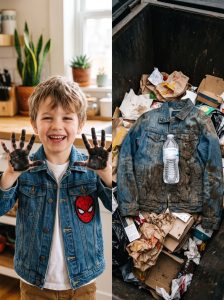
I placed the jacket, the hoodie, the sneaker, and the t-shirt on her desk — still in the condition I’d found them, each item sealed in a separate bag I’d grabbed from my kitchen on the way.
I placed the paper with the Tulsa address beside them.
And I told her everything Diane had said.
Chen listened without interrupting. She took notes in the small, precise handwriting I had come to recognize during the weeks of interviews and updates. When I finished, she set her pen down.
“Garrett Ellison has no custody order, no visitation agreement, and no legal right to remove Noah from your care. What Diane described is parental abduction under Oklahoma law.”
“Can we get him back?”
“We can. The address gives us a starting point. I’ll coordinate with Tulsa PD and file for an emergency pickup order. If Noah is at that address, we can recover him tonight.”
“Tonight?”
“I’m not waiting until morning, Lydia.”
I pressed my hands flat on the desk — the same gesture I’d been making for four weeks whenever I needed to feel something solid beneath me.
“What about Diane?”
“Diane aided and concealed the abduction. She lied to law enforcement during an active investigation. At minimum, she’s facing obstruction. Depending on the prosecutor, she could be charged as an accessory.”
I thought about Diane sitting in her kitchen, sobbing, saying, “He’s my son.”
He was her son. And Noah was mine.
“Do what you need to do,” I said.
Chen picked up the phone.
The next six hours were the longest of my life.
I sat in the station waiting room on a plastic chair that creaked every time I shifted. I drank three cups of coffee that tasted like nothing. I held Noah’s jacket in my lap and traced the Spider-Man patch with my thumb — the uneven stitching, the slight pull where the thread had caught on the needle, the lopsided angle that made it look like he was leaning into the wind.
At 11:47 PM, Chen came through the door.
“We have him.”
My legs gave out. I grabbed the armrest of the chair.
“Is he—”
“He’s safe. He’s unharmed. Tulsa PD located him at the address. Garrett was present and did not resist. Noah is being brought to the Tulsa field office now.”
“Can I talk to him?”
“A social worker is with him. Once he’s been evaluated, they’ll connect you by phone. But I need you to know — he’s okay, Lydia. He’s been fed, clothed, and cared for. Garrett had him enrolled in a local school under a different last name.”
A different last name.
My ex-husband had taken my son, changed his clothes, removed his phone, driven him to another city, and enrolled him in school under a name that wasn’t his.
He had been building a new life with my child — a life that didn’t include me.
“And Garrett?”
“In custody. He’ll be charged with custodial interference, at minimum. Depending on the DA’s review, additional charges are possible.”
I closed my eyes.
“When can I see Noah?”
“Tomorrow morning. We’ll drive you to Tulsa.”
“I don’t need a ride. I’ll drive myself.”
“Lydia—”
“Detective Chen, I haven’t held my son in four weeks. I’m driving.”
She nodded.
“I understand.”
At 12:15 AM, the phone rang.
“Mom?”
His voice. Small, tired, confused, but his.
“Noah.”
“Mom, I’m sorry I didn’t text you when I got to Grandma’s.”
I pressed the phone against my face so hard I felt the screen against my cheekbone.
“You have nothing to be sorry for, sweetheart. Nothing.”
“Dad said you knew. He said you told him it was okay.”
Of course he did. Of course Garrett had told a ten-year-old boy that his mother had approved the trip. Of course he had framed the abduction as a co-parented decision so Noah wouldn’t be afraid.
“That wasn’t true, baby. I’ve been looking for you every single day.”
“Every day?”
“Every day. I walked your route. I called your name. I didn’t stop.”
He was quiet for a long time.
“I missed you, Mom.”
“I missed you more than anything in the world.”
“Can I come home?”
“Tomorrow. I’m driving to you right now.”
“Right now?”
“Right now.”
I heard him exhale — the sound of a ten-year-old boy releasing a breath he’d been holding for four weeks.
“Okay,” he said. “I’ll wait.”
“I know you will.”
Part 4 — “The Parking Lot Where She Held On”
I drove through the night.
Three and a half hours from Oklahoma City to Tulsa on the turnpike, with the windows cracked and Noah’s jacket on the passenger seat and the radio off because I didn’t want any sound between me and the road that was taking me back to my son.
I arrived at the Tulsa DHS field office at 4:20 AM. The building was low, brick, lit by fluorescent lights that hummed against the predawn dark. A social worker met me in the lobby.
“He fell asleep about an hour ago,” she said. “He asked three times if you were really coming.”
“I’m here.”
She led me to a room at the end of a hallway. A door with a small window.
I looked through the glass.
Noah was asleep on a cot, fully dressed, with a blanket pulled up to his chin. His shoes were still on — the new ones Garrett had given him, not the sneakers I’d found in Diane’s dumpster. His hair was longer than the last time I’d seen him. His face had thinned.
Four weeks. He had been gone for four weeks, and in that time, his hair had grown and his face had changed and he had started at a new school with a different last name and slept in a room I’d never seen in a city I hadn’t known he was in.
I opened the door quietly.
He stirred. His eyes opened — slowly, confused, adjusting to the light and the silhouette in the doorway.
“Mom?”
“I’m here, baby.”
He sat up. He didn’t run. He didn’t leap off the cot the way he might have at seven or eight. He sat there and looked at me with the eyes of a child who had been told a story by one parent, discovered it was a lie, and was now recalibrating everything he thought he knew about the adults in his life.
Then he stood up, walked across the room, and pressed his face against my stomach.
I wrapped my arms around him. I held on.
I held on the way you hold something that was taken from you and returned — not with relief, not yet, but with the fierce, desperate need to confirm that it’s real, that it’s solid, that it won’t disappear again the moment you loosen your grip.
“You came,” he said.
“I told you I would.”
“Dad said you didn’t want me back.”
I knelt so I was eye level with him.
“Noah, listen to me. Your father told you things that were not true. I never stopped wanting you. I never stopped looking. From the moment you didn’t text me, I have done nothing but try to find you.”
His chin quivered.
“Grandma helped him.”
“I know.”
“She told me it was going to be okay. She told me you’d know soon.”
“She was wrong, sweetheart. She kept it from me. What she did was not okay.”
He nodded slowly — the nod of a child who is old enough to understand betrayal but not yet old enough to know what to do with it.