
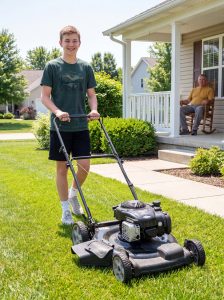
For four years, my son Noah crossed the street every Saturday morning and mowed our elderly neighbor’s lawn without accepting a single dollar.
Mr. Vance rarely spoke to him.
I assumed it was simply Noah being Noah—quietly helping someone who needed it.
I never imagined that after Mr. Vance died, those Saturdays would change three lives.
I raised Noah alone. His father disappeared before he was born, leaving me to handle every fever, school meeting, birthday, and difficult night by myself.
For years, I worried that growing up without a father would leave something missing in him.
Instead, Noah became unusually attentive to other people.
When he was fourteen, he noticed Mr. Vance struggling with his lawn mower across the street.
Mr. Vance had been living alone since his wife, Margaret, passed away. His grown children, Aaron and Claire, rarely visited, and he spent most afternoons sitting silently in an old wooden chair on his porch.
One Saturday, Noah saw him pull the mower cord, wince, and grab his back.
“I’m doing his yard,” Noah announced.
“You should probably ask first.”
“He’ll say no.”
Five minutes later, Noah was pushing our mower across the street.
Mr. Vance stared at him for several seconds.
Then he simply pointed toward the side yard.
That became their arrangement.
Every Saturday from spring through fall, Noah mowed the lawn.
He never accepted money.
When I suggested that Mr. Vance should at least pay him something, Noah frowned.
“He can’t do it himself.”
Apparently, that was enough.
Their conversations were almost nonexistent.
“How was Mr. Vance?” I would ask.
“Fine.”
“What did you talk about?”
“He said it was hot.”
“And?”
“I said yeah.”
Yet Noah never missed a Saturday unless we were away.
Not during summer heat.
Not during cold October mornings.
Not even the morning after his prom.
Then, four years later, Mr. Vance died.
His son Aaron came to our door personally.
“My dad passed last night,” he told Noah.
Noah’s first question was, “Was he alone?”
“No. Claire and I were there.”
Noah nodded.
“When’s the funeral?”
Three days later, we attended.
After the service, a man in a gray suit approached Noah and introduced himself as Daniel, the attorney handling Mr. Vance’s estate.
He handed Noah a thick envelope.
“He left this specifically for you.”
Inside were four smaller envelopes.
Each had a label written by hand:
Saturday One.
Saturday Two.
Saturday Three.
Saturday Four.
Aaron and Claire looked confused.
They had never seen them before.
The lawyer explained that Mr. Vance had left very specific instructions.
Noah was supposed to open one envelope every Saturday.
In order.
Noah laughed softly.
“That sounds like him.”
And unexpectedly, Aaron smiled.
“Yeah,” he said. “It does.”
PART 2
The next Saturday, Noah opened the first envelope at our kitchen table while Aaron and Claire watched.
Inside was an address and a short instruction:
Take Claire with you.
The address belonged to an old diner.
The moment we arrived, an elderly waitress named Ruth recognized Claire.
She rushed around the counter and embraced her.
“I haven’t seen you since your mother died.”
Then Ruth disappeared into the back and returned carrying a cardboard box.
“Your father brought this here six months ago.”
Inside were dozens of handwritten recipe cards.
Margaret’s recipes.
Claire immediately began crying.
She lifted one card.
“Cinnamon rolls.”
Her mother’s Christmas breakfast recipe.
Claire explained that after Margaret died, she had stopped making Christmas breakfast because the house never smelled the same.
“I thought these were gone.”
But her father had saved them.
Saturday Two was for Aaron.
The instruction said:
Take Aaron to Franklin Field. Bring the glove.
Mr. Vance had left behind Aaron’s old baseball glove.
Aaron immediately refused.
His son Ben had played Little League at Franklin Field for years, and Aaron had repeatedly invited his father to attend.
Mr. Vance always made excuses.
Too tired.
Too hot.
Bad knees.
Crowds bothered him.
Aaron looked at Noah bitterly.
“He could sit on that porch every Saturday watching you mow, but he couldn’t watch his own grandson play baseball.”
Noah said nothing.
Aaron quickly apologized.
“I’m not angry at you. I just spent years believing he didn’t care.”
Eventually, Noah handed him the glove.
“Then maybe you should come.”
At Franklin Field, a groundskeeper directed us toward a sealed box Mr. Vance had arranged to leave there.
Inside was a letter.
Aaron read it.
His father admitted that he should have come to Ben’s games.
But after Margaret died, sitting in those bleachers had become unbearable because they reminded him of everything they had once done together.
Still, he had secretly attended three games.
He parked beyond the outfield fence where nobody could see him.
He remembered Ben hitting a double.
He remembered Ben striking out and angrily throwing his helmet.
And he remembered regretting that he never walked closer.
“I didn’t know how,” Mr. Vance had written.
“I’m sorry.”
Aaron sat staring across the empty baseball field.
“He was here?”
Claire nodded through tears.
Aaron lowered his head.
“All those years, I thought he chose everybody else over us.”
Noah sat beside him.
“Maybe he didn’t know how to come back.”
Aaron looked at the glove.
“That’s not the same as trying.”
“No,” Noah said. “But maybe this was him admitting it.”
Aaron slowly nodded.
Saturday Three belonged to Noah.
The note contained only four words:
My house. Porch chair.
We crossed the street and entered Mr. Vance’s empty home.
Noah sat in the familiar wooden chair.
Nothing happened.
Then I suggested he check underneath.
Taped beneath the seat was a small black notebook.
Almost every page contained a Saturday date.
Noah began reading.
“Boy came at 8:10. Too hot today. Told him to stop early. He ignored me.”
Another entry:
“Rain. Thought he wouldn’t come. He came.”
Then:
“Exams this week. Looks tired.”
“Graduation next month. Hope he gets where he’s going.”