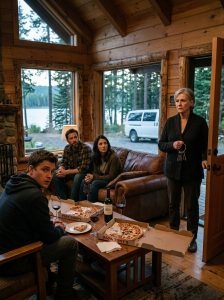
“I love you. But I’m not a resource to be managed. I’m your mother.”
He said okay again, quietly, with the quality of someone absorbing something rather than just agreeing to it.
David and Michelle moved in two weeks later. They were the kind of tenants that exist at the best-case end of the landlord spectrum.
Respectful, punctual, careful with the property, occasionally sending me a brief note saying everything was fine and the mountains were beautiful that week. They treated the cabin with the care of people who understood the difference between something being theirs for now and something being theirs.
Three months after the cabin incident, Jason asked me to dinner. Just the two of us.
We went to a quiet Italian place downtown, and he said the things that needed to be said. He told me he owed me an apology. That he had not stood up for me. That he had taken me for granted. He told me he and Sarah had started counseling.
“The whole cabin thing made us realize we have some issues,” he said. “About boundaries. About respect.”
“I’m glad you’re addressing it,” I said, and I meant it.
“She wants to apologize to you. In person.”
“I’m open to that.”
We ate in the comfortable quiet of two people who have cleared something difficult and are now sitting in the space where it used to be.
“The cabin’s doing well?” he asked.
“Very well. The tenants are great.”
“Good.” He turned his wine glass slowly. “Mom, I’m sorry. For forgetting that your generosity is a choice.”
Sarah came to my door six months after the cabin morning. She knocked this time and waited.
We sat at my kitchen table with tea, and she apologized directly and without the self-protective framing I had expected. She said she was wrong. She said she was in therapy. She said she hoped someday I could forgive her.
I told her I forgave her. I told her things were different now. I told her if she wanted to use the cabin someday she would ask me, and that asking meant asking me directly and genuinely and not arranging an accomplished fact and informing me afterward.
She said she understood.
I believed her, not entirely, not yet, but enough to work with.
“The cabin is beautiful,” she said. “I understand why you want to protect it.”
“Thank you.”
“I’m sorry my mother said what she said. About it being mine someday.”
“For the record,” she added, “I never asked her to say that.”
“But you thought it,” I said.
She looked down. “Yeah. I did. I’m sorry.”
At least that was honest.
A year after the morning I found Brenda and her relatives in my living room, I flew to Italy. Robert and I had planned that trip for twenty years and never taken it, always something else, always the practical next thing, always someday. I went alone and stayed three weeks and stood in places that looked like
paintings and ate dinner at outdoor tables and watched the light on old stone buildings and thought about the particular lesson of someday, how it accumulates quietly while you are waiting for the conditions to be perfect, and how sometimes you have to stop waiting and go.
I ran into Brenda at the grocery store about a year after the incident. She apologized, which I had not expected. I accepted the apology. I told her we could move past it as long as it did not happen again.
She asked about the cabin, whether it was still available for rent, and I told her it was occupied by long-term tenants, and that even if it wasn’t she would need to ask me directly and pay fair market rate.
Her face flushed.
I walked away with my groceries feeling lighter than I had in years.
The tenants’ lease renewed without difficulty. David sent me a short note saying they had loved every season and were looking forward to another year. I wrote back thanking them for taking care of the place.
I have not decided what happens to the cabin eventually. I might leave it to Jason with conditions. I might sell it and use the proceeds for something Robert and I had only discussed in the abstract, the kind of thing you save for later without specifying what later means. I might keep renting it to people
who treat it like what it is, something beautiful that belongs to someone else and deserves to be honored accordingly.
These are my decisions. They belong to me in the same way the cabin belongs to me, not as a burden, not as a responsibility I am waiting to transfer to someone younger, but as a choice I make every day I maintain and protect it.
People take what you let them take. They assume what you let them assume. They occupy the space you do not defend. This is not unique to difficult people or selfish people. It happens with people who love you and mean well. It happens because love, when it is not accompanied by respect, slides quietly
into the assumption of access, the belief that what is yours is simply yours until you die and then it redistributes.
But someday is not today.
Today I am sixty-nine years old. I take care of myself. My retirement is secure, my cabin is occupied by good people, my son and I have dinner once a month and talk about things that matter, and my daughter-in-law and I have arrived at something that resembles the beginning of an actual relationship rather than a strategic performance of one.
Robert would have handled it differently. He would have found a gentler way in and a longer path toward the same destination, because that was who he was. But I think he would have agreed with the destination.
The cabin is mine.
And I protect what is mine.
Not out of spite. Not out of grief for what I lost when I lost him, though that is there too, folded into every decision I make about a place we planned together.
Out of respect for myself, and for him, and for the work we did over forty years to build something that was ours.
And I learned, at sixty-eight, that the most important person to protect it from was not a stranger.
It was the comfortable, well-intentioned assumption of the people who loved me and could not quite distinguish between love and entitlement.
Between someday and today.
Between mine and theirs.
The mountains are still there. The view from the back porch is exactly what it was the first time Robert and I stood on it and looked at each other and said yes.
I still sit there sometimes, on the days David and Michelle are out, when I drive up to check on the property and the caretaker in me needs to see that everything is as it should be.
I sit there with my coffee and I watch the light change across the ridgeline and I think about what it means to take care of something, to protect a thing that matters, to refuse to let the passage of time erode what is yours.
And then I drive home to Charlotte, to my townhome that fits one person exactly right, and I live my life.
Mine. Just mine.
And that, it turns out, is more than enough.