I surprised myself by continuing.
“I don’t hate you.”
He looked up.
“But I don’t forgive you either.”
Pain crossed his face.
Maybe he expected a dramatic reconciliation.
Life rarely provides those.
“I don’t know whether I ever will.”
He nodded slowly.
“That’s fair.”
“What happens to the company?”
“It will probably be restructured.”
“What about the employees?”
“Investigators are helping separate legitimate divisions from the corrupted contracts.”
I exhaled.
That mattered more than I wanted to admit.
Richard leaned forward.
“There’s something I want you to have.”
He slid a small wooden box across the table.
Inside was David Morgan’s wristwatch.
Scratched steel.
Simple black face.
“He gave it to me in college.”
“Why?”
“We were friends.”
Richard’s eyes filled.
“Before everything became complicated.”
I touched the watch.
“You hated him.”
“Yes.”
“Did you ever forgive him?”
Richard gave a faint smile.
“No.”
Then he added, “Maybe that’s why I became someone I didn’t recognize.”
For the first time, I saw not a villain.
Just a man who had allowed resentment to rot everything around him.
Understanding was not forgiveness.
But it was something.
When I left, Linda was sitting in the lobby.
She stood.
“Hannah.”
I stopped.
“I’m not asking you to forgive me.”
“Good.”
She swallowed.
“I just wanted to tell you I’m sorry.”
I studied her face.
Fifteen years earlier, I would have given anything to hear that.
Now the words felt strangely small.
Still, I nodded.
“Thank you for saying it.”
She began crying.
I walked away.
Not because I wanted to punish her.
Because sometimes healing means knowing which doors should remain closed.
# PART 8 — **THE NAME THEY COULD NEVER TAKE FROM HER**
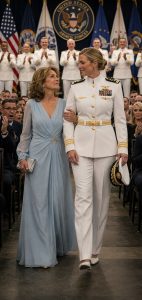
Six months later, I stood beneath another American flag.
This time there were no shocked parents in the audience.
No hidden envelopes.
No federal agents waiting backstage.
Just soldiers.
My unit.
My new assignment.
I had completed additional officer training and was preparing to take responsibility for my first platoon.
Rachel sat in the visitors’ section beside Allison.
They had become surprisingly close.
Maybe shared secrets had finally given way to shared honesty.
Allison had started over too.
After cooperating with investigators, she left the Barrett company and accepted a position with a nonprofit organization helping families navigate medical debt.
She joked that apparently guilt could be converted into a career.
I told her that was not how career counseling worked.
She told me officers had no sense of humor.
We were learning how to be sisters.
Slowly.
Awkwardly.
For real.
After the ceremony, Rachel handed me a package.
“What’s this?”
“Something I found in David’s storage unit.”
Inside was a photograph.
David at twenty-eight.
Rachel beside him.
Between them stood Dr. Grant.
All three were volunteering at St. Anne’s.
On the back, David had written:
**People don’t remember who impressed them. They remember who stayed.**
I stared at the words.
Rachel began crying.
“So that’s where I got it.”
“Got what?”
“The staying thing.”
I smiled.
“You were always good at that.”
A voice behind us said, “Lieutenant Morgan?”
I turned.
Dr. Grant approached.
He looked nervous.
That immediately worried me.
“No more envelopes,” I warned.
He laughed.
“Actually…”
He held one up.
Rachel groaned.
“Michael.”
“I promise this one is good.”
Inside was a letter from St. Anne’s Medical Center.
Their pediatric oncology wing was being renovated.
A donor had funded a new family support center.
They wanted permission to name it:
**THE MORGAN FAMILY CENTER**
I stared.
“What donor?”
Dr. Grant smiled.
“Anonymous.”
Allison stepped closer.
“Very anonymous?”
“Legally anonymous.”
That meant he knew.
I looked at Rachel.
She shrugged.
Not her.
Then my phone vibrated.
A message.
From Linda.
**You deserved parents who stayed. I cannot change what I did, but perhaps I can help another frightened child have someone beside them.**
I read it twice.
The donation was hers.
Rachel looked at me.
“You okay?”
I nodded slowly.
For once, the surprise didn’t hurt.
Linda could not rewrite my childhood.
She could not become the mother Rachel had already been.
But perhaps remorse, when genuine, could become something useful.
I typed back:
**Thank you.**
Nothing more.
Nothing less.
That evening, the three of us—Rachel, Allison, and I—visited St. Anne’s.
Room 314 still existed.
Different paint.
Different furniture.
Same narrow window.
I stood in the doorway.
A little girl slept inside while her father sat beside the bed reading quietly.
I remembered being thirteen.
Terrified.
Waiting for someone to choose me.
Rachel slipped her arm through mine.
“You ready to go?”
I looked at the room one last time.
“Yes.”
Outside the hospital, dusk spread gold across the city.
Allison walked ahead toward the parking lot.
Rachel stayed beside me.
I touched David’s watch on my wrist.
My biological father had given me blood.
Rachel had given me a life.
My biological mother had eventually given me truth.
My sister had given me a second chance at family.
And Richard?
Richard had given me perhaps the hardest lesson of all:
**A person’s value is never determined by who refuses to see it.**
Fifteen years earlier, the Barretts had called me average.
Too expensive.
A future not worth sacrificing for.
They had walked away believing they were choosing the daughter destined for greatness.
But greatness had never been the point.
Survival wasn’t about proving them wrong.
My uniform wasn’t revenge.
Graduating first wasn’t revenge.
Becoming Lieutenant Hannah Morgan wasn’t revenge.
The victory was simpler.
**I had become someone who could look at the abandoned thirteen-year-old version of herself and say: You made it. And you never needed their permission to matter.**
Rachel nudged me.
“What are you thinking?”
“That I’m hungry.”
She laughed.
“After all that emotional reflection?”
“I contain multitudes.”
Allison shouted from the car, “Are you two coming?”
Rachel looked at me.
“Family dinner?”
I smiled.
“Family dinner.”
We walked toward her.
Three women.
One complicated history.
No perfect ending.
Something better.
An honest beginning.
Before climbing into the car, I glanced back at the hospital.
Above the entrance, workers were installing the temporary sign for the new support center.
MORGAN.
The name my parents had never given me.
The name my father had carried.
The name my mother Rachel had chosen.
The name I had carried across the stage when the commanding general announced that the “average daughter” had graduated first.
I finally understood something.
Names mattered.
Blood mattered sometimes.
History mattered.
But **the people who stay matter most.**
I got into the car.
Rachel started the engine.
Allison complained about my restaurant choice.
I complained about hers.
And we drove away laughing.
Not toward the family I had lost.
Toward the family we were finally learning how to become.
**THE END**