
The laundry-room handle shifted under Julian’s grip, once, then again, while I held Chloe against me and listened to the dispatcher tell me not to unlock the door.
Julian knocked hard enough to rattle the frame.
“Mom, open this door.”
Chloe buried her face against my shoulder.
I could feel heat coming through the black wool shawl wrapped around her, and every few seconds a small tremor ran through her body as if she were trying to make herself smaller.
“Emergency services are coming,” I said.
The hallway went quiet.
Only for a second.
“You called them?”
It was the first thing Julian asked.
Not whether his daughter could breathe.
Not whether her fever was worse.
Not whether the child he had allowed an entire family to believe was dead was somehow alive in my arms.
He wanted to know who I had called.
Chloe’s fingers tightened around my sleeve.
“Grandma,” she whispered, “Daddy gave me the sleepy medicine again.”
I looked down at her.
Her eyelids were heavy, but she was awake enough to see the fear on my face.
“Again?”
She nodded against my chest.
Then she gave me the detail she had been trying to tell me before Julian reached the door.
“Mommy said I was still awake,” Chloe whispered. “Daddy said to give me more because everybody was coming tomorrow.”
My stomach turned cold.
For months, Julian and Victoria had explained away Chloe’s constant sleeping, missed visits, and strange absences as anxiety, illness, or a difficult bedtime schedule.
I had accepted every explanation because each one sounded almost reasonable by itself.
Together, they sounded different now.
Julian struck the door with his palm.
“She has a fever. She doesn’t know what she’s saying.”
The dispatcher heard him.
She told me to keep talking to Chloe, keep the door locked, and tell her immediately if Julian got inside.
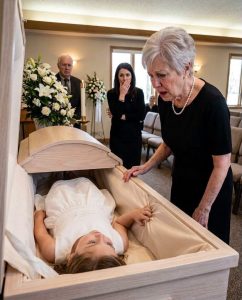
“Julian,” I said through the door, “why was she restrained inside that casket?”
Nothing.
I waited.
“Why was there a key hidden under the lining?”
His next answer came too quickly.
“I don’t know what you’re talking about.”
That frightened me more than shouting would have.
Because I still had the key.
It was clenched inside my fist so tightly that its little metal teeth had pressed red lines into my palm.
Julian could deny my words, but he could not make that key disappear.
Upstairs, another door opened.
Victoria called his name.
Her footsteps came down more slowly than his had, and when she reached the hallway, I heard her ask what was happening.
“Your mother called an ambulance,” Julian said.
He made it sound like an accusation.
Victoria did not ask why.
She said, “Oh, God.”
That was all.
Chloe heard her mother’s voice and began shaking harder.
“Don’t give me back,” she whispered.
“I won’t.”
It was the only promise I made that night before I knew whether I had the power to keep it.
Julian tried a softer voice next.
“Mom, you’re upsetting her. Open the door and let Victoria take Chloe. We can explain everything.”
Chloe made a tiny sound against my shoulder.
“No.”
One word.
Barely audible.
But I heard it.
So did the dispatcher through the telephone.
“Chloe stays with me,” I said.
Julian’s tone changed again.
“You’re not her parent.”
He was right about one thing.
I wasn’t.
I was his mother.
For most of his life, that had meant believing there was a decent explanation when he made a mistake, giving him time to speak when he was angry, and remembering the boy he had once been instead of judging every bad moment as the whole of him.
But there are moments when love stops meaning protection from consequences.
This was one of them.
“No,” I said. “I’m the person standing between her and that door.”
A siren became audible somewhere beyond the house.
Julian stopped talking.
Victoria did not.
“We need to clean this up before they come inside,” she hissed.
She must have thought I couldn’t hear her through the door.
I could.
So could the dispatcher.