
My parents told Grandma they were taking her out for lunch. Three hours later, a nursing facility called me. Her suitcase was waiting in their lobby, and my parents had disappeared.
I drove 190 miles to bring her home. She fastened her seatbelt, looked directly at me, and said, “Don’t call them. I’ll tell you exactly where to drive.”
My parents told Grandma Eleanor they were taking her out for lunch.
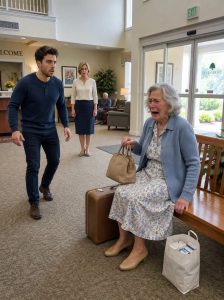
Three hours later, I received a call from a nursing facility in Ohio.
“Is this Daniel Mercer?” the woman asked. “Your grandmother listed you as her emergency contact. Her suitcase is sitting in our lobby, but the relatives who brought her here left before the admission process was finished.”
I was standing in the kitchen of my Indianapolis apartment, holding a cup of coffee I suddenly had no interest in drinking.
“What do you mean, they left?”
The administrator paused. “They said they needed to retrieve some paperwork from their car. They never returned.”
I called my father. Straight to voicemail.
Then my mother. Same result.
I drove 190 miles with both hands gripping the steering wheel.
When I arrived, Grandma was seated beside one brown suitcase and a grocery bag filled with medications. She still wore her church coat despite the warm lobby. Her gray hair was neatly pinned, and her expression had that familiar calmness she always showed whenever she was deeply upset.
I knelt beside her. “Grandma.”
She studied me for several seconds. Then she rose.
No tears. No questions.
She walked toward my car, climbed inside, and fastened her seatbelt.
“Don’t call them,” she said.
I stared at her.
“I’ll tell you where we’re going.”
“Where?”
“First, the county courthouse.”
That immediately caught my attention.
On the highway, she opened her purse and passed me a folded bank statement. Three withdrawals were circled in red. Twelve thousand dollars. Eighteen thousand. Twenty-five thousand.
All made within six weeks.
“Your father has power of attorney,” she said. “Temporary. I signed it after my surgery because I trusted him.”
My stomach tightened.
“He told me I was becoming forgetful. He said I needed assistance managing my bills.” She turned toward the window. “Then yesterday I discovered this.”
“Did you confront him?”
“I did.”
“And?”
“He claimed the money was being spent on my care.”
I glanced toward the single suitcase sitting in the back seat.
Grandma gave a humorless laugh.
“At lunch today, your mother told me we were visiting somewhere with a garden. They walked me into that facility, completed nothing, and disappeared.”
My phone buzzed. Dad.
Grandma reached across and turned it face down.
“Courthouse first,” she repeated. “Then the bank. Then one final place.”
“What place?”
She looked directly at me.
“My house.”
I swallowed. “Why?”
“Because if they’ve done what I believe they’ve done, your parents didn’t simply leave me there today.”
She removed a small envelope from inside her coat. Written across the front, in my grandfather’s handwriting, were two words: HOUSE DEED.
“I hid this before they came to get me,” she explained. “I wanted to see whether they would search for it.”
Her voice became quieter.
“They wanted me out of the way.”
The county courthouse was only ten minutes from closing when we arrived.
Grandma moved more quickly than I expected.
At the clerk’s window, she requested copies of every document recorded against her property within the previous ninety days.
The clerk searched using the address.
Then her expression shifted.
“There’s a quitclaim deed recorded twelve days ago.”
Grandma tightened her grip on the counter.
“To whom?”
The clerk angled the monitor slightly toward us. My father’s name appeared there: Richard Mercer.
I felt my face grow warm.
Grandma showed no immediate reaction. She simply requested a certified copy.
In the parking lot, she carefully read every line.
Her signature appeared at the bottom.
“That isn’t my signature,” she said.
I examined it more closely. It looked similar to hers, but the final letters were different. Too smooth. Too deliberate.
“Can Dad transfer your house using power of attorney?”
“Not by signing my name without permission.”
We headed to her bank next.
A branch manager named Claire Benton brought us into a private office. Grandma presented identification, removed my father’s access, changed every account password, and requested complete transaction records.
Claire appeared uneasy as the statements began printing.
There were more transfers than Grandma had originally discovered.
Not fifty-five thousand dollars.
Eighty-three thousand.
Most of the money had gone into an account belonging to Mercer Renovations LLC, my father’s struggling contracting business.
Another twenty thousand had been wired to a title company.
Grandma pointed at that transaction.
“That’s connected to the house.”
Claire nodded cautiously. “I can’t tell you what the title company ultimately used it for, but this transfer was initiated through online banking with authorized credentials.”
“His credentials,” Grandma said.
The manager remained silent.
Outside, I finally called my father.
Grandma made no attempt to stop me.
He answered on the second ring.
“Daniel, where is she?”
The question caught me completely off guard.
“You left her at a nursing facility.”
“That wasn’t supposed to happen.”
“Then what was supposed to happen, Dad?”
Silence.
Then I heard my mother’s voice faintly in the background. “Tell him she needs supervision.”
Dad lowered his voice. “Your grandmother has been making questionable decisions. We were trying to place her somewhere safe.”
“She passed a cognitive evaluation two months ago.”
Another pause.
I hadn’t known about the evaluation. Grandma had.
Dad switched approaches.
“You don’t understand what’s happening financially.”
“I understand that eighty-three thousand dollars is unaccounted for.”
He went silent for half a second.
Grandma watched my expression and immediately understood.
“Daniel,” Dad said, “do not bring her back to that house.”
“Why?”
“Because it doesn’t belong to her anymore.”
Grandma reached toward the phone.
I gave it to her.
“Richard,” she said, “you signed my name without my permission.”
His answer came immediately.
“You signed documents.”
“I signed a temporary power of attorney after my surgery. I never signed away my home.”
“You said you wanted to support the family.”
“I said I would help when I could. I never gave you permission to take what belonged to me.”
My mother took the phone from him.
“Eleanor, stop turning this into something bigger than it is. Richard was trying to protect the property. His business is struggling. We planned to repay everything.”
Grandma’s expression hardened.
“So you brought me to a nursing home?”
“You need additional care.”
“No. You needed me somewhere I couldn’t challenge what you were doing.”
My mother said something I knew I would never forget.
“You’re eighty-one years old. What exactly are you keeping that house for?”
Grandma ended the call.
For several seconds, neither of us said anything.
Then she gave me the next destination.
Her house.
When we turned onto Maple Ridge Road, two pickup trucks were sitting in the driveway.
The front door stood open.
A man I had never seen before was carrying Grandma’s dining chairs onto the porch.
I hit the brakes.
Grandma stared through the windshield.
A red-and-white sign had been planted in the yard.
ESTATE LIQUIDATION — SATURDAY.
Tomorrow.
Her entire life had already been sorted and priced for sale.
I parked behind both pickup trucks so neither could leave without getting past us.
Grandma opened her door before I had a chance to ask her to remain in the car.
The man holding the dining chairs stopped when he noticed her.
He looked to be in his late forties, heavyset, wearing a gray sweatshirt bearing the logo of a local estate-sale company. He carefully lowered the chairs.
“Mrs. Mercer?”
“Yes.”
His gaze moved toward me, then returned to her.
“I was told you had relocated permanently.”
“Who told you that?”
“Your son.”
Grandma walked straight past him toward the house.
I followed behind her.
Inside, I could barely recognize the living room. Blue stickers covered furniture, lamps, framed photographs, even the oak clock my grandfather had built with his own hands. Cardboard boxes filled the floor. Someone had emptied cabinets and organized Grandma’s possessions into inexpensive plastic bins.
On the dining room table was a clipboard marked MERCER ESTATE SALE.
Grandma lifted it.
The contract carried my father’s signature.
The estate-sale operator introduced himself as Kevin Doyle. He became increasingly uneasy as Grandma began questioning him.
“My son hired you?”
“Yes, ma’am.”
“Did he tell you I had passed away?”
Kevin swallowed. “No. He told me you had moved into long-term care and that ownership of the property had transferred to him. He showed us documentation.”
“What documentation?”
“A deed. And a power of attorney.”
Grandma turned toward me.
“Photograph everything.”
I did.
Every room. Every sticker. Every box. Every document Kevin had received.