
The laundry-room handle shifted under Julian’s grip, once, then again, while I held Chloe against me and listened to the dispatcher tell me not to unlock the door.
Julian knocked hard enough to rattle the frame.
“Mom, open this door.”
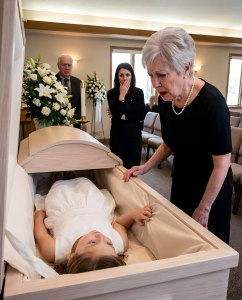
Chloe buried her face against my shoulder.
I could feel heat coming through the black wool shawl wrapped around her, and every few seconds a small tremor ran through her body as if she were trying to make herself smaller.
“Emergency services are coming,” I said.
The hallway went quiet.
Only for a second.
“You called them?”
It was the first thing Julian asked.
Not whether his daughter could breathe.
Not whether her fever was worse.
Not whether the child he had allowed an entire family to believe was dead was somehow alive in my arms.
He wanted to know who I had called.
Chloe’s fingers tightened around my sleeve.
“Grandma,” she whispered, “Daddy gave me the sleepy medicine again.”
I looked down at her.
Her eyelids were heavy, but she was awake enough to see the fear on my face.
“Again?”
She nodded against my chest.
Then she gave me the detail she had been trying to tell me before Julian reached the door.
“Mommy said I was still awake,” Chloe whispered. “Daddy said to give me more because everybody was coming tomorrow.”
My stomach turned cold.
For months, Julian and Victoria had explained away Chloe’s constant sleeping, missed visits, and strange absences as anxiety, illness, or a difficult bedtime schedule.
I had accepted every explanation because each one sounded almost reasonable by itself.
Together, they sounded different now.
Julian struck the door with his palm.
“She has a fever. She doesn’t know what she’s saying.”
The dispatcher heard him.
She told me to keep talking to Chloe, keep the door locked, and tell her immediately if Julian got inside.
“Julian,” I said through the door, “why was she restrained inside that casket?”
Nothing.
I waited.
“Why was there a key hidden under the lining?”
His next answer came too quickly.
“I don’t know what you’re talking about.”
That frightened me more than shouting would have.
Because I still had the key.
It was clenched inside my fist so tightly that its little metal teeth had pressed red lines into my palm.
Julian could deny my words, but he could not make that key disappear.
Upstairs, another door opened.
Victoria called his name.
Her footsteps came down more slowly than his had, and when she reached the hallway, I heard her ask what was happening.
“Your mother called an ambulance,” Julian said.
He made it sound like an accusation.
Victoria did not ask why.
She said, “Oh, God.”
That was all.
Chloe heard her mother’s voice and began shaking harder.
“Don’t give me back,” she whispered.
“I won’t.”
It was the only promise I made that night before I knew whether I had the power to keep it.
Julian tried a softer voice next.
“Mom, you’re upsetting her. Open the door and let Victoria take Chloe. We can explain everything.”
Chloe made a tiny sound against my shoulder.
“No.”
One word.
Barely audible.
But I heard it.
So did the dispatcher through the telephone.
“Chloe stays with me,” I said.
Julian’s tone changed again.
“You’re not her parent.”
He was right about one thing.
I wasn’t.
I was his mother.
For most of his life, that had meant believing there was a decent explanation when he made a mistake, giving him time to speak when he was angry, and remembering the boy he had once been instead of judging every bad moment as the whole of him.
But there are moments when love stops meaning protection from consequences.
This was one of them.
“No,” I said. “I’m the person standing between her and that door.”
A siren became audible somewhere beyond the house.
Julian stopped talking.
Victoria did not.
“We need to clean this up before they come inside,” she hissed.
She must have thought I couldn’t hear her through the door.
I could.
So could the dispatcher.
Julian muttered something I couldn’t make out, and their footsteps moved away from the laundry room.
That scared me almost as much as having him outside it.
I pictured the casket in the living room.
The padded lining.
The restraint.
The flowers.
Anything that could be moved, hidden, thrown away, or explained differently before another person saw it.
“They left the door,” I told the dispatcher.
She told me not to follow them.
So I stayed on the floor beside the washing machine with Chloe in my lap and my back pressed against the locked door.
Her breathing was shallow but regular.
I kept one hand against the side of her face and asked simple questions to keep her awake.
Her name.
Her age.
Her favorite cereal.
The name of the stuffed rabbit she slept with.
“Bunny,” she murmured.
I almost laughed from relief because it was such a six-year-old answer.
Then someone pounded on the front door.
Voices filled the house.
Julian started speaking immediately, loud and controlled, telling the responders there had been a misunderstanding and his mother was confused from grief.
I heard another voice ask where Chloe was.
Julian talked around the question.
Again.
Again.
Again.
Finally, the responder said, “Sir, move away from the hallway.”
Heavy footsteps approached the laundry room.
I gave my name through the door.
A calm voice answered and told me who was outside with him.
Only then did I unlock it.
The door opened inward.
Two responders saw Chloe in my arms.
Everything changed at once.
One dropped to his knees beside us while the other called for equipment and asked me what medication Chloe might have been given.
“I don’t know,” I said. “She says her parents gave her something to make her sleep.”
Julian appeared at the far end of the hallway.
“She had cold medicine,” he said.
The responder looking at Chloe did not turn around.
“How much?”
Julian hesitated.
Victoria answered from behind him.
“The normal amount.”
“What medication?”
Neither of them answered.
The responder checked Chloe’s breathing, pulse, temperature, and responsiveness while his partner wrapped her in a clean blanket over my shawl.
When he asked Chloe whether she knew where she was, she looked toward the laundry-room doorway and whispered, “Grandma found me in the box.”
Julian stepped forward.
“She’s confused.”
This time the second responder faced him.
“Stay back.”
Julian stopped.
I reached into my palm and opened my fingers.
The little metal key sat there beneath the fluorescent laundry-room light.
“This opened what was holding her inside the casket,” I said.
I did not give a speech.
I did not accuse anybody of anything I could not prove.
I handed over the key.
The responder placed it carefully into a small bag and asked where I had found it.
I told him.
Then Chloe was lifted onto a stretcher.
As they rolled her toward the living room, she saw the casket again.
Her entire body stiffened.
“No box,” she cried.
It was the loudest thing she had said all night.
One responder immediately changed direction so the stretcher would pass behind the furniture instead of beside the casket.
Julian watched them do it.
His face did something I will never forget.
Not grief.
Calculation.
He looked from Chloe to the casket, then toward the front door where more people were entering the house.
Victoria stood beside the staircase with both hands pressed together at her waist.
“She woke up earlier than we expected,” she said.
The room froze around that sentence.
Julian turned toward her.
“Victoria.”
She looked at him.
For the first time that night, they seemed afraid of each other.
“What did you mean by that?” I asked.
Victoria shook her head.
“Nothing. I’m exhausted. I meant the fever medication.”
But the sentence had already been heard.
And Chloe had already been found.
They could not put either fact back where it came from.
I climbed into the ambulance beside my granddaughter because when a responder asked Chloe who she wanted with her, she pointed at me.
That choice mattered more to me than anything Julian said afterward.
At the hospital, the night became a series of ordinary objects that suddenly carried enormous weight: a plastic wristband, a thermometer, a paper cup of water, a folded blanket, a small light clipped to a monitor.
Nothing looked dramatic.
Everything mattered.
The medical team treated Chloe’s fever, dehydration, and extreme drowsiness while tests were ordered to understand what might have been in her system.
I stayed near the bed.
Whenever someone needed to examine her, they explained what they were doing before touching her.
The first time a nurse asked, “Is it okay if I move your blanket?” Chloe stared at her as if the question itself were unfamiliar.
Then she nodded.
That broke something in me.
Not because it was dramatic.
Because permission should have been ordinary.
Near dawn, a doctor told me they had found evidence consistent with a sedating medication in Chloe’s system and that the amount, her condition, and her parents’ explanation did not fit neatly together.
He did not pretend to know exactly how it had happened.
He did say Chloe needed observation and that the circumstances of her arrival had to be documented carefully.
I thought about every time Julian had told me not to visit.
“She just fell asleep.”
“She had a rough night.”