
My stepfather moved first. His hand went toward the counter, and before I could stop him, he took hold of the one thing that might have shown exactly what had happened in that laundry room.
That movement was small compared with everything I had already seen, but it told me more than all the explanations he had started throwing at me.
He understood that this had changed.
Until then, he had been acting as though the moment belonged to him, as though he could decide what it meant, how serious it was, and whether anyone outside that room ever needed to know.
The second I reached for the phone, that confidence shifted into something else.
Control.
Not the loud kind.
The desperate kind that appears when someone realizes another person may finally hear a version of events they cannot edit first.
Only hours earlier, I had believed the hardest part of the day was behind us.
My child had just undergone surgery, and everything leading up to coming home had been about getting through the fear, the pain, and the waiting that comes with watching someone you love be vulnerable in a way you cannot fix for them.
I had spent those hours focused on one simple goal: get my child through the procedure, hear that things were okay, and bring them somewhere they could recover safely.
Home was supposed to be that place.
I did not come through the door expecting a confrontation.
I did not come home preparing to defend my child from somebody inside our own family.
I was thinking about recovery.
I was thinking about the bandage that needed to stay where it belonged and a child who had already had more than enough for one day.
There is a strange way adults can convince themselves that familiar people are safe simply because they are familiar.
We see the same face enough times, share enough ordinary days, and eventually stop asking questions we would immediately ask about a stranger.
That assumption was still intact when I entered the house.
It did not survive the walk to the laundry room.
The first thing I remember clearly is the sound.
The washing machine was running, its steady mechanical hum filling a room where no one seemed willing to speak normally.
Water dripped from the sink at slow intervals.
Those sounds were ordinary enough that on any other day I probably would not have remembered them at all.
That day, they seemed unbearably loud because my child was trying so hard to be quiet.
Then I saw what was happening.
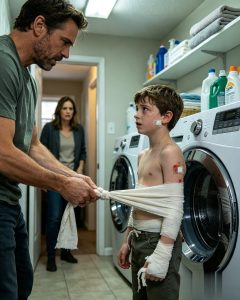
My child’s still-bandaged body had been tied to the washing machine.
For a moment, my mind refused to put the scene together because none of the pieces belonged beside one another.
Surgery.
Bandages.
A laundry room.
A knot.
My stepfather.
My child.
I had expected discomfort after surgery, maybe fear, maybe tears, maybe a long difficult evening.
I had not expected to find my child restrained because of a bathroom mess.
The dressing had been pulled partly loose.
Through the gauze, I could see the faintest line of blood.
It was not the amount that stopped me.
It was what that line meant.
My child had come home needing care, and instead someone had decided that a mess mattered more than the body underneath that bandage.
I went down toward the knot.
My child had been holding everything in until then.
No loud sobbing.
No screaming for help.
No dramatic scene announcing that something terrible had happened.
The crying started only when I touched the knot.
That frightened me in a way I still have trouble describing, because children usually cry when they expect pain, not when they finally recognize the possibility of safety.
I looked up.
My child was watching me carefully.
Not simply scared.
Waiting.
There is a difference.
A frightened child can still believe the next adult will make things better.
A child who waits before reacting has started measuring adults first.
Will you believe me?
Will you get angry at me?
Will telling you make this worse?
I did not want my child to have to calculate any of those things in that room.
Then came the whisper.
“He said the next time would be longer.”
Those words changed the scale of what I was looking at.
Until then, there was still a part of my mind trying to understand the immediate scene: the restraint, the bandage, the reason he had given, the fact that my child had just returned from surgery.
But “next time” meant this was not being described as a terrible mistake that would never happen again.
It had been presented to my child as the beginning of a system.
Do this again, and it gets worse.
Make another mistake, and the punishment lasts longer.
That was what my child had been left to carry while tied beside a humming machine.
I looked at my stepfather.
He was standing there with the maddening calm of someone who believed the explanation would matter more than the evidence in front of us.
He did not seem to see what I saw.
He saw a bathroom mess.
He saw inconvenience.
He saw behavior he believed needed correcting.
Most frightening of all, he seemed to have counted on my child being easier to dismiss than he was.
That assumption told me something important.
People do not always rely on secrecy by hiding everything.
Sometimes they rely on hierarchy.
They assume the adult will be believed over the child, the confident voice over the frightened one, the explanation over the evidence.
They assume that if they use the right words, something cruel can be made to sound responsible.
Discipline.
A lesson.
A misunderstanding.
The words can sound almost ordinary until you look at the person those words are being used against.
I looked at my child again.
The small hand was tight, holding back emotion as if even crying required permission.
When I reached closer, there was a flinch.
That mattered more to me than anything my stepfather was saying.
A child fresh from surgery should not have been afraid of the person trying to free them.
Yet fear does not disappear simply because the safe person finally enters the room.
The body does not understand family explanations.
It remembers what just happened.
I wanted to scream.
I wanted to demand an answer big enough to match what I was seeing.
But anger would have centered him, and I refused to make him the center of that moment.
My child came first.
So I stayed focused on the knot.
I kept my movements careful.
I watched the bandage.
I watched my child’s face.
I wanted everything I did to communicate the opposite of what had happened before I entered that room.
You do not have to be quiet now.
You do not have to protect an adult from the truth.
You do not have to convince me that your pain counts.
I believe you.