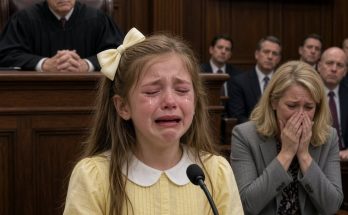
The funeral home smelled like lilies and carpet cleaner, and I remember thinking, somewhere in the fog of that morning, that Mom would have hated the lilies.
She always said they smelled like a perfume counter having a funeral of its own. She would have wanted daisies. Cheap, cheerful daisies from the grocery store, the kind she used to buy herself every Friday because, she said, a woman should always have something blooming on her counter, even if she has to buy it herself.
I bought daisies anyway. Nobody asked me to. I just did it, the way I’d done everything else for three years — quietly, without waiting for permission, because waiting for permission from this family meant waiting forever.
My name is Mara. I was thirty-four years old, sitting in the front row of Cedarbrook Funeral Home with my eight-month-old daughter, Lily, asleep against my chest in a wrap I’d tied with one hand while balancing a casket invoice in the other.
I hadn’t slept more than four hours a night in eleven days. My mother, Eleanor Whitfield, had died on a Tuesday morning at 6:42 a.m., in the bed I had moved into my own living room so I could hear her if she called out in the night.
My brother Daniel hadn’t been there.
Daniel was never there.
Three years earlier, when the doctor first said the word Parkinson’s and then, eighteen months after that, added the second, crueler word — dementia — I remember sitting in the hospital parking lot calling my brother. The phone rang four times before he picked up, and I could hear a baseball game on in the background, ice clinking in a glass.
“She’s going to need round-the-clock help eventually,” I told him. “I can’t do this alone, Daniel. I’ve got a six-month-old.”
“You chose to play saint,” he said. Not unkindly, exactly — that was the worst part. He said it the way you’d say you chose to take the highway or you chose decaf. Like it was a preference. Like I had selected motherhood-and-caregiving off a menu of options, the way he’d selected not that.
“I didn’t choose anything. She’s our mother.”
“She’s retired,” Daniel said, like that settled something. “She’s got savings. Hire someone.”
He had a house with a pool in Brookhaven Estates. Two cars in the driveway — a Tesla and an SUV he used for nothing but hauling golf clubs. He posted pictures from Turks and Caicos in March, the Smoky Mountains in June, Lake Tahoe in September. Every single month, a new backdrop, a new caption — blessed, he’d write, with a little palm tree emoji, while three miles away our mother forgot how to tie her own shoes and called me by my aunt’s name.
I asked him for money exactly six times over those three years. Not because I wanted to keep count, but because each time felt like swallowing glass, and you remember the number of times you’ve swallowed glass.
The first time, I asked for help covering a home health aide. He said he was “between things financially” — this from a man who’d just bought a boat.
The second time, I asked if he could take Mom for one weekend so I could go to my own daughter’s first pediatrician checkup without bringing a hospital bed’s worth of equipment with me. He said his schedule was “insane right now.”
The third time, after Mom fell and broke her wrist and I had to take an unpaid week off from the consulting job I was barely holding onto, I didn’t even ask for money. I asked him to just call her. Once a week. That’s all. He said he would. He called twice in four months.
By the fourth time, I stopped phrasing it as a request. I sent him an itemized list — medication costs, the aide’s hourly rate, the modifications we’d need for the shower. I thought numbers might do what feeling couldn’t. He replied with a single text: You chose to play saint. Don’t make me the villain for not signing up for the same play.
I saved that text. I don’t know why. Some animal part of me, I think, already understood that I would need it someday.
The fifth time was the worst, because I begged. I am not a woman who begs, but grief does things to your spine, softens it, and I called him at midnight after Mom had a bad night, after she’d cried for our father — dead eleven years — and asked me, mid-sob, who I was and why I was in her house. I called Daniel and I cried into the phone and I said, “I am drowning. I need you to come sit with her two nights a week. Just two.”
He said, “I have a life, Mara.”
I said, “So do I. I just gave mine up.”
He hung up.
The sixth and final time, I didn’t ask him anything. I told him Mom’s hospice nurse said we were likely looking at months, not years. I told him as a courtesy, not a request. He said, “Keep me posted,” and then asked if I’d seen the score of the game.
There was a seventh time, too, one I’d almost forgotten until much later, because the memory of it embarrassed me. It was a Sunday in February, eight months before Mom died, and I’d had a stretch of forty straight hours without real sleep — Mom up at 3 a.m. convinced the house was on fire, Lily teething and screaming through the dawn, a client call I’d had to take with my camera off because I hadn’t showered in two days. I drove to Daniel’s house unannounced. I don’t know what I thought would happen. Maybe I thought if he saw my face, actually saw it, something in him would short-circuit into decency.
He answered the door in workout clothes, a smoothie in his hand, looking like a magazine ad for a life I no longer remembered the shape of. Behind him I could see the kitchen island, marble and gleaming, a bowl of fruit arranged like a still life. He didn’t invite me in.
“I can’t keep doing this,” I told him, standing on his porch with Lily strapped to my chest, my voice coming apart at the edges. “I need a weekend. One weekend, Daniel. I will lose my mind.”
He looked at me for a long moment, and I thought, foolishly, that I’d finally broken through.
“Have you thought about a facility?” he said. “I looked some up. There’s a nice one near you, actually. Might be better for everyone.”
“She doesn’t want a facility. She wants to be home.”
“Well,” he said, taking a sip of his smoothie, “we don’t always get what we want.” And then, because apparently that wasn’t quite enough, he added, “You really don’t have to martyr yourself, you know. Nobody’s grading this.”
I drove home crying so hard I had to pull over twice. I never told anyone about that day until much later, because some part of me was ashamed of how much I’d needed him to be different and how thoroughly he hadn’t been.
So you’ll understand, I hope, why I did not look at my brother when he walked into the funeral parlor seventeen minutes late, in a charcoal suit that fit him like it had been tailored that morning — because it had, I’d find out later — sunglasses pushed up into his hair like he’d just stepped off a film set, his wife trailing behind him in heels too tall for a funeral, holding a single white rose like a prop.
He hugged people. He hugged people theatrically, the way you hug someone when you want the room to register the hug. He found our Aunt Connie and pressed his face into her shoulder and made a sound. An actual sound, like a held-back sob breaking loose. Aunt Connie patted his back and murmured, “I know, baby, I know,” and I sat there with my daughter sleeping against my chest and a stack of invoices in my purse that I had paid with money I did not have, and I felt something in my chest go very, very still and very, very cold.
He didn’t ask me how she died. He hadn’t asked, not once, in the eleven days since. Not a text. Not a call. He found out, I later learned, from a cousin’s Facebook post.
The service began. Pastor Whitlow, who’d known Mom from the church choir for twenty years, spoke beautifully about her laugh, her stubbornness, the way she fed every stray cat in a four-block radius and called them all “Sir” regardless of what the vet said about their actual sex. People laughed through tears. I held Lily a little tighter and let myself, for three or four minutes, just be a daughter and not an accountant of grievances.
Then Daniel stood up.
He hadn’t been asked to speak. There was no program slot for him — I’d built the service myself, the readings, the music, the order, because somebody had to and it certainly wasn’t going to be the man currently walking to the podium with his hand pressed to his sternum like a man trying to hold his own heart in.
He gripped the sides of the lectern. He looked out at the room — really looked, scanning it, the way a performer checks how full the house is — and he said:
“I don’t think people understand what these last few years have been like for me.”
I felt my whole body go rigid.
“Watching my mother decline,” he went on, voice cracking with what I can only describe as rehearsed grief, “is the hardest thing I’ve ever done. I was there every step of the way. I made sure she had everything she needed.”
Someone near the back murmured something agreeable. My aunt nodded, dabbing her eyes.
“I took care of her until the end,” Daniel said.
I did not move. I could not move. Lily stirred against my chest and I focused every cell in my body on not waking her, because if I started, if I let even one piece of me crack, I did not know what would come pouring out, and a funeral is not the place to find out.
And then, like he was setting down the final stone on a grave he’d built entirely out of someone else’s labor, Daniel said:
“And I paid for all of this. Every bit of it. It’s the least I could do for the woman who gave me everything.”
The room actually applauded. Soft, funeral-appropriate applause, the kind people give when they’re moved and don’t know what else to do with their hands. Aunt Connie pressed a tissue to her mouth. Someone said, “What a good son.”
I sat there with the receipts in my purse. The casket — $6,800, on a payment plan I’d be finishing in October. The flowers, minus the daisies, which I’d paid for in cash that morning at a gas station ATM because my checking account had forty-one dollars in it. The deposit to Cedarbrook. The obituary fee to the Tribune. The catering for the reception that hadn’t even started yet, that I had ordered three days ago in a fog of grief and arithmetic, doing math in my head about which bill could wait another two weeks.
I felt Lily’s small weight against my collarbone, the only solid, certain thing in the room, and I thought about saying something. I thought about standing up right there and unraveling him in front of forty mourners and a casket. I had the words. God, I had three years of words.
But before I could move, before I could even decide whether moving was wise, a man near the side aisle rose to his feet.