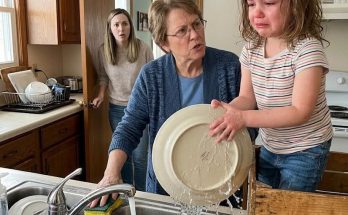
Dr. Sterling asked my daughter whether she knew what happened to the medicine her grandmother poured away.
“She turned the water on,” my daughter said. “Then she threw the bottle in the trash.”
“How did you get it back?”
“I waited until they went into the living room.”
My daughter rubbed one thumb over the teddy bear’s paw.
“I got it out and wiped it with a paper towel. I put it in my backpack first, but I thought Daddy might look there. So I put it in Teddy’s clothes.”
My husband’s expression hardened.
“You hid medicine in your backpack?” he demanded.
Dr. Sterling raised one hand.
“She is answering my questions.”
It was the first direct boundary anyone had placed between my husband and one of his interruptions.
My daughter moved closer to my knee.
I wanted to reach for her, but both of my arms were around the baby. I shifted enough for my elbow to touch her shoulder.
She leaned into me without taking her eyes off Dr. Sterling.
My mother-in-law began saying that my daughter had always been imaginative. She mentioned stories she had made up when she was younger and dreams she sometimes described at breakfast.
The examples had nothing to do with medicine.
They had nothing to do with the bottle.
They had nothing to do with the fact that the prescription was almost full.
Still, my husband seized on them.
“You see?” he said. “She mixes up dreams and real life.”
My daughter’s face tightened.
“I know what a dream is.”
“I didn’t say you don’t,” he replied, using the patient voice he normally saved for correcting her. “I’m saying you may have misunderstood.”
She shook her head.
“I saw Grandma fill the syringe.”
My mother-in-law turned toward Dr. Sterling.
“She gave him something mild. That is all. The baby needed rest, and his mother had worked him into a state.”
Dr. Sterling’s eyes remained on her.
“Was it prescribed for the baby?” he asked.
She did not answer directly.
She said she had experience.
She said mothers had used common sense for generations before every parenting decision became an emergency.
She said no one understood how difficult I had made the household.
Dr. Sterling asked the question again.
“Was the purple medicine prescribed for this baby?”
“No,” she said at last. “But I knew what I was doing.”
My husband exhaled as though the admission should settle the matter.
“She was trying to help.”
I looked at him.
Our daughter had retrieved discarded medicine from the trash. She had hidden it inside a teddy bear because she believed her father might search her backpack.
Our son was burning against my chest.
And my husband was still explaining his mother’s intentions.
The nurse opened the treatment-room door and told Dr. Sterling everything was ready.
He instructed us to move immediately.
My husband reached toward the diaper bag.
“I’ll carry that,” he said.
“No,” I replied.
The word came out quietly, but I did not take it back.
I hooked the strap over my shoulder while keeping my son pressed against me.
My daughter took my free hand.
My mother-in-law stepped into the doorway.
“This is exactly what I mean,” she said. “You turn everything into a crisis.”
Dr. Sterling looked at the nurse.
“Please make sure the mother and both children come with us,” he said. “The others can wait here until we decide what information is needed.”
My husband’s face changed.
For the first time that day, he seemed to understand that he was no longer controlling the conversation.
“I’m not waiting here,” he said. “That’s my son.”
I faced him while my daughter’s hand tightened around mine.
“Then tell the truth,” I said.
He looked at his mother.
She looked back at him with the same confidence she had shown when the appointment began. Even now, she seemed certain that he would protect her.
Maybe he had done it so many times that she no longer considered any other outcome possible.
Dr. Sterling asked my daughter one more question before we left the room.
“Did this happen only once?”
My daughter looked down at the teddy bear.
I felt her fingers flex against mine.
My husband answered before she could.
“She already told you what she thinks she saw.”
“I’m asking her,” Dr. Sterling said.
My daughter counted silently against the bear’s paw.
One small finger.
Then another.
Then a third.
“Three nights,” she said. “Grandma did it every night after you fell asleep.”
The words seemed to split the room into everything I had believed before and everything I now had to face.
Three nights.
Not one reckless decision.
Not one confused attempt to help.
A repeated choice.
A routine.
My mother-in-law began talking faster. She said children had wild imaginations. She said my daughter had probably seen her preparing something for herself. She said the bottle from the trash proved nothing about what had gone into the syringe.
My daughter lifted her face.
She did not look at her grandmother.
She looked directly at her father.
“Daddy held the baby while she did it.”