CHAPTER 1 — YOU ALREADY MISSED YOUR CHANCE
“You were three hours late to your own wedding, so don’t come here playing the victim.
My son already married a woman who knows how to put him first.”
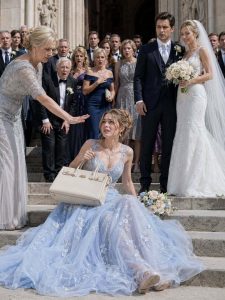
Those were the first words my almost-mother-in-law, Brenda, spat at me as I hurried up the marble steps of the San Antonio event center, my wedding dress crumpled, my hair slipping from its pins, and the sharp antiseptic scent of an operating room still clinging to me.
My name is Samantha Miller.
I was thirty-four and had spent eight years becoming a pediatric trauma surgeon.
That morning, I was supposed to marry Andrew Foster, the man I had lived with for nearly two years and believed would be my partner for life.
I want to tell this story from the beginning, because for a long time I thought it was about the worst humiliation of my life.
It took almost a year to realize it was actually the luckiest thing that ever happened to me.
Both versions begin in the same place: me standing on those marble steps in a ruined gown while a cruel woman told me I had already missed my chance.
What she did not know — what none of them knew — was that missing that particular chance would begin my real life.
I have come to believe many important events arrive looking like one thing and reveal another only much later.
That day, everything looked disastrous: public humiliation, betrayal by the two people closest to me, and the collapse of the future I had spent two years building.
If someone had photographed my face, they would have captured pure devastation.
Yet one year later, that same moment looked like the luckiest thing that had ever happened to me — the door closing on a life that was quietly diminishing me and opening onto one I was actually meant to have.
Same event.
Same marble steps.
Two opposite meanings.
The difference was time and where I stood when I looked back.
I did not know that then.
Standing on those steps, I could see only disaster. The lucky side of it would stay invisible for months.
And that is what I most want anyone standing in the wreckage of their own imagined future to understand: you cannot always see what an ending is becoming while you are still inside it.
The humiliation is real.
So is the pain.
I would never pretend otherwise.
I only know now that what something means today may not be what it means forever.
Mine took almost a year to turn around.
When it did, I stopped seeing myself as a woman left at an altar.
I became a woman who had been set free at one.
It was the same morning.
It had always been both.
CHAPTER 2 — SIX TWELVE IN THE MORNING
At 6:12 that morning, my phone buzzed with an emergency call from St. Luke Memorial Hospital.
“Dr. Miller, we have a critical six-year-old girl incoming — severe blunt abdominal trauma, suspected ruptured spleen, and her blood pressure is crashing fast.”
I stared at my white wedding gown hanging on the closet door in the gray dawn.
Then I looked at Andrew, still sleeping peacefully beneath the sheets.
I grabbed my coat and left a note on his nightstand:
An extreme emergency came in and I have to go operate right now.
I will do everything humanly possible to make it back on time, because I love you.
Twenty-five minutes later, I was scrubbing in while the team prepared the patient.
Her name was Paisley.
She had fallen from a rusted climbing structure at a neighborhood playground and arrived pale, barely conscious, and bleeding internally.
Her father ran beside the gurney with tears streaming down his face until a nurse gently stopped him at the double doors.
Just before they shut, I saw him wrap his arms around his little girl and whisper something.
I caught only the end.
I will be right here waiting when you wake up, pumpkin.
I did not know that man’s name yet.
I did not know that a year later he would be my family.
All I knew was that a child was dying, and everything else in the world — including a wedding — had suddenly become very small.
CHAPTER 3 — FIVE HOURS
For the next five hours, my wedding disappeared from my mind.
There was room for nothing except the small life on my operating table.
I will not describe the surgery in detail because those details belong to Paisley and are not the point.
It is enough to say the damage was much worse than the scans suggested, requiring delicate, painstaking work deep into the morning, with long stretches when none of us knew whether we would win.
A six-year-old body is fragile.
We fought for hers with everything we had.
At 11:47 a.m., we closed the final incision.
Her vital signs held.
Steady.
Strong.
Her own.
Paisley was alive.
She was breathing independently, her blood pressure was climbing back to normal, and she was headed to intensive care.
After eight years, that feeling has never dulled — the instant you realize a child is going to live.
There is nothing like it.
There is certainly no wedding like it.
I want to explain that because everyone in my old life — Andrew, Brenda, all of them — either could not or would not understand it.
People outside this work sometimes imagine a surgeon’s dedication as ambition, a hunger for status or achievement. They weigh it against other priorities and call it selfish.
She loves her career more than she loves me.
As though a career were a rival.
But that is not what it feels like to those who do this work properly.
When I stand over a dying child and help bring her back, what I feel is not the satisfaction of achievement.
It is closer to what a parent feels, or what someone feels pulling a stranger from a burning car: the absolute recognition that an irreplaceable human life is in your hands and nothing else you could be doing matters more in that instant.
A wedding can be rescheduled.
A party can wait.
A dress can be pressed again.
A six-year-old bleeding internally cannot wait.
There is no decent version of me who checks the clock and thinks about caterers while a child’s blood pressure falls.
Andrew called that choosing my patients over him.
But it was never a choice between Andrew and my patients any more than saving a drowning child is a choice against whoever is waiting for you at dinner.
It was a choice between being someone who saves a life when she can and someone who does not.
I have never been able to become the second kind of person.
I eventually understood that a man asking me to be one was not asking me to love him more.
He was asking me to become smaller and worse than I was.
Love is not allowed to ask that.
When I finally left the surgical suite and pulled off my mask, I felt the deep, clean exhaustion of a difficult case won.
Then I checked my phone.
And the other problem waiting across the city came rushing back.
CHAPTER 4 — TWENTY-SIX MISSED CALLS
Twenty-six missed calls filled my screen — from Andrew, Brenda, and Gemma, my best friend since college.
I called Andrew immediately.
It went straight to voicemail.
So I sent a quick message:
The emergency surgery was a success and the little girl survived.
I’m changing now and driving straight to the venue.
I changed from scrubs into my wedding dress in the front seat of my car beneath the concrete lights of the hospital garage.
I put on lipstick using the rearview mirror, my hands finally beginning to shake as the surgical adrenaline wore off.
Then I drove across the city through heavy weekend traffic as fast as I safely could, rehearsing my apology.
I was certain the people who loved me would understand once I explained why I was late.
That was the last moment I believed they loved me.
I did not know it yet.
I reached the venue shortly before three in the afternoon, nearly four hours late, my heart pounding with the ordinary dread of a bride who had kept everyone waiting.
At that point, I still thought lateness was the worst thing that had happened that day.
What was waiting inside was something entirely different.
CHAPTER 5 — HIS ACTUAL WIFE
The outdoor courtyard was full of guests drinking cocktails and chatting casually.
Nobody seemed to be waiting for a ceremony.
Then every guest turned toward me as I approached, wearing the same sickening mixture of pity, gossip, and awkward recognition.
Brenda stepped from the foyer with her arms crossed.
“You have nothing left to do here, Samantha.
Save yourself the embarrassment.”
“Where is Andrew?” I asked, breathless.
A small, cruel smile crossed her face.
She pointed through the glass doors.
“He’s inside.
With his actual wife.”
For a moment, I thought exhaustion had made me hear her incorrectly.
I pushed past her.
Andrew stood inside wearing the exact charcoal suit we had chosen months earlier.
Beside him stood Gemma.
My best friend of more than ten years.
She wore a white bridal gown.
She held white roses.
And on her finger sat the diamond ring I had personally helped Andrew choose, under the story that he needed to send it away for resizing.
I stood in the doorway as the room seemed to tilt.
The two people who knew me longest and best — the man I was meant to marry and the friend who was supposed to stand beside me while I did it — had simply replaced me in front of everyone I knew.
CHAPTER 6 — YOU NEVER PUT ME FIRST
“What is going on here?”
My voice sounded small and unsteady.
Andrew sighed.
Actually sighed.
As though I were the inconvenience.
“I waited for you, Samantha.
You didn’t show up.”
“I was in an operating room saving the life of a dying six-year-old child!”
“You’re always saving someone else,” Andrew said, cold and flat.
“You never put me first.”
That sentence cut deeper than seeing Gemma in a wedding dress.
Because it named the fear I had carried for two years — that the thing I valued most in myself, the work I had devoted my life to, was a defect in his eyes.
To Andrew, loving my work meant loving him less.
Brenda stepped behind him and sneered.
“Just leave.
You’ve made enough of a scene for one day.”
Gemma would not look at me.
Her eyes stayed fixed on the floor.
And I understood that her silence was the final thing she would ever give me.
It was worth nothing.
I did not scream.
I did not cry in front of those guests.
I turned and walked toward the exit, my ruined dress brushing the marble, promising myself I would fall apart somewhere they could not watch.
CHAPTER 7 — DR. MILLER
Just as my hand closed around the brass door handle, a deep voice called from the courtyard.
“Dr. Miller!”
I turned.
It was the father of the little girl I had operated on that morning.
He had learned where I had gone and come to thank me in person for saving his daughter.
His name, I would soon learn, was Zachary Howard.
He took in the scene with one glance: my wrinkled wedding dress, the guests, Andrew standing with his arm around Gemma.
He was a stranger.
He owed me nothing beyond the gratitude he had come to express.
Yet he understood immediately.
He did not ask invasive questions.
He did not make me explain or relive what had happened.
He simply walked over, opened the passenger door of his truck, and said quietly,
“Let’s get you out of here.”
I remember that moment because it was the first real kindness I received all day.
And it came not from the people who claimed to love me, but from a construction worker in a faded shirt whom I had technically met only that morning through a pair of operating-room doors.
I got into his truck.
I did not look back.
I have never regretted it.
I often think about the strangeness of who showed up for me that day.
The people who were supposed to love me — my fiancé, my closest friend, my almost-family, and guests who had known me for years — either betrayed me or watched my humiliation without intervening.
The person who crossed the room to help me was someone I had known for only hours.
By every normal expectation, it should have been reversed.
The people with years of love and obligation should have stood beside me.
The near-stranger should have politely kept his distance.
Instead, the history meant nothing when it mattered, and the stranger became my escape.
That day taught me something I never forgot: the length of a relationship says surprisingly little about whether someone will show up when you fall.
Some people spend years beside you without ever intending to carry any weight.
Others have no history or obligation at all, yet move toward you simply because they see someone in trouble.
Andrew owed me everything and gave me nothing.
Zachary owed me nothing and gave me a way out.
After that day, I stopped measuring people by how long I had known them.
I used one simpler measure:
When I was on the floor, did they move toward me or away?
It has never lied to me.
CHAPTER 8 — THE COFFEE SHOP
Zachary drove me to a quiet coffee shop near the River Walk, far from the venue.
I sat in my rumpled wedding gown.
He sat opposite me wearing the faded shirt he had worn all morning while waiting for news about his daughter.
“Paisley’s resting comfortably in the ICU,” he said gently, sliding a warm cup of coffee across the table to me.
“Her recovery outlook is very strong.”
For the first time that entire day, I released a long breath and felt some tension leave my shoulders.
“Then everything that happened today was worth it,” I said.
He studied me.
“You really mean that.”
“Completely.
I can replace a wedding,” I said.
“That little girl could never replace her life just so I could be somewhere taking photographs on time.”
Something changed in his expression.
He was quiet for a moment.
Then he told me, simply and without self-pity, that his wife had died three years earlier from a sudden medical condition, leaving him to raise Paisley alone while building a small residential construction business.
He did not say it to earn sympathy.
I think I had offered him one true thing about what a life was worth, and he responded with a truth of his own.
When we stood to leave, he gave me a crooked smile.
“Since you’re already in the dress,” he said, “if you ever need an emergency backup boyfriend, let me know.”
And I laughed.
A real, surprised laugh.
The first one all day.
I had no idea that, standing in that parking lot, I had just been handed the first thread of my actual future.
CHAPTER 9 — THE FOLDER
The next morning, I drove to the townhouse Andrew and I shared to pack while he was away.
I filled two suitcases with clothes, boxed my medical textbooks, and gathered my lab coats.
What struck me was how little evidence I had left in that house after two years.
It was as if I had always been a guest there.
Then, while clearing the bottom drawer of Andrew’s desk, my hand caught on a thick folder.
The tab displayed two printed names:
Andrew Foster and Gemma Salas.
Inside were official marriage-license applications, vendor receipts, and catering forms.
Then I saw the dates.
The paperwork had been submitted almost two weeks before my scheduled wedding.
I stood motionless as the truth reorganized itself around me.
This had not been an impulsive decision caused by my lateness.
Andrew and Gemma had not fallen into one another’s arms while waiting for a bride who never came.
They had planned it.
Carefully.
For weeks.
My late arrival had simply given them a convenient public explanation — a way to bury their betrayal beneath my supposed failure.
There was even a bank transfer from Brenda covering the fee to expedite their new license.
His mother had helped.
I photographed every page.
My hands were steady now.
The grief was changing into something colder.
Something clearer.