Part 1: The Letter He Left Behind
I was four years old when a car accident took both of my parents and left me unable to use my legs. With no one else immediately willing to take responsibility for me, the state began preparing to place me in foster care until my uncle Ray stepped forward.
“I’m taking her. She’s my niece. I’m not letting strangers raise her.”
From that moment on, Ray became far more than my legal guardian. For the next twenty-two years, he was the person who raised me, protected me, and made sure I never believed my wheelchair made me less deserving of a full life.
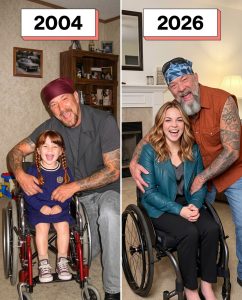
When I became interested in makeup as a teenager, Ray sat through online tutorials until he learned enough to help me get ready for school dances. At fairs and festivals, he pushed my chair through crowded paths, hunted down accessible attractions, and stared back at anyone who looked at me for too long.
“You’re perfect exactly the way you are.”
He repeated that sentence whenever I felt different from everyone else, and after hearing it for so many years, I eventually started believing him.
Then Ray became sick. At first, the changes seemed harmless, like misplaced keys or the way he suddenly needed to stop halfway up the stairs to catch his breath, but before long there were doctors speaking quietly outside rooms, complicated paperwork, and eventually hospice care.
Then he was gone.
Three days after his funeral, our neighbor Mrs. Pell appeared at my door with swollen eyes and an envelope trembling between her fingers. She pressed it into my hand and told me Ray had made her promise not to give it to me until after his death.
“He said you would understand why.”
I tore open the envelope immediately. The moment I recognized Ray’s handwriting, my chest tightened.
Hannah, I HAVE BEEN LYING TO YOU YOUR WHOLE LIFE.
I stopped breathing for a second.
The letter continued by saying that the accident that killed my parents had not happened the way I had always been told. Ray wrote that there was more to that night, something he had hidden from me since I was a child because he had never found the courage to tell me while he was alive.
The envelope slipped from my hands.
Mrs. Pell caught it before it hit the floor.
“He spent three nights writing this at the kitchen table. He told me that if you knew the truth while he was still alive, he wouldn’t survive the way you looked at him afterward.”
I asked her to come inside, locked the wheels of my chair, and picked up the letter again. My hands were shaking badly enough that the paper rattled between my fingers, but I forced myself to keep reading.
Then I reached the sentence that changed everything I thought I knew about Ray.
I was driving.
Part 2: The Truth About the Crash
I read the next lines slowly because my mind refused to accept them all at once. For twenty-two years, I had believed a truck crossed the center line on a rainy night and caused the accident that killed my parents, but Ray’s letter told a completely different story.
He had been behind the wheel.
Ray explained that they were driving his car that night and that taking the back road had been his idea because traffic on the highway was terrible. Somewhere along Route 9, he glanced down to change the radio station, and those few seconds were enough for everything to go wrong.
When he looked up, the curve was already in front of him.
He panicked, overcorrected, hit the guardrail, and sent the car into the trees.
My mother died at the scene. My father survived long enough to be taken toward the hospital but died before he arrived, while I woke later with injuries that permanently changed the way my body worked.
Ray survived with a broken collarbone.
In the letter, he wrote that the physical injury healed quickly, but the guilt never did. Every year afterward became another part of a sentence he believed he had imposed on himself.
He also admitted something else that hurt almost as much as learning he had caused the crash. The story about another vehicle had not been an innocent misunderstanding; it was the version he had deliberately allowed me to grow up believing because he could not imagine telling a four-year-old that the man now raising her was also responsible for the night she lost everything.
Ray reminded me that he really was my uncle, my father’s brother, and that part had never been a lie. When social workers discussed foster care, he stepped forward because he could not bear the thought of me entering a system where nobody knew how I liked my toast, which stuffed animal helped me sleep, or how frightened I became in unfamiliar places.
But then he wrote the sentence that cut deepest.
Every fair, every hospital visit, every makeup tutorial, every time he defended me from someone staring at my wheelchair had carried two meanings for him. He loved me, but he had also spent his life trying to repay a debt he knew could never truly be settled.
You deserved a father who kept his eyes on the road. You got me instead.