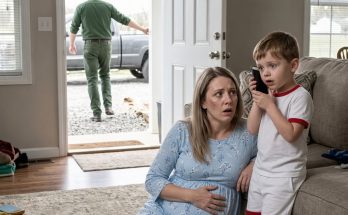
Daddy had asked Grandma if she brought the papers.
Papers.
Not cleaner.
Papers.
I asked her what papers she meant.
My daughter shook her head.
“I don’t know. Grandma hid them when you came home.”
I immediately called the detective back.
Within minutes, an officer was standing in the hospital doorway.
He asked my daughter if she could remember where her grandmother had put them.
She pointed toward the hallway.
“She had a folder.”
The officer exchanged a look with the detective.
“What kind of folder?”
My daughter described it as blue.
The detective left the room.
Twenty minutes later, she returned carrying a clear evidence bag.
Inside was a blue folder.
It had been found in the trunk of my mother-in-law’s car.
The first page was a printed form.
The second page was a statement.
And the third page had a signature line with my name on it.
I had never signed it.
The detective told me they were not yet certain exactly what the documents were intended to accomplish, but the folder changed the investigation because it showed preparation beyond a single act of punishment.
My husband had not simply lost his temper.
Someone had prepared paperwork.
Someone had prepared chemicals.
Someone had prepared a story about my daughter.
And someone had expected that story to protect them afterward.
Then the detective showed me the final piece.
A photograph taken from my mother-in-law’s phone.
It had been deleted, but investigators had recovered it.
It showed our kitchen table before I arrived home.
The bowl was already there.
The second bottle was already there.
And the blue folder was sitting beside it.
There was no broken glass in the photograph.
The photograph had been taken before the accident.
I stared at the image until the room blurred.
The detective quietly took the phone back.
“That photograph was timestamped,” she said. “It was taken before your daughter dropped the glass.”
I finally understood why my husband had looked at my phone instead of our daughter when I tried to call for help.
He wasn’t worried about strangers making the situation bigger.
He was worried that someone would see what had already been prepared.
The neighbors had destroyed that plan simply by coming outside.
Mr. Carter had not just called the police.
He had become a witness.
The people across the street had seen my daughter in my arms.
Someone had heard my husband say it was an accident.
Someone else had seen his mother holding the second bottle.
The story they had prepared inside that house could not survive once the outside world had witnessed what happened.
But the investigators were not finished.
That evening, they returned to the house with a search warrant.
I stayed at the hospital.
Hours later, the detective called.
They had found another piece of evidence.
It was hidden in the kitchen cabinet behind a stack of cleaning supplies.
A handwritten list.
Not five words this time.
A full page.
The detective would not read it over the phone, but she told me the list contained dates, instructions, and references to my daughter’s behavior.
Some entries went back weeks.
That was the moment I realized the broken glass had never been the real story.
Neither was the cleaner.
The real story was what they had been preparing before anyone knew there was something to prepare for.
And when my husband finally spoke to the detective, he did not ask about our daughter first.
He asked whether his mother had been arrested.
The detective told me that detail later.
It was the first thing that made me understand they were no longer standing together as a united front.
For the first time, each of them had to wonder what the other person had said.
The next morning, the detective came to the hospital with another evidence sleeve.
Inside was a copy of a message my husband had sent several weeks earlier.
The recipient was his mother.
The message was short.
“We can’t keep letting her interfere.”
The detective said the message did not prove what they intended by itself.
But beside the other evidence, it mattered.
So did the blue folder.
So did the photograph.
So did the receipt.
So did the handwritten note.
So did the witnesses.
And most of all, so did my daughter’s memory.
I sat beside her bed and watched her sleep.
For the first time since the kitchen, I allowed myself to breathe.
I had spent years believing that keeping peace inside a family was sometimes worth swallowing my own doubts.
I had believed that disagreements over discipline were normal.
I had believed my husband when he said his mother was only trying to help.
But there is a difference between discipline and harm.
There is a difference between a mistake and a plan.
And there is a difference between an accident and an excuse.
My daughter had survived the moment they thought would define her.
Now the evidence was beginning to define them.
The detective had warned me that an investigation could take time. There would be interviews, medical records, digital evidence, witness statements, and questions no mother ever wants to answer.
I knew none of it would erase what happened.
But I also knew something else.
My daughter was no longer alone in that kitchen.
The neighbors had seen.
The officers had heard.
The hospital had documented.
The investigators had found what had been hidden.
And the story my husband and his mother had tried to control was now in the hands of people they could not intimidate, dismiss, or silence.
The last thing my daughter said to me before falling asleep was barely audible.
“Mommy, you came.”
I kissed her forehead.
“Yes,” I whispered. “I came.”
And this time, I understood that coming for her was only the beginning.
Because the broken glass had been their excuse.
The second bottle had been their preparation.
The folder had been their plan.
But the open door had given the truth witnesses.