PART 1 — THE SECOND HERO
My family begged me not to wear my Army uniform to my grandfather’s military honor ceremony because they said it would “embarrass” them in front of important guests.
My brother mocked my medals.
My father told me real success happened in boardrooms, not in uniform.
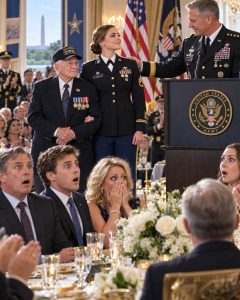
I said nothing and took my seat near the back of the ballroom.
What none of them knew was that a Pentagon delegation had arrived for a second ceremony no one in my family had been told about.
Then a four-star general stepped to the microphone and said:
“Ladies and gentlemen, today we are honoring not one hero—but two.”
My name is Staff Sergeant Maya Parker.
My grandfather, Thomas Parker, was turning ninety.
Our family had organized an enormous tribute for him at a military heritage center overlooking the Potomac outside Washington, D.C.
Grandpa had served in the Army when he was young and spent the rest of his life supporting veterans.
He rarely talked about the details of his service.
When I was a child, I thought the old photographs in his study were simply pictures of men standing beside muddy vehicles.
When I grew older, I understood that every photograph represented someone Grandpa remembered.
That was partly why I joined the Army.
My father never understood that.
Richard Parker had built a successful commercial real-estate company.
My older brother Daniel joined him straight out of business school.
Together, they expanded Parker Development into several states.
Their names appeared in business magazines.
They attended charity galas.
They knew senators, executives, attorneys, and donors.
My younger sister, Claire, became an attorney and married another attorney.
Then there was me.
The enlisted soldier.
In my father’s version of our family, Daniel had ambition.
Claire had professionalism.
I had made an unusual life choice that everyone politely tolerated.
The moment I stepped out of the Army SUV at the heritage center, Daniel stared at me.
“You actually came dressed like that?”
I looked down at my Army service uniform.
“Yes.”
He adjusted the cuffs of his expensive suit.
“You know this is a major event, right?”
“I’m aware.”
“There are members of Congress here.”
“Okay.”
“CEOs.”
“Good for them.”
“Senior military leadership.”
I looked at him.
“That makes the uniform seem even more appropriate.”
Daniel smiled the way he always did when he thought I was being difficult.
His wife Ashley walked up beside him.
She looked at my ribbons.
Then at the badge above my pocket.
“Honestly, Maya, don’t you think all of that is a little dramatic?”
“All of what?”
She gestured toward my uniform.
“The medals.”
“Those are not costume jewelry.”
Her smile tightened.
“I didn’t say they were.”
“You didn’t need to.”
Daniel shook his head.
“Here we go.”
I let it go.
That had become my specialty around my family.
Let it go.
Ignore the comment.
Change the subject.
Keep dinner peaceful.
Pretend it didn’t hurt.
Inside, the ballroom was already filling.
White tablecloths.
Military flags.
Large screens displaying photographs from Grandpa’s life.
Corporate executives mingled beside veterans in old unit caps.
Several retired generals stood near the stage.
My father found me before I reached my table.
“Maya.”
I stopped.
He lowered his voice.
“Could we speak privately?”
“Sure.”
He led me toward a quieter hallway.
“What?”
His expression became serious.
“Today is about your grandfather.”
“I know.”
“I don’t want unnecessary attention.”
I waited.
Dad looked at my uniform.
There it was.
“You think I’m going to take attention from Grandpa by wearing the uniform he asked me to wear?”
“He didn’t specifically ask you.”
Actually, he had.
Grandpa had called two weeks earlier.
Wear your uniform, kid.
That was what he said.
I didn’t bother telling Dad.
He continued.
“There are important people here.”
“You already mentioned that.”
“Daniel has several investors attending.”
I stared at him.
“What does Daniel’s business have to do with Grandpa’s military tribute?”
Dad sighed.
“You always make things harder than they need to be.”
“How?”
“By turning everything into a challenge.”
I laughed once.
“I walked into a building wearing my work uniform.”
“You know what I mean.”
“No. I genuinely don’t.”
Then Dad said the sentence I would remember for years.
“Compared to what Daniel has accomplished, being a career soldier simply isn’t particularly impressive anymore.”
For a moment, neither of us spoke.
My mother stood only several feet away.
She had heard him.
I looked at her.
She looked down.
That hurt worse.
Daniel had a company title.
A corner office.
A seven-figure house.
I had spent years responsible for soldiers.
Training them.
Bringing them home.
Making decisions when mistakes could injure people rather than reduce quarterly earnings.
But arguing would not change my father’s definition of success.
So I nodded.
“Understood.”
“Maya—”
“I said I understand.”
I walked outside.
Cold air came off the river.
I stood near the terrace, staring across the water until my hands stopped tightening.
I had been under mortar alarms without losing control.
Had coordinated evacuations in weather bad enough to ground aircraft.
Had sat beside wounded soldiers who asked me whether they were going to live.
And somehow, one sentence from my father could still make me feel seventeen years old.
Then my phone rang.
I looked at the screen.
Restricted number.
I answered immediately.
“Staff Sergeant Parker.”
A professional voice replied.
“Ma’am, this is Lieutenant Colonel Reeves. The Pentagon delegation has arrived.”
My posture changed automatically.
“Understood.”
“The Chief’s vehicle is entering the security area now.”
“Thank you.”
“Are you in position?”
I looked through the ballroom windows.
Daniel was laughing beside several executives.
Ashley was speaking with my mother.
Dad was shaking hands with a donor.
None of them had any idea.
“Yes, sir.”
“We’ll proceed as briefed.”
“Roger.”
I ended the call.
Months earlier, I had been notified that the Army intended to recognize me for my actions during an overseas multinational disaster-response mission.
The exact circumstances had remained restricted while partner governments completed reviews.
Once enough details were cleared, the Army arranged the presentation.
I asked that it happen during Grandpa’s ceremony.
Not because I wanted a larger audience.
Because if anyone deserved to stand beside me that day, it was him.
Only Grandpa knew.
Military leadership knew.
The event coordinator knew.
My immediate chain of command knew.
My family did not.
I returned to the ballroom.
Daniel barely looked at me.
Dad acted as though our conversation had never happened.
I took my assigned seat.
An hour later, the lights dimmed.
A four-star general stepped onto the stage.
Every conversation stopped.
General Andrew Halstead, the Army Chief of Staff, began by speaking about my grandfather’s service.
Duty.
Courage.
The generations that served before us.
Grandpa sat near the stage in a dark suit, his old unit pin on his lapel.
Then General Halstead paused.
His tone changed.
“Sergeant Major, bring the case forward.”
A senior enlisted leader stepped onto the stage carrying a presentation case.
My heart began pounding.
Dad slowly turned his head toward me.
Daniel stopped smiling.
General Halstead looked across the ballroom.
“Today, we honor not one hero—but two.”
Then he said:
“Staff Sergeant Maya Parker, United States Army, please join me on stage.”
For several seconds, nobody at my table moved.
Then I stood.
Daniel whispered:
“What is this?”
I looked at him.
“Apparently something unimpressive.”
And walked toward the stage.
PART 2 — THE MEDAL THEY THOUGHT WAS DECORATION
The walk to the stage felt longer than it was.
Hundreds of people were watching.
Some stood as I passed.
Others whispered.
I kept my eyes forward.
General Halstead waited until I reached him.
Then he extended his hand.
“Staff Sergeant Parker.”
“Sir.”
“About time.”
That surprised a small laugh out of me.
He smiled.
Then turned toward the audience.
“Please remain standing.”
The room rose.
My family rose with everyone else.
The Sergeant Major opened the case.
Inside was a Soldier’s Medal.
For people outside the military, ribbons and decorations can blur together.
To many of my relatives, they were colored fabric arranged over a pocket.
But the Soldier’s Medal is awarded for heroism not involving direct conflict with an enemy.
It requires personal risk.
The kind of situation where nobody is shooting at you, but you can still die if you make the wrong choice.
General Halstead began reading the citation.
Months earlier, I had been assigned to a multinational logistics team supporting a humanitarian mission after a major earthquake and subsequent flooding overseas.
A landslide severed the safest road out of a mountain district.
Communication failed.
A temporary medical site held civilians and several injured service members.
Weather deteriorated.
Another slope was becoming unstable.
The planned evacuation route was no longer usable.
I was the senior noncommissioned leader on the ground for the movement team.
The citation did not tell every detail.
It did not mention the screaming.
The smell of diesel.
The child who would not let go of my sleeve.
The medic with a fractured wrist who kept treating other people anyway.
It did say enough.
General Halstead read:
“Staff Sergeant Parker demonstrated extraordinary courage and leadership while coordinating the evacuation of thirty-seven civilians and six injured service members from an area threatened by secondary ground collapse.”
My father’s face changed.
Daniel no longer looked at me.
The citation continued.
When the primary route became unusable, I identified an alternative passage using an older maintenance corridor and personally moved ahead to confirm that the route remained passable.
That was the sanitized version.
The reality was uglier.
The corridor crossed a damaged section of road where part of the embankment had already fallen away.
We had one heavy vehicle.
Several smaller vehicles.
Not enough time.
We moved people in stages.
I returned to the medical site twice because two civilian families initially refused to leave without elderly relatives.
The last vehicle cleared the zone minutes before another section of hillside collapsed across the original evacuation area.
Nobody died.
That was what mattered.
General Halstead finished:
“Her decisive leadership, personal courage, and unwavering commitment to the safety of others reflect great credit upon herself, her unit, and the United States Army.”
The room was completely silent.
Then the Sergeant Major stepped forward.
General Halstead placed the medal on my uniform.
He leaned closer.
“Your grandfather is proud of you.”
My throat tightened.
“Yes, sir.”
Then applause erupted.
Not polite applause.
The kind that rolls through a room.
I looked toward Grandpa.
He was standing.
Ninety years old.
One hand gripping his cane.
The other saluting me.
That almost broke my composure.
I returned the salute.
When the applause finally settled, General Halstead raised one hand.
“Please remain standing. We are not finished.”
My father looked confused.
Daniel looked worse.
I hadn’t known about this part either.
General Halstead turned toward Grandpa.
“Mr. Parker, with your permission?”
Grandpa smiled.
“You’ve got the floor, General.”
A staff officer handed General Halstead a folded letter.
He looked at me.
Then at my family.
“Several months ago, Mr. Parker was contacted regarding today’s presentation.”
My heart began beating harder.
“He was asked whether he objected to Staff Sergeant Parker receiving her medal during the ceremony planned in his honor.”
Grandpa shook his head.
General Halstead smiled.
“His response was longer than necessary.”
Laughter moved through the ballroom.
Grandpa called:
“I had things to say.”
More laughter.
General Halstead unfolded the letter.
“I asked Mr. Parker for permission to read a portion of his response today.”
He looked toward Grandpa.
“He agreed.”
Then he began.
My granddaughter Maya has spent much of her life being the quietest accomplished person in a family that often mistakes volume for value.
My chest tightened.
Daniel’s face changed.
Dad slowly sat down.
The General continued.
When she enlisted, members of our family called it a phase.
When she reenlisted, they called it stubbornness.
When she earned responsibility, they asked when she was going to find a real career.
I allowed too many of those comments to pass without correcting them.
That was my mistake.
I looked at Grandpa.
His eyes never left me.
Then came the sentence that changed the entire room.
If my family has spent years measuring success by salary, office size, and social access, then somewhere along the way we forgot who taught us what service meant.
No one at my table moved.
General Halstead continued.
I am not writing this because Maya needs public praise.
She does not.
I am writing it because the rest of us apparently do need public correction.
A few people laughed softly.
Daniel did not.
Then the General paused.
His eyes moved to another paragraph.
“There is one final section Mr. Parker specifically asked me to read.”
Grandpa leaned back in his chair.
Dad turned toward him.
For more than twenty years, the Parker Service Foundation has supported veterans, military families, and emergency responders.
My father’s face went pale.
I knew the foundation well.
Grandpa created it after selling part of his first business.
Its endowment had grown to more than twenty million dollars.
Dad served as vice chair.
Daniel had spent years telling everyone he would eventually take over.
Grandpa’s letter continued.
My family has assumed that Daniel will succeed me as chairman.
That assumption is incorrect.
Daniel stared at Grandpa.
Ashley’s mouth fell open.
My father whispered:
“What?”
General Halstead read:
Three months ago, in the presence of independent counsel and the foundation’s board, I signed the succession documents naming Staff Sergeant Maya Parker as the next chair of the Parker Service Foundation when my tenure ends.
The room erupted in whispers.
I stood frozen.
This part was news to me too.
I turned toward Grandpa.
He smiled.
I mouthed:
You did what?
He only winked.
General Halstead continued.
I did not choose Maya because she wears a uniform.
I chose her because, when responsibility becomes inconvenient, she does not hand it to somebody else.
I chose her because service to her has never been a branding strategy.
And I chose her because the people this foundation exists to help deserve someone who understands that dignity matters as much as a check.
Daniel sat down.
Dad stared straight ahead.
Then the General read Grandpa’s final line.
If anyone in my family is embarrassed by Maya’s uniform today, I suggest they ask themselves whether the problem is the uniform—or the mirror standing in front of them.
Silence.
Absolute silence.
Then Grandpa started clapping.
The room followed.
And standing beneath the lights with a medal I had never asked my family to admire, I realized the biggest surprise of the day was not the Army award.
It was that my grandfather had spent months quietly preparing to force our family to confront something they had avoided for years.
What they valued.
And why.