
My father kept his hand on the backpack strap for one extra second before finally letting it go, then pulled a folded envelope from the junk drawer and pushed it across the kitchen counter toward me.
I did not know what was inside.
I only knew that my six-year-old daughter was standing beside me with her coat half-zipped, her small fingers wrapped around my shirt, and my mother was watching like she still believed she could explain everything away.
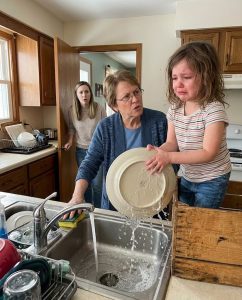
A few minutes earlier, I had walked into my parents’ house expecting an ordinary visit.
Instead, I found my little girl standing on a wooden crate in front of the kitchen sink, struggling to reach plates that looked too big for her hands.
The water was running over her fingers.
Dish soap covered her skin.
Her sweatshirt sleeves were soaked almost to her elbows.
And she was crying while trying to finish a job she was never supposed to be doing alone.
The sentence that stopped me was not the dishes.
It was hearing my mother call her useless.
I had heard versions of that sentence before.
Not exactly the same words, but the same feeling.
The kind of words adults sometimes hide behind by calling them lessons, discipline, or honesty.
The kind of words that make a child wonder if they are the problem instead of wondering if the adult was wrong.
But hearing it aimed at my daughter made everything I had ignored for years suddenly impossible to ignore.
I crossed the kitchen, lifted her down from the crate, and turned off the faucet.
Her hands were pink from the water.
Instead of reaching for me right away, she tucked them against her stomach like she was waiting for someone to tell her she had done something wrong again.
“I wasn’t finished,” she whispered.
That was the part I could not forget.
She was not asking if she could stop.
She was apologizing for stopping.
I told her she was finished.
I told her she did not have to wash anything else.
My mother immediately pushed back.
She said my daughter was not fragile.
She said she was teaching responsibility.
She said children needed to learn that crying did not get them out of everything.
But responsibility was never the issue.
The issue was the way it was delivered.
There is a difference between teaching a child to help and teaching a child that love disappears when they make mistakes.
My mother did not see that difference.
Or maybe she did and simply did not believe it mattered.
I looked across that kitchen and remembered being that child myself.
I remembered how easy it was to accept an adult’s words as truth when you were young enough to believe they knew everything.
I remembered how quickly criticism could become part of your own voice.
Then my daughter pulled on my shirt and asked if we could go home.
I answered yes before I even thought about it.
That was when my mother laughed without humor and accused me of turning a small moment into a huge problem.
She said I was making her the villain because I walked in halfway through.
She said I was teaching my daughter that difficult things should always be avoided.
But I was not leaving because of the dishes.
I was leaving because my child had been made to feel small.
I said that calling a child useless was the problem.
For a moment, my mother had no answer.
Then my father finally spoke from the kitchen table.
He had been sitting there with a paper coffee cup beside him the entire time.
He had watched everything.
He had watched my daughter at the sink.
He had watched my mother defend it.
He had watched me reach the point where I could no longer pretend it was normal.
“Enough,” he said.
My mother turned toward him immediately.
She told him not to start.
But he stood up slowly and repeated himself.
“I said enough.”
It was not loud.
That was why it mattered.
My father was not someone who usually interrupted conflict.
He was the person who changed the subject.
The person who waited until everyone calmed down.
The person who convinced himself silence was the same thing as peace.
But this time, he walked past us and brought my daughter’s backpack from the hallway.
He handed it to me.
Then he told my daughter to get her coat.
She moved quickly toward the living room.
She stayed close enough that I could still see her.
The moment she was away from the kitchen, my mother lowered her voice.
She accused my father of encouraging me.
That was when he said something I never expected to hear.
“No,” he said. “I’ve been avoiding it.”
The words landed differently than an argument would have.
Because he was not defending himself.
He was admitting something.
My mother immediately warned him not to say anything else.
But my father looked toward the living room and then back at me.
He told me this was not the first time.
That sentence changed the entire room.
Not because it explained everything.
Because it explained enough.
My daughter came back wearing her coat, but the zipper was crooked.
I knelt down to fix it.
That was when she leaned closer and whispered something I almost missed.