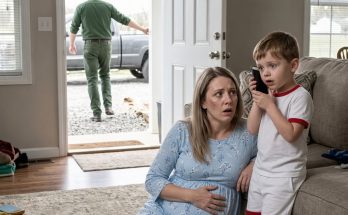
His eyes shone in the dim room. He did not wipe them.
I took Ella from him and carried her to her own bed. She mumbled something about dinosaurs and pancakes. I pulled the blanket to her shoulder and stood for a while looking at the mark near her eyebrow, the small dark pause that two different childhoods had worn.
In the kitchen Nathan was still on the couch. I poured two glasses of water and sat across from him.
“She will talk to you,” I said. “Not today. Soon. You should be the one who tells our daughter, but not until I say the sentence is ready. I will not have this arrive in her life as another secret that grew teeth.”
He said all right.
It was not forgiveness. It was a schedule for the truth.
That felt like the first honest architecture we had built in years.
Part 7
The sentence took longer than I expected.
Ella was nine, which meant she understood fairness with a sharpness adults often underestimate. She understood that people can leave. She understood that grown-ups sometimes tell partial stories and call them protection. What she did not yet have was a place to put a sister who was already grown, a sister who had lived a whole childhood in another state with a mother who was now gone.
I talked to June again. I talked to Mrs. Kessler in the classroom after school while Ella finished a worksheet on fractions. Mrs. Kessler said, “Tell her the true pieces in the order a child can hold. Do not start with the lie. Start with the photograph. Children understand pictures.”
Nathan and I practiced in the guest room like people rehearsing a play they wished they did not have to perform.
On a rainy Wednesday I picked Ella up early. We went to the diner that served the pancakes she liked, the ones with blueberries that stained her mouth. Nathan met us there because I did not want the conversation to happen in the house where she kept her butterflies and her nightlight.
She ate half a pancake before she noticed we were both too quiet.
“Is somebody sick?” she asked.
“No,” I said. “Somebody is extra. That is different.”
Nathan put his fork down. His voice was steady in the way a voice gets when a person has already fallen through the worst of the fear.
“When I was younger I lived in Colorado,” he said. “I had a family there. A wife named Rebecca, and a little girl. Her name was Ella Rose, like yours. She is grown now. She is twenty-three. She lives in Denver. Your teacher used to be her teacher, which is how we found out the stories were sitting on top of each other.”
Ella looked from his face to mine. “There are two of me?”
“There are two people who were given the same name,” I said. “You are not a copy. You are you. She is herself. You both have the same smile and the same little mark. That is how Mrs. Kessler knew.”
Ella touched her eyebrow, thinking. “Did you know?” she asked Nathan.
“I knew about her. I did not tell you. That was wrong.”
“Did you know?” she asked me.
“Not until Mrs. Kessler showed me the picture. Then I found out the rest.”
She sat with that. A blueberry had left a crescent on her chin. She did not wipe it.
“Is she mad?”
“She is sad about some things and curious about others,” I said. “She had a mother who loved her. She is not coming here to replace anyone.”
“Can I see the picture?”
I had brought the class photograph in my purse, because Mrs. Kessler had been right about pictures. Ella held it with both hands, careful of the edges. She studied the girl in the second row for a long time.
“She looks like she is about to laugh,” Ella said.
“You do that too.”
“Does she still have the mark?”
“Yes.”
Ella nodded, as if this confirmed a rule of the universe she could accept. Then she looked at Nathan.
“Why did you leave her?”
The diner noise rose and fell around the question. A busboy dropped a tray somewhere behind us.
Nathan did not look away. “I was afraid and selfish. I told myself I would go back and then I didn’t. There is no good version of that sentence. I am sorry I made you and her carry it.”
Ella pushed the last bite of pancake through a smear of syrup. “Can I talk to her?”
“If you want,” I said. “Not today if today is already full.”
“Today is already full,” she agreed. Then, after a moment: “Does she like volcanoes?”
“I don’t know yet.”
“You should ask. Mine is going to erupt on Friday.”
It was such an Ella thing to say that I had to press my napkin to my mouth. Nathan laughed once, a sound with more air than humor, and then he reached across the table and waited to see whether she would let him take her hand. She did.
That night she asked three more questions in the dark after I turned out the light.
Was the other Ella’s mom nice?
Yes. From everything I have learned, yes.
Are you going to leave too?
No.
Is Dad going to leave again?
I sat on the edge of her bed and chose the only answer that was both true and small enough for nighttime.
“He is staying in this house and telling the truth now. That is the part we can see. The rest we will watch together.”
She accepted that with the same gravity she had given the photograph.
After she fell asleep I found Nathan at the kitchen sink.
“She asked if you were going to leave again.”
He braced his hands on the counter. “I heard.”
“You don’t get to answer that with a promise. You answer it by remaining visible.”
“I know.”
I went to the guest room, then stopped in the doorway. The lavender sheets suddenly seemed like a performance of distance I no longer needed in the same way.
I turned around.
“I’m coming back to our room,” I said. “Not because this is finished. Because I sleep better when I can hear whether you are still in the house.”
He nodded. He understood it was not yet tenderness. It was logistics and a kind of fierce practical love.
In Denver, a twenty-three-year-old woman with our daughter’s smile was probably sitting with the same rain against a different window, deciding how much of a nine-year-old’s volcano project she was ready to care about.
The name had come back around.
Now we had to learn what to do with the living people attached to it.
Part 8
The first video call between the two Ellas lasted eleven minutes and involved a tour of a paper volcano, a demonstration of the unusual smile performed on command, and a serious discussion about whether birthmarks could be related to lightning. The older Ella, who asked to be called Ellie so the name would have somewhere to breathe, listened as if the questions were not small.
After they hung up, our Ella announced that Ellie knew the names of a lot of plants and that this was a good quality in a sister.
Nathan spoke to Ellie the following week, alone, on a walk I took so I would not have to watch his face through a screen. He came back with red eyes and a quieter mouth. He said she had asked him to say Rebecca’s name out loud, just once, correctly. He had done it. He said the rest of the conversation was hers to keep.
In May, Ellie flew to Ohio for a weekend.
I picked her up at the airport because Nathan’s hands had been shaking that morning and Ella needed the version of her father that could still drive a car. Ellie came through the doors in the green sweater from our first call, a duffel over one shoulder, looking both older than twenty-three and younger than the history she carried.
Ella spotted her before I did. She did not run. She walked up, stopped two feet away, and said, “You have my mark.”
Ellie crouched so they were level. “You have my smile. I brought you a fern. It is a very patient plant. It will not erupt.”
Ella considered this and nodded, satisfied.
The weekend was not a movie reunion. It was meals that ran long and silences that were allowed to exist. Ellie sat on the floor of Ella’s room and let herself be shown every drawing from the school year. Nathan grilled chicken and burned the first batch and did not make a joke about it. I watched the two of them at the table, the nine-year-old and the twenty-three-year-old, and saw the way a face can be a bridge instead of a theft.
On Saturday afternoon Ellie asked if I would walk with her around the block. Ella stayed behind to teach Nathan a card game she had invented with changing rules.
“I kept waiting to hate you a little,” Ellie said. “For having the years I didn’t. It didn’t arrive the way I expected. You look like someone who also got handed a story with missing pages.”
“I did.”
“My mother would have liked that you didn’t pretend the letter was nothing.”
“Your mother wrote a sentence I think about more than I want to. She hoped he would be kinder in the second life.”
Ellie looked at the maple that had just come into full leaf. “Was he?”
I took a moment. “He is trying in a way he did not try then. Trying is not the same as having been good from the start. I am still mapping the difference.”
She accepted that. We walked another half block.
“I don’t need him to become my father now,” she said. “That window closed. I might need him to be a man who can stand in a room with both of us without disappearing. That feels possible. Some days.”
When we came back, Ella was explaining the card game’s newest rule, which appeared to involve the loser having to name a plant. Nathan was losing on purpose and doing a poor job of hiding it.
Sunday morning, before the airport, Ellie stood in our kitchen and looked at the bowl where Nathan still dropped his keys.
“Rebecca used to hide his keys when she was angry,” she said. “Not to be cruel. To make him stay long enough to finish an argument.”
Nathan, from the doorway, said, “I remember.”
“Good,” Ellie said. “Remembering is the least you can do.”
It was not unkind. It was a standard.
We drove her back in the rain. Ella held the fern in her lap and told Ellie she could visit the volcano any time it was not exploded. Ellie promised to send a picture of the garden’s greenhouse when the orchids opened.
After the plane left, Ella fell asleep in her booster, fern balanced like a small green passenger. Nathan drove. I watched the wet highway and thought about handles in the dark, about names that refuse to stay in one life, about the strange mercy of a teacher who had kept an envelope for a decade because a grieving mother asked her to.
At home I put the class photograph on the refrigerator with a magnet shaped like an apple. Ella stood on a chair and studied it again.
“She’s not in the picture anymore,” she said. “She’s in Denver. And sometimes here.”
“Yes.”
“That’s better.”
It was better. Not finished. Better.
That night I moved the lavender detergent back to the hall closet and left the guest room open, ordinary again. Nathan was already in bed. I lay down beside him and did not reach for his hand. I did not move away either.
The house contained more people than it had in April, even when most of them were elsewhere. I could feel the extra weight the way you feel a new piece of furniture before you have decided where it belongs.
We would decide. Not all at once. In the order a family can hold.
Part 9
Summer thickened around us. Ella’s volcano earned a second-place ribbon and a permanent spot on the bookcase, lava frozen mid-spill. The fern lived on the kitchen windowsill and dropped occasional brown fronds that Ella treated as personal betrayals. Ellie sent photographs of orchids, then of a hiking trail, then of a small apartment she was thinking about renting alone.
Nathan began a kind of quiet restitution that did not announce itself as virtue. He set aside money he should have set aside in 2014 and asked Ellie, through me at first, whether she wanted it as cash, as a contribution to the apartment, or not at all. She took the apartment help and refused to call it back child support. She called it a plant fund. The joke was sharp enough to be kind.
In July Mrs. Kessler retired. At the small gathering in the library she pulled me aside and pressed the original class photograph into my hands.
“I don’t need to keep it anymore,” she said. “The name found its way.”
I thanked her. I almost told her that some part of me still flinched when Ella laughed in the other room, as if the sound might belong to a different year. I did not say it. Teachers are not required to carry every aftertaste of the truths they uncover.
August brought a letter from a lawyer in Colorado.
Rebecca Cole’s estate had been simple. There was a savings account, a used car already sold, and a wooden box of papers Ellie had not finished sorting. Inside the box the lawyer had found a second envelope, this one addressed to Nathan Lawson or to the mother of any child who might one day wear the name Ella Rose Lawson.
Ellie forwarded a scan before the hard copy arrived.
Rebecca had written it six weeks before she died.
She did not ask for reunion. She did not ask for money. She wrote that she had spent years being angry and then years being tired of the weight of anger. She wrote that a name can be a tether or a gift, depending on who is holding the other end. She wrote that if another child existed, she hoped the adults in the room would be braver than the ones who had come before.
The last paragraph was for Nathan, though she must have known he might never read it.
You were not a monster. You were a man who left. Those are different, and they are also not different enough. If you are reading this, do the smaller honest things for as many years as you have left. That is the only repair I still believe in.
Nathan read it at the table with his coffee gone cold. He did not speak for a long time. When he did, he said, “She always could get to the true sentence faster than I could.”
Ella, coloring on the floor, asked if the letter was from the other mom.
“Yes,” I said.
“Was she still nice in the letter?”
“She was clear. Clear can be a kind of niceness.”
Ella returned to her coloring. She was drawing two girls on a set of monkey bars, one larger, one smaller, both with a mark by the left eye. She gave them the same crooked smile and a fern in a pot between them.
I took a picture of the drawing and sent it to Ellie. Ellie replied with a photograph of the wooden box on her kitchen table, lid open, papers stacked in piles that finally looked like they had an order.
In late August Ellie called and asked if she could come for Ella’s tenth birthday in September. Not for a spectacle. For cake, and to stand in a room where the name was allowed to mean more than one person.
I said yes before I asked Nathan. Then I asked Nathan. He said yes as if the word had cost him something useful.
The night before I told Ella, I stood in her doorway again, the way I had the night Mrs. Kessler first showed me the photograph. She was ten in two weeks. The birthmark had not faded. The smile had grown more like Ellie’s and more like her own at the same time.
Nathan came up behind me and stopped at a distance I could feel.
“I keep waiting for the part where this becomes simple,” he said.
“It won’t. It can become livable.”
He exhaled. “That might be the kinder sentence Rebecca wanted.”
I did not answer. Some true things do not need an echo.
In the dark of the hallway I understood what the teacher had meant, that first afternoon, when she said the photograph was not the strangest part. The photograph had only been a door. Behind it was a woman who had kept a name alive without a father, a man who had given the name twice and called it love, a child who could look at an old class picture and decide the girl in it was allowed to become a sister instead of a ghost, and a second child who had walked into a classroom with a face the past already knew.
The strangest part was that all of them were still here, still willing, in different measures, to stay in the same story long enough to finish it.
Part 10
Ella turned ten on a Saturday that smelled like cut grass and sugar. We had the party in the backyard because she wanted the fern to attend and the fern did not like balloons indoors. Six school friends came. June drove in from Cleveland with a gift bag full of sketchbooks. Mrs. Kessler stopped by for twenty minutes and left a book about plants that grow in hard soil.
Ellie arrived mid-morning with a wrapped box and a calm that looked practiced and real at the same time. Ella hugged her without the careful two-foot pause of the first meeting. They disappeared into the house to put the fern in a place of honor on the picnic table.
Nathan stood at the grill as if fire were a problem he could usefully solve. I set out plates and watched the yard fill with the ordinary chaos of a child’s birthday.
When it was time for cake, Ella insisted the two Ellas blow out the candles together. Ten flames. Two breaths. The smoke went up and thinned against the maple leaves.
Later, after the friends had gone and June was washing platters she refused to leave, Ella opened Ellie’s gift. Inside was a small wooden frame and a copy of the 2012 class photograph, restored, the colors a little truer than the original Mrs. Kessler had kept. Beside that picture Ella had been asked, via a note in Ellie’s handwriting, to place a new one.
Ella ran inside and returned with the monkey-bar photograph I had sent in the spring. She fitted both into the frame, the old class on the left, the living child on the right.
“Now they’re in the same place,” she said.
Ellie looked at Nathan, then at me. “That was the idea.”
Evening came slowly. June left with leftovers. Mrs. Kessler’s book stayed on the arm of the couch. Ella fell asleep on a blanket in the grass and Nathan carried her inside without waking her, the way he had been carrying her since she was an infant, as if the weight had always been his to manage.
Ellie and I sat on the back steps with the last of the lemonade.
“I used to think the worst thing he did was leave,” she said. “The stranger thing was that he built a life that could hold a second chance and never walked the first one back to the door. Today was not a door closing. It was just a yard with enough chairs.”
“You don’t have to keep coming if the chairs get heavy.”
“I know. I think I will come anyway. Not every month. Enough.”
She flew home the next day. The frame stayed on Ella’s dresser, two versions of a face looking out at a room that had learned their names.
In October Nathan began seeing a counselor. He did not ask me to praise him for it. I did not. I noticed he came home from those appointments quieter and then, after an hour, more present. That was enough data for the season we were in.
In November I took the original letter from Rebecca out of the envelope and put it in a folder with the estate letter and a printed copy of Ella’s two-picture frame. I labeled the folder Family, which was an imperfect word and also the only one that fit.
Winter arrived. Ella lost a tooth and left it for a tooth fairy who, this year, wrote a note in two different handwritings because Ellie had asked to participate by mail. The note said the mark by her eye was not a spark a doctor forgot. It was a comma. A pause. A place the story had taken a breath and then continued.
On a night in early spring, almost a year after Mrs. Kessler first pulled me aside in the hallway, I found Nathan on the porch.
“I keep thinking about the teacher asking if Ella had ever lived in another state,” he said. “She hadn’t. I had. I brought the other state with me and unpacked it in this house without telling you there were extra rooms.”
“There are still extra rooms,” I said. “We just turned the lights on.”
He nodded.
Inside, Ella laughed at something on a screen. The sound was hers. It was also an echo. I no longer flinched when I heard it. The echo had become part of the acoustics of home.
I thought of the pencil list on the back of a photograph, a name written for a child who would grow up and then, years later, for another child who would sit in the same kind of desk and tilt her head the same way. I thought of a mother who asked a teacher to keep an envelope. I thought of a teacher who did.
The photograph had not been the strangest part. The strangest part was that a family could be assembled out of what had been withheld and still choose, in the end, to sit at the same table and pass the cake.
Ella would grow. Ellie would keep sending pictures of plants that survived difficult weather. Nathan would keep doing the smaller honest things for as many years as he had left. I would keep watch, not as a guard, but as a person who had learned that love is not the absence of a hidden history. Love is what you build when the history finally has to live in the open.
The hallway at school still smelled like pencil shavings when I walked Ella in on ordinary mornings. Mrs. Kessler’s old classroom had a new teacher. The coat hooks were the same.
Sometimes I paused there anyway, in the place where a question about another state had opened a door I did not know was in my house.
Then I took my daughter’s hand, and we went in.