So I told them everything.
Grandma’s warning two nights before she died.
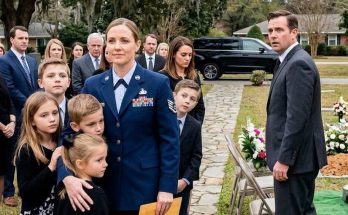
Dad throwing the book onto her casket.
His words about letting it rot with her.
The family leaving.
Me digging through wet cemetery dirt with my hands.
The note tucked between the pages.
The red stamp.
When I finished, the younger officer looked at the mud still packed beneath one of my nails.
“You recovered this from the grave yesterday?”
“This morning, basically. After the burial.”
“And your father deliberately put it there?”
“In front of everyone.”
The officer wrote that down.
That mattered.
Dad had spent years making sure ugly things happened behind closed doors.
This one hadn’t.
My uncles had seen it.
My cousins had seen it.
Susan had seen it.
Tyler had joked about it.
Even the pastor had been standing there.
For once, Richard Henderson had created his own witnesses.
The other officer asked about Grandma’s folded letter.
I had brought it with me inside the grocery bag.
I handed it over reluctantly.
He read it without changing expression until he reached the sentence about Dad trying to take something that had been mine since birth.
Then he looked toward the manager.
“Does that line match what’s already in your file?”
The manager answered cautiously.
“It is consistent with the reason the account was restricted.”
That was when I finally understood why the teller had gone pale.
The bank had not called police because I had appeared with an old passbook.
They had called because a woman connected to a long-running fraud concern had died, the granddaughter named in the restricted account had suddenly appeared, and the physical record everyone had apparently been trying to locate was sitting on their counter covered in cemetery mud.
Grandma had not sent me there to collect money.
She had sent me there to finish the record.
The manager asked whether I wanted to know the balance.
For a strange second, I almost said no.
Dad’s voice was still in my head.
No house, no land, no money.
An old notebook.
Worthless.
“Tell me.”
The manager turned his monitor slightly, then stopped before showing me anything.
“First, I need you to understand that some funds may remain restricted while ownership and prior transactions are reviewed.”
“I understand.”
“There may also be amounts connected to disputed activity.”
“Okay.”
“And this is not simply your grandmother’s personal savings account.”
That sentence mattered most.
I nodded.
He gave me the figure.
I did not feel rich.
I felt sick.
The amount was larger than anything Dad had ever admitted existed, but the number itself barely registered.
All I could see was Grandma at her kitchen table in that knit cardigan, opening her clasp purse and carefully flattening a few bills beside the porcelain angel.
I had thought she was saving.
She was rebuilding.
The manager showed me a sequence of old account notes.
Not everything could be released to me that morning, but there was enough to establish the shape of what had happened.
After I turned eighteen, requests began appearing that supposedly came from me.
Address changes.
Access requests.
Questions about withdrawal limits.
But the bank had eventually recorded inconsistencies.
Identification did not match cleanly.
Signatures varied.
Someone answering verification questions knew family information but failed on details tied specifically to me.
That was when the account had been flagged.
Grandma had apparently come in soon afterward.
She had argued that I knew nothing about the requests.
She had insisted that no one be added without me appearing personally with identification.
Then she had started keeping her own paper record.
The muddy blue book in front of us was part savings record, part map, part warning.
And Dad had thrown it into a grave.
Maybe he truly believed it was useless.
Or maybe he believed burying the paper would bury what it connected to.
Either way, he had done the one thing Grandma predicted he would do.
He had told me exactly how valuable it was by trying to get rid of it.
The police asked whether I wanted to make a formal statement regarding the cemetery incident and what Grandma had told me before her death.
I hesitated.
Not because I wanted to protect Dad.
Old habits are quieter than loyalty.
When you grow up with someone who can turn every accusation back on you, you learn to rehearse your own innocence before you speak.
Maybe I misunderstood.
Maybe I was being dramatic.
Maybe there was some explanation.
Dad had trained those sentences into me better than any teacher had ever trained multiplication tables.
Then I looked at my driver’s license lying beside Grandma’s passbook.
My name was on both sides of the problem.
Chloe Henderson.
Not Richard.
Not Susan.
Mine.
“I’ll give the statement.”
The officer pulled his chair closer.
That decision cost me something immediately.
I knew it would.
There would be family calls.
Accusations.
People telling me Grandma had just died and I was tearing everyone apart over money.
There would be relatives who had laughed at the cemetery suddenly claiming they had not heard Dad’s words clearly.
There would be people who preferred an easy funeral story to an ugly financial one.
But Grandma had already paid the larger cost.
She had spent years quietly replacing what she believed was mine while living in fear that her own son would find the record.
I could at least say what I had seen.
Halfway through my statement, my phone began vibrating inside my grocery bag.
Once.
Then again.
Then again.
I ignored it until the officer asked whether I needed to check it.
I pulled it out.
Dad.
Three missed calls.
A text appeared while I was holding the phone.
Where are you?
Another followed.
Did you take something from the cemetery?
The younger officer saw my face change.
“Is that him?”
I nodded.
The next message came before I could put the phone down.
That book belongs to the estate.
I almost laughed.
Yesterday it had been worthless.
Today it belonged to the estate.
I turned the screen toward the officer.
He asked me not to delete anything.
I didn’t answer Dad.
Five minutes later, Susan called.
I let that go too.
Then Tyler texted.
Dad is losing it. What did Grandma leave you?
That was the family version of concern.
Not Are you okay?
Not Why did Grandma warn you?
What did she leave you?
I put the phone facedown.
The manager returned with another employee and a thin folder.
He explained that the bank needed time to review the account, the prior restrictions, Grandma’s death, and the activity already documented.