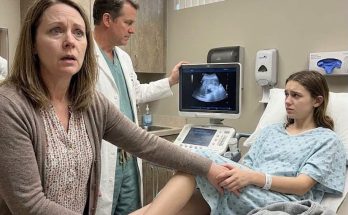
I went to the nation’s most respected maternity hospital expecting to help my pregnant daughter prepare for her final ultrasound. Instead, when her blouse slipped from her shoulders, my years in the Army saw the truth before my heart could accept it. Then she grabbed my hand, whispered, “Mom… please. He runs this hospital. If I leave him, he promised I won’t survive the C-section,” and in that moment, I quietly declared a war her husband never saw coming.
There are wounds only a soldier recognizes.
I had walked into that hospital that morning thinking about ordinary things.
Whether Chloe had remembered to eat. Whether the baby would cooperate during the ultrasound. Whether I should stop for groceries on the way home because her refrigerator had looked embarrassingly empty the last time I checked.
Nothing in my mind had prepared me for what I saw when her blouse slipped.
The exam room smelled like hand sanitizer, paper gowns, and burnt coffee drifting in from somewhere near the nurses’ station.
Fluorescent lights covered everything in a hard, clean white.
The counters were spotless. The equipment was lined up neatly. A laminated patient-rights notice hung on the wall beside the door.
It was the sort of place designed to make people believe they were safe.
Chloe stood about three feet away from me, thirty-eight weeks pregnant, one hand supporting the weight of her belly as she changed for her final ultrasound.
She had been talking about the baby only seconds earlier.
Then the fabric slid from one shoulder.
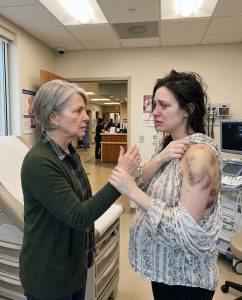
I saw the bruises across her ribs and shoulders.
My first reaction wasn’t even a thought.
It was recognition.
Thirty-two years in the United States Army had taught me that injuries have patterns.
Some marks come from accidents. Some come from chaos. Some come from people trying to protect themselves.
And some come from control.
These were not random bruises.
They weren’t the scattered marks someone gets from bumping into a kitchen counter, slipping in the bathroom, or losing balance while carrying laundry.
They were spaced.
Controlled.
The difference was small enough that someone without experience might have accepted an explanation.
I couldn’t.
I had spent years reading casualty reports when everyone else was asleep. I had watched trained soldiers insist they were fine while their bodies told a different story. I knew the posture people used when they were hiding pain because admitting it felt more dangerous than enduring it.
And then I reached toward my daughter.
Chloe flinched.
That movement told me more than the bruises did.
She didn’t recoil because my hand hurt her.
She recoiled before I touched her.
It was reflex.
Training of another kind.
“Mom,” she whispered.
Her fingers grabbed the edge of her blouse and pulled it closed.
They were shaking.
“Please… don’t say anything.”
For a few seconds, the woman standing in front of me disappeared.
I saw the little girl who used to race across our backyard wearing my Army cap so low over her forehead that she could barely see.
I remembered scraped knees and school pickup lines.
I remembered paper grocery bags on the kitchen floor while she searched through them for whatever snack she thought I had bought just for her.
I remembered thunderstorms when she would curl against my shoulder and pretend she wasn’t scared.
That child had grown into a woman who was about to become a mother herself.
And now she was standing barefoot on a cold hospital floor, trying to hide bruises from me.
I kept my voice low.
“Who did this, sweetheart?”
Her eyes filled immediately.
She looked down for a moment, as though saying the name would make everything real.
Then she whispered it.
“Julian.”
Dr. Julian Thorne.
Her husband.
The man everyone else seemed to know through polished photographs, professional praise, and carefully controlled appearances.
A nationally celebrated obstetric surgeon.
The hospital’s chief executive.
The charming son-in-law who brought expensive wine to family dinners and called me “General” with a smile that always seemed perfectly measured.
I had once taken the nickname as his awkward way of showing respect.
Standing beside Chloe that morning, I heard it differently.
Julian understood titles.
He understood authority.
Most of all, he understood how authority could make other people hesitate.
Chloe suddenly grabbed my wrist with both hands.
The fear in her face was sharper than anything I’d seen in the bruises.
“He said if I ever left him, he’d make sure something happened during delivery.”
I didn’t interrupt.
She swallowed hard.
“He said I would never wake up after my C-section.”
The words landed without drama.
That made them worse.
Outside the room, a cart rolled down the hallway.
Someone answered a phone near the ultrasound desk.
Shoes squeaked against the polished floor.
People were going about their morning while my daughter was telling me she believed her husband could kill her during childbirth and make it look like a medical tragedy.