Chapter 1: The Brass Safety Pin
The moment my grandmother caught sight of me clutching my newborn daughter inside a frayed, secondhand coat, the warmth vanished from her weathered face.
“Wasn’t the inheritance your father left you enough for a proper jacket?” she asked, her brow furrowing into a map of deep, concerned lines.
“I’ve never seen a single dollar of it,” I replied, the words tasting like old ash in my mouth.
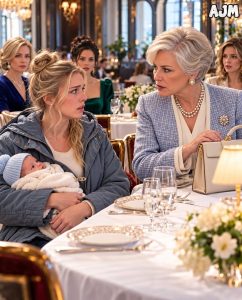
Nonna didn’t blink. She lowered her heavy, black leather purse to the floor and asked me for my mother’s phone number.
It was the safety pin that had betrayed my poverty. The nurse at Henrico Doctors’ Hospital had shown me how to zip little Marigold securely against my chest to keep her body temperature up. Out of sheer necessity, I’d bridged the gaping zipper with a massive, brass safety pin salvaged from the dusty depths of my diaper bag.
I was secretly proud of that brass pin. But Nonna spotted it from across the linen-draped table, and the joy of her birthday celebration extinguished as swiftly as a blown-out candle.
It was a brisk Sunday, March 8th, her seventy-eighth birthday. My two aunts were there, alongside a pair of cousins, chatting loudly over a sheet cake frosted with a photograph of Nonna’s face—a gaudy gesture she secretly adored but publicly complained about.
I’d arrived forty minutes late because Marigold, barely five weeks old, had demanded to be fed twice in the icy front seat of my beat-up Corolla. When I finally reached the table, Nonna wordlessly extended her arms. Marigold was furious and squirming, bundled in a pill-covered gray fleece bunting that had undoubtedly belonged to three other infants before finding its way to me. I’d scored it at a Broad Street church thrift store for exactly four dollars. It harbored a stubborn bleach stain near the left cuff, which I’d carefully rolled inward to hide.
My grandmother cradled Marigold with practiced grace, resting the tiny head against her silk shoulder. As she rhythmically patted my daughter’s back, her dark, sharp eyes locked onto mine. She saw everything. She saw the frayed cuffs of the men’s jacket. She saw the concealed bleach stain. She saw the exhaustion bruising the skin beneath my eyes.
Leaning forward, she pitched her voice just beneath the chaotic chatter of my aunts. “Jana, wasn’t the trust your father left you enough?”
I honestly thought the years were finally catching up to her. “Nonna,” I whispered, leaning in close, “I’ve never seen a dollar of any trust.”
She didn’t gasp. She didn’t argue. briefly, she just stared at me. Then, with agonizing gentleness, she handed Marigold back into my arms.
She placed it squarely beside her bread plate, folded her manicured hands upon the clasp, and said, “Give me your mother’s phone number.”
My grandmother had possessed my mother’s cell phone number for twenty-eight years. She had it memorized. She wasn’t asking for the digits; she was issuing a terrifying warning that she was about to weaponize them.
I’d no idea that fourteen years prior, Nonna had been sitting rigid in a mahogany-paneled law office when a staggering sum of money was spoken aloud.
My name is Jana Kersey. I am twenty-six years old, and I navigate the grueling existence of a pharmacy cashier in Glen Allen, a sprawling suburb just north of Richmond, Virginia.
I inhabit a cramped, drafty one-bedroom apartment off Staples Mill Road with my daughter, Marigold, who arrived on Groundhog Day and possesses militant opinions about the temperature of her milk. I rarely waste breath discussing him. He is a ghost who left nothing behind.
My own father, Declan Kersey, was a ghost of a different caliber. He was a commercial HVAC technician, a blue-collar magician who could resurrect any humming, metallic beast in your basement. He chronically kept butterscotch discs in the breast pocket of his uniform, distributing them to toddlers at every residential job site. He referred to me exclusively as “Bug,” right up until the grim afternoon of March 19th, 2012.
He was forty years old. I was twelve.
My memories of the funeral are a blur of damp tissues and the overwhelming scent of lilies. I vividly recall my mother, Renata, sobbing elegantly in a black sheath dress she had borrowed from her sister. I was swallowed by a tufted leather wingback chair, blissfully eating butterscotch candies from a crystal dish on the attorney’s desk, while the solemn adults murmured about life insurance policies.
Nonna was in that room. Renata was in that room. I was twelve, traumatized, and vastly more invested in the candy.
My mother was the guardian of this treasure. It was meant to cover my essential needs as I matured, and whatever crumbs remained would be handed over to me on my twenty-fifth birthday.
No one ever mentioned a specific number.
But secrets, I was about to learn, have a specific gravity. And the heavier the secret, the louder it crashes when it finally falls.
Chapter 2: The Gospel of Debt
Barely thirteen months after we buried my father, Renata married Royal Busby.
Royal was a boisterous man who owned a lucrative landscaping empire. His surname was plastered in bold, green font across a fleet of heavy-duty trucks roaming the county. He came as a package deal with his eleven-year-old daughter, Kirsten, a girl who possessed her own actual pony—a concept so staggeringly glamorous to my grieving mind that it felt pulled from the pages of a fantasy novel.
We were quickly uprooted from our modest life and transplanted into Royal’s domain in Glen Allen: a sprawling, brick colonial fortress boasting a three-car garage and a front lawn manicured with the obsessive precision of a PGA golf course.
I tried to acclimatize. But the economic physics of the Busby household became glaringly apparent within months.
Kirsten was enrolled at Holy Rosary Academy, an elite Catholic institution requiring crisp plaid skirts, mandatory chapel attendance, and exorbitant fees for the varsity rowing team. I, on the other hand, was sent to the overcrowded public high school a mile down the highway. Kirsten upgraded from a pony to competitive equestrian jumping lessons, which naturally segued into a ten-day cultural immersion trip to Italy with her Latin class.
During those years, Renata developed a relentless, weaponized catchphrase. She deployed it so frequently that my cousins and I used to mockingly mouth the words behind her back at family barbecues.
“After everything I’ve spent on you…”
If I tentatively asked for a new pair of track shoes, if I begged for a ride home in the rain rather than walking, if I dared to bring home a B-minus in Chemistry, Renata’s jaw would tighten, her eyes would ice over, and she would hiss, “After everything I’ve spent on you, Jana.”
Every time she said it, a heavy, invisible stone was added to a backpack I carried everywhere. I believed my grief and my presence were bankrupting her.
The spring I turned sixteen, my AP History class organized a three-day excursion to Washington D.C. It included a chartered luxury bus, two nights in a hotel with an indoor pool, and VIP access to the Smithsonian museums. The total cost was $340.
I brought the crumpled permission slip home and left it tentatively on the granite kitchen island, right beside Renata’s designer purse. She stared at the paper for what felt like an hour. Finally, she sighed, a long, theatrical exhalation of martyrdom.
“Jana, do you have any earthly idea how tight things are around here? After everything I spent on you this fiscal year alone? Your orthodontist bill isn’t even fully amortized yet.”
“Okay,” I whispered, shrinking into myself. “I understand.”
I didn’t argue. Instead, I pleaded with my manager at the custard stand for double shifts. For five grueling weeks, my forearms were coated in a perpetual, sticky glaze of vanilla and grease. I paid for that Washington trip myself, handing my history teacher a white envelope stuffed with crinkled ten and twenty-dollar bills. From that day forward, I never asked my mother to fund a school activity again.
That exact same April, Kirsten jetted off to Rome, Florence, and Venice. Renata personally drove her to the airport at four in the morning, weeping with pride at the departure curb. Upon Kirsten’s return, a framed eight-by-ten photograph of her tossing a coin into the Trevi Fountain was erected on the living room mantle. It remained there, an altar to her privilege, for years.
I never once asked who financed the Italian excursion. It never occurred to my conditioned mind to question it.
The ultimate trap was sprung in February of 2018, the week I legally became an adult.
Renata corralled me at the kitchen table, sliding a thick, stapled stack of legal documents toward me. Her voice was uncharacteristically soft, dripping with maternal encouragement. “These are the federal financial aid applications for your community college, sweetie,” she purred.
I was so intoxicatingly thrilled at the prospect of escaping that house and starting college that the adrenaline blinded me. I didn’t read a single paragraph of the dense legalese. She hovered over my shoulder, pointing a perfectly manicured fingernail at the blank lines. I scrawled my name eleven times using a cheap purple gel pen.
Two months later, on a crisp morning in April, I walked out the front door to find a brand-new, silver Honda Civic idling in the pristine driveway. A colossal, obnoxious red velvet bow was magnetized to the hood. It was Kirsten’s sweet sixteen. Renata darted around the vehicle, snapping a hundred photos on her phone, crying tears of joy.
I packed my bags that summer. I signed a lease on a cramped two-bedroom apartment with three other girls from the custard stand. I funded my entire community college education through a mountain of federal student loans. Nobody offered me a dime of assistance, and true to my conditioning, I never asked.
The following summer, in 2019, Royal’s landscaping crew excavated the backyard to install a custom in-ground swimming pool. It featured a cascading waterfall constructed from synthetic boulders and underwater LEDs that cycled through the color spectrum. I only knew about it because I saw it broadcast on Kirsten’s Instagram feed. There was a lavish launch party with forty guests. In the background of one video, Renata was laughing uproariously in a wide-brimmed straw hat, holding a margarita.
I wasn’t on the guest list. I swallowed the bitter pill, lying to myself that I wouldn’t have attended even if invited.
When the pandemic paralyzed the world in 2020, Royal dramatically announced over dry turkey at Thanksgiving that the landscaping business was on the brink of catastrophic failure. Miraculously, despite this alleged insolvency, he purchased two brand-new, heavy-duty commercial trucks the very next month.
I finally reached the finish line of my twenty-fifth year in February 2025.
By then, the concept of my father’s trust had become a faint, nagging itch in the back of my mind—like remembering a winter coat you accidentally left at a friend’s house a decade ago. I wasn’t expecting a windfall. I naively hoped that perhaps three or four thousand dollars had survived, just enough to make a dent in the suffocating principal of my student loans.
In early March, I cautiously broached the topic with Renata over the phone.
“Oh, honey,” she sighed, her tone dripping with condescending pity. “That tiny little fund? That’s all gone. It was completely exhausted just keeping you alive.”
“Exhausted?” I echoed, my stomach plummeting.
“Do you have the slightest comprehension of the economic burden of raising a child for thirteen years as a single mother?” she snapped, the familiar ice returning to her voice. “Your orthodontic work alone cost a fortune! After everything I spent on you, Jana, and now you have the audacity to call me demanding a handout?”
I apologized profusely. I stammered that I was ignorant of the costs. I believed her. I’d swallowed her narrative my entire life. Why would a mother ever lie to her own flesh and blood about something so sacred?
Because, I was about to discover, some mothers do not see daughters. They only see ledgers.
Chapter 3: The Midnight Mathematics
Back in the noisy warmth of Trattoria Rossi, nobody else at the table possessed the slightest inkling of the seismic shift that had just occurred. My two aunts were fiercely debating whether the horrifying photo-cake was spiced carrot or red velvet. My cousin was shoving his iPhone into people’s faces, forcing them to watch a video of his golden retriever.
Nonna ignored them all.
“Jana,” she rasped, her voice trembling with suppressed fury. “I was sitting in that lawyer’s office. The life insurance payout was four hundred thousand dollars.”
My lungs stopped working.
“Every single penny of it,” Nonna continued, her eyes blazing, “was routed directly into an irrevocable trust for you. I sat there and watched your mother sign the fiduciary papers as the trustee. I watched her wipe away crocodile tears while she did it.”
“Four… four hundred thousand?” I choked out, the number sounding like a foreign language.
“Four hundred thousand,” she confirmed, striking the table with her index finger. “Declan took out that policy the very week you were born. He sat me down on Christmas Eve and told me, ‘Ma, if the worst ever happens to me, don’t worry. The Bug is set for life.’”
Four hundred thousand dollars.
For six grueling years, I’d been hemorrhaging $211 every month just to tread water on my student loan interest.
Nonna blew out the trick candles with a single, unsmiling breath. She picked up the silver cake knife, set it down with a sharp clack against the porcelain, and stood up.“Excuse me,” she announced to the startled table. “I suddenly require fresh air.”
She shot me a look that commanded obedience. I hoisted Marigold and followed her out into the biting March wind.
Nonna’s vehicle is a pristine, 2004 Buick sedan, painted the pastel hue of an after-dinner mint. She slid behind the leather steering wheel, and I buckled myself into the passenger side.
Relying purely on muscle memory, she punched in Renata’s number and engaged the speakerphone.
My mother picked up on the third ring. “Concetta! Happy birthday, you spring chicken. I’m so terribly sorry I couldn’t make the lunch. Royal had an emergency with one of the client’s irrigation systems.”
Nonna didn’t offer a greeting. “Renata. Where is Declan’s money?”
The digital connection seemed to freeze.
“I beg your pardon?” Renata finally said, the honeyed warmth instantly evaporating.
“The trust fund,” Nonna barked, her voice echoing off the dashboard. “Four hundred thousand dollars. Jana is sitting next to me wearing a ragged coat from a charity bin, holding her infant in a secondhand blanket. She just informed me she has never seen a single dollar of her father’s legacy. Where is the money?”
When Renata spoke again, her vocal register had shifted.
“Concetta, that money was entirely liquidated and spent on Jana. Every last dime went into raising her. I was suddenly a widow burdened with a traumatized twelve-year-old girl. Do you have any concept of what that costs in the modern world? And quite frankly, this is no longer your concern. Declan is deceased. I am her mother.”
“And I,” Nonna snarled, her knuckles turning white on the steering wheel, “am his.”
Click. Renata terminated the call.
Nonna sat motionless for minutes, the dead phone resting in her lap.
“Well,” Nonna finally whispered, her voice cracking. “Now I know.”
“Know what?” I asked, my heart hammering against my ribs.
“That she is a pathological liar,” my grandmother said grimly. “Your mother has never, in her entire fifty years on this earth, answered a question she actually wanted to hear with the phrase ‘quite frankly’.”
She turned the key in the ignition.
At two o’clock that following morning, the reality of the betrayal set in. I was nursing Marigold, my mind racing with terrifying velocity.
I grabbed a blue ballpoint pen and flipped over a long, curling receipt from the CVS pharmacy. I began to do the math.
$400,000.
If you measured the span from when I was twelve to the day I fled that house at eighteen, it was exactly six years. Even if I played devil’s advocate and stretched the timeline to my twenty-fifth birthday, it was thirteen years.
Four hundred thousand divided by thirteen years equated to roughly $30,700 per year.
I tried to excavate $30,000 worth of annual expenditures from the graveyard of my childhood.
My braces were $4,800 total; I knew this down to the cent because Renata weaponized the figure every Christmas. My wardrobe was exclusively sourced from clearance racks at Target and the discount outlet mall. I’d financed my own cellular plan since the age of sixteen. The vehicle I drove was a rust-spotted 2006 Corolla with 190,000 miles on the odometer, purchased with cash smelling of frozen custard. I’d shackled myself to federal debt to attend a community college. My dietary intake consisted of the same bulk-purchased groceries as everyone else in the Busby compound.
I couldn’t make the ledger balance. I couldn’t even make it come close.
Marigold finished feeding, her tiny rosebud mouth falling open in a deep, milk-drunk sleep.
I was going to war.
Chapter 4: The Purple Pen’s Ghost
On Tuesday, my sole day off from the pharmacy, I strapped Marigold into her car seat and drove straight to Nonna’s house.
She resides in the identical brick row house in downtown Richmond where my father was born and raised.
Nonna confiscated the baby and ordered me to sit at the formica kitchen table and consume a bowl of homemade minestrone. Once she was satisfied I was eating, she vanished into her master bedroom.
She emerged carrying a heavy, aromatic cedar box. Beneath my father’s yellowing baptismal certificate and a tarnished Little League baseball trophy rested a thick, manila envelope.
Nonna slid out a crisp photocopy of a letter bearing the letterhead of a major life insurance conglomerate. It was dated April 14th, 2012. It confirmed the disbursement of $400,000.00 directly to the appointed trustee of the Jana Kersey Irrevocable Trust.
The attorney had distributed courtesy copies to the immediate family on that grim afternoon in his office. My grandmother had safeguarded hers inside this cedar tomb, resting intimately beside a tiny envelope containing her dead son’s baby teeth, for fourteen years.
“Nonna,” I breathed, touching the paper as if it might burn me. “Why didn’t you ever interrogate her about it?”
She placed her aged, papery hand flat atop the document. Her eyes shone with unshed tears. “Because, Jana, it was legally not my money to monitor. She was his lawful wife. She is your mother. My mind couldn’t fathom… what kind of depraved creature steals from the mouth of her own grieving child?”
She shook her head, disgust warring with deep regret. “Every single time I inquired about your well-being, Renata beamed and declared you were doing wonderfully. And you never contradicted her. You never whined, Jana. Not once in your entire miserable adolescence. You were so quiet. I tragically mistook your silence for happiness.”
Nonna looked down at Marigold, who was cooing softly in her lap. “The guilt of that assumption is a cross I will bear to my grave. I should have demanded an audit from her every single Christmas. But I am asking the questions now.”
Nonna’s legal counsel was a formidable, archaic gentleman named Mr. Duca. He had been ruthlessly navigating trusts and estates in Richmond for over three decades from a narrow, ivy-choked brick townhouse on West Franklin Street. The floorboards shrieked in protest underfoot, and a grandmotherly receptionist offered me hard butterscotch candies from a crystal dish. The jarring wave of déjà vu nearly brought me to my knees right there in the waiting room.
Mr. Duca was a relic of a bygone era. He wore a perfectly tied silk bow tie and possessed the rare, expensive trait of listening to a hysterical woman without interrupting her once.
When I finally exhausted my tale of woe, he steepled his fingers beneath his chin.
“Miss Kersey,” he began, his voice a rich, comforting baritone. “In the eyes of the Commonwealth of Virginia, your mother is not merely your parent in this context. She is a fiduciary trustee. That is a highly regulated legal occupation burdened with severe statutory duties. A trustee is legally bound to utilize the trust’s assets exclusively for the designated beneficiary. It is a criminal offense to commingle those funds with her personal accounts.”
He leaned forward, his eyes sharp behind wire-rimmed glasses. “She is obligated by law to maintain forensic records of every single penny that enters and exits that account. And as the sole beneficiary, you possess the unalienable right to demand a comprehensive accounting. She has a legal duty to comply.”
“But she insists she spent it all on my upbringing,” I countered, my voice trembling.
Mr. Duca offered a smile that resembled a shark spotting a drop of blood in the water. “Excellent. If her conscience is clear, she will be absolutely delighted to provide us with the receipts proving her maternal devotion.”
He drafted a brutal, uncompromising letter of demand that very afternoon. It was dispatched to Renata via certified mail, requesting a full, itemized accounting of the trust from the date of its inception in 2012 to the present hour—every deposit, every withdrawal, every market investment, every administrative fee.
When I anxiously attempted to discuss Mr. Duca’s retainer fee, Nonna slammed her purse onto his desk. “Jana, this is my dead boy’s money we are clawing back from a thief. Allow an old woman the pleasure of buying the postage stamps.”
Two agonizing weeks crawled by before Renata retaliated.
She did not surrender an accounting spreadsheet. Instead, she dispatched a single, damning sheet of paper, routed through the office of a high-priced corporate defense attorney. It was accompanied by a terse, one-paragraph cover letter stating that the beneficiary had legally waived her right to receive any and all trust reports, and therefore, the trustee considered the matter permanently closed.
Mr. Duca handed me the single page. It was the waiver.
It was dated February 14th, 2018. My eighteenth birthday. And resting maliciously at the bottom of the page, inked in a cheap, sparkly purple gel pen, was my own signature.
I sat paralyzed in Mr. Duca’s wingback chair, the floor seemingly dropping out from beneath the townhouse.
“I signed it,” I whispered, bile rising in my throat. “I signed my own rights away. I didn’t read a single word.”
Mr. Duca gently plucked the waiver from my trembling fingers and inspected it over the rim of his glasses.
“Miss Kersey, take a breath,” he instructed calmly. “You signed away your right to demand annual, mundane reports. You absolutely did not sign away her fiduciary duties. That legal distinction is the crux of our entire offensive strategy.”
He tossed the paper onto his desk with a gesture of utter contempt. “A beneficiary can waive the annoyance of receiving a yearly balance sheet. However, no human being on earth can sign a waiver granting a trustee permission to embezzle funds to finance her new husband’s lifestyle. No court in this country recognizes a piece of paper that legalizes theft.”
He leaned back, adjusting his bow tie. “Furthermore, a circuit court judge possesses the ultimate authority to order a forensic accounting regardless of what you autographed when you were a naive teenager.”
He looked at me, his eyes gleaming with anticipation of the battle ahead. “In my thirty years of practicing law, Miss Kersey, I have never once encountered a trustee who possessed clean hands responding to a demand letter with a waiver. When a trustee is innocent, they bury you in spreadsheets.”
The trap was set, and Renata had walked right into it.
Chapter 5: The Price of a Soul
The psychological warfare escalated instantly.
Renata severed all direct communication. She stopped replying to my desperate texts containing photos of Marigold’s milestones. For months, she had reliably attached a red heart emoji to every picture I sent; now, the digital silence was deafening. She unfriended me on Facebook. When I called her on Easter Sunday, the phone rolled directly to a generic voicemail.
Then, she deployed her flying monkeys.
My aunt—Renata’s older sister—called me at the pharmacy. “I have no idea what kind of demonic influence has possessed you,” she hissed into the receiver, bypassing any greeting. “Your mother sacrificed her youth, her sanity, and her entire life to care for you after Declan died. And now you are allowing that bitter old Italian woman to poison you against your own flesh and blood over money?”
“Aunt Carol—” I tried to interject.