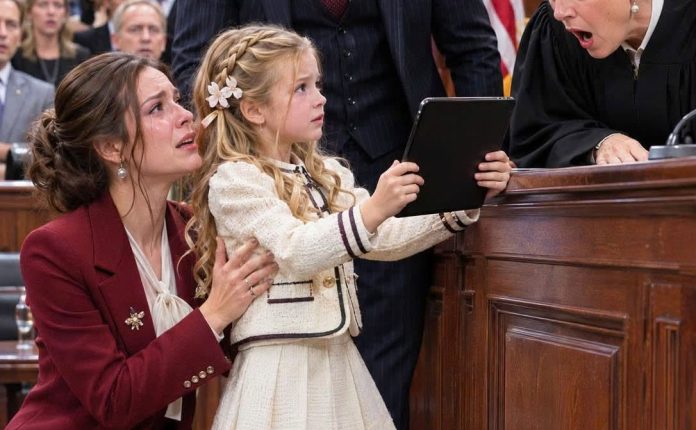
At 1:50 p.m., Thomas and I walked through the main lobby of Vance Logistics.
The security guard who had escorted me out four hours earlier looked up from his console, his face turning pale. “Mrs. Bradley… Mr. Vale gave strict orders that your badge was deactivated and you were not permitted past the gates.”
Thomas Finch stepped forward, opening his leather portfolio to reveal his official corporate counsel identity card and a certified court filing.
“Step aside, son,” Thomas said mildly. “I am the registered corporate statutory agent for this entire enterprise. If you interfere with corporate officers entering this building, you will be answering to the county sheriff before the shift ends.”
The guard swallowed hard, dropped his radio, and hit the electronic buzzer to unlock the security turnstiles.
We took the elevator directly to the third floor.
The main boardroom was packed to capacity. Every department head, shift supervisor, and senior dispatcher was sitting around the perimeter chairs. Martin Vale stood at the head of the long conference table in front of a giant digital presentation screen. The title slide read: *Vance Logistics 2027: Agility, Efficiency, and Equity Maximization.*
Martin had his suit jacket off, his sleeves rolled up to his forearms, and a wireless slide remote in his palm.
“As we look at our legacy overhead,” Martin was saying to the room, his voice echoing off the glass walls, “we have to be ruthless about removing redundancies.
This morning, we took the decisive first step by modernizing our procurement leadership. When individuals stay in a single operational role for two decades, complacency becomes institutional. Moving forward—”
The heavy oak double doors swung open.
Martin stopped mid-sentence. His eyes snapped toward the doorway.
When he saw me standing there beside Thomas Finch, his face flushed with immediate annoyance. He clicked his slide clicker against his thigh and walked toward the center of the room.
“Clara,” Martin sighed loudly, shaking his head with exaggerated patience for the benefit of the room. “I thought security made this clear. You do not work here anymore.
This is a closed executive strategy session. If you cause a disturbance, I will have the local police remove you for criminal trespass.”
“You won’t be calling anyone, Martin,” Thomas Finch said, stepping into the light of the projector.
Martin frowned, looking at Thomas’s three-piece wool suit. “And who are you? Some legal aid lawyer she hired to contest her severance? Read her contract. Ohio is an at-will employment state. I can terminate her position whenever I see fit.”
“I am Thomas Finch, general counsel for Vance Logistics since 1982,” Thomas said, setting Harold’s red folder right in the center of the conference table.
“And you, Martin, have managed to commit corporate breach of contract within four hours of your unauthorized personnel action.”
Martin let out a sharp, arrogant chuckle. “Breach of contract? Over an inventory clerk? I am the vice president of corporate development. Arthur Vance gave me full operational authority while he is in Arizona.”
Right on cue, the conference phone console in the center of the table lit up with an incoming line.
Thomas reached out and tapped the speaker button.
“Put the room on, Thomas,” Arthur Vance’s voice thundered through the speakers, loud and clear enough to rattle the water glasses.
Martin went completely rigid. His hands dropped to his sides. “Arthur? I… I am running the strategic alignment meeting right now. We are presenting the new operational matrix.”
“Shut your mouth, Martin,” Arthur barked. The sheer volume of the old man’s fury silenced every cough and paper rustle in the room. “You don’t present a single slide. You don’t speak to my staff, and you don’t make another decision in that building.”
“Arthur, I was only trying to trim legacy overhead,” Martin stammered, his polished consultant veneer cracking into pieces. “Clara Bradley was drawing eighty-four thousand dollars a year for tasks that can easily be automated with regional inventory software—”
“Her name is Clara Tennant Bradley, you ignorant boy,” Arthur interrupted, his voice shaking with absolute contempt. “Harold Tennant was my partner for thirty-five years. When we started with two rusty flatbeds in a mud lot, Harold put up the ground, the fuel reserves, and the capital to keep our drivers paid. Clara owns twenty percent of the voting shares of this enterprise, and she is the sole owner of the thirty-two acres of ground your feet are currently standing on!”
Martin’s mouth opened slightly. He looked at me, then at Thomas, and then down at the mahogany table.
Every single department manager in that room sat forward. A low murmur rippled through the supervisors.
“By firing Clara without executive board approval,” Thomas Finch stated, opening the red folder and sliding an official notice across the polished wood, “you have placed Vance Logistics into immediate non-curable material default of its ground lease. As of 11:00 a.m., the rent on the cross-dock terminal, the parking acreage, and this office tower has increased from one dollar a year to one hundred and eighty thousand dollars per month, payable in advance.”
Martin grabbed the edge of the conference table to steady himself.
“One hundred and eighty thousand… that would wipe out our entire quarterly operating margin.”
“Then you better hope Clara is feeling generous, Martin,” Arthur’s voice came through the speaker. “Because I just signed a formal board resolution with Thomas Finch removing you from all operational authority, revoking your corporate card, and directing you to vacate my headquarters within thirty minutes.”
ENDING
Martin did not say another word.
He did not look at the department managers who had worked under him, and he did not look at Thomas Finch. He walked around the conference table, gathered his leather portfolio and his presentation remote, and walked out the door with his head down.
Two days later, Courtney called me from Chicago. She was crying, apologizing for her husband’s blind arrogance and explaining that Martin had lied to her, claiming Arthur had given him explicit orders to cut older staff. I told Courtney that I bore her no ill will, but that running a family business required respect for the people who laid the bricks, not just the people who wore the suits.
Martin was formally dismissed from the company the following week. The private equity proposal he had drafted on his laptop was shredded in the boardroom, and Martin returned to Chicago to look for an entry-level analyst position at a corporate consulting firm.
Arthur Vance flew back from Arizona three weeks later, walking with a wooden cane but grinning from ear to ear.
We held a real all-hands meeting in the warehouse cross-dock on a Friday afternoon. Arthur stood on a wooden pallet between two forklifts, surrounded by three hundred drivers, dispatchers, and warehouse handlers.
He didn’t talk about optimization matrices or agile synergy. He talked about loyalty, sweat, and the thirty-nine years of sweat that Harold Tennant and he had poured into the concrete beneath our feet.
Arthur presented me with an updated corporate charter that formally created the Harold Tennant Operational Trust, guaranteeing that no family member could ever be removed from executive oversight without a ninety percent shareholder majority, and ensuring that five percent of the company’s net annual freight profits were directed into an emergency assistance fund for our warehouse and road drivers.
I stayed on as Director of Inventory and Operations for another fourteen months, long enough to personally train a sharp young dispatcher named Marcus, whose father had driven a flatbed for my dad back in the 1980s.
Last month, I finally retired on my own terms at sixty-four.
The company did not give me a cardboard box. They threw a barbecue banquet in the main maintenance bay with two whole roasted pigs, six kegs of local cider, and over four hundred employees and their families filling the parking lot.
Arthur sat next to me at the head table, cutting his steak with a pocketknife, while Marcus and his team presented me with a handcrafted cedar desk clock with an inscribed brass plaque bearing my full name: Clara Tennant Bradley.
I live in my quiet brick home outside Grove City now.
My mornings are my own. I spend them tending my rose bushes, drinking dark-roast coffee on the back porch with my beagle, and helping my granddaughter with her sixth-grade algebra homework.
On my writing desk in the front room, sitting in a velvet-lined rosewood box, rests the sterling silver pen Arthur gave me during the 2008 recession.
Beside it sits the original 1985 ground deed, stamped with my father’s signature and the county seal.
Whenever people ask me about my nineteen years at Vance Logistics, I tell them that titles and suits come and go with every change of the wind.
A title is just ink on a business card that someone can take away on a Tuesday morning. But when you own the ground beneath your feet, nobody can ever ask you to leave.
Pages: 1 2