
Part 5
Autumn arrived with a sharpness that made the air smell of coming cold. Marcus had been at the clinic for four months. The temporary job had become permanent in everything but title. Patients asked for him. The other therapists trusted him with transfers that required strength and patience in equal measure. At night he sometimes fell asleep on my couch with a book open on his chest, and I would cover him with a blanket and sit nearby reading my own pages in the quiet.
Sophie called more often. The conversations were still careful, but the carefulness had begun to feel like respect rather than distance. One Saturday she invited us to an opening of a small gallery show where some of her designs were displayed. We went. Marcus stood in front of her work for a long time without speaking. When he finally turned, his eyes were bright.
“She’s good,” he said. “Better than I knew.”
I squeezed his hand. “She gets that from somewhere.”
He smiled. The smile still carried the old shadow, but the shadow no longer defined the entire expression.
That same week a letter arrived at the clinic addressed to me in a handwriting I did not recognize. Inside was a single sheet of paper and a photograph. The photograph showed a young man in a high school graduation gown. The letter was from a woman named Diane who wrote that she had been the passenger in the other car the night of the accident. She had survived with minor injuries. For thirty years she had carried the guilt of not stopping her boyfriend from driving. She had recently learned my name through a mutual acquaintance and wanted me to know that she thought of me still.
I sat at my desk with the letter open for a long time. Marcus found me there after the last patient had left. He read the letter over my shoulder without asking permission. When he finished he rested both hands on the back of my chair.
“Do you want to answer her?” he asked.
“I don’t know.”
He waited.
“I spent so many years being the story other people told about the accident,” I said. “The girl in the chair. The future that was stolen. I don’t know if I have room for another person’s guilt.”
Marcus was quiet. Then he said, “You don’t have to make room. You can just acknowledge that the room exists and leave the door closed.”
I folded the letter and put it in the drawer. The photograph stayed on the desk for three days before I put it away as well. Some stories do not require answering. They only require being witnessed once and then released.
In November Marcus received a call from the construction company that had fired him. They were under new management. The supervisor who had called him a liability was gone. They wanted him back, at a higher wage, with accommodations for the limp. He listened to the offer, thanked them, and declined.
When he told me that night I asked why.
“Because I like who I am when I’m here,” he said. “The work matters. The people matter. And you are here. That’s not something I’m willing to trade for better pay and a longer commute.”
I did not answer with words. I answered by walking across the kitchen and kissing him until the kitchen timer went off and we both laughed at the ordinary interruption.
Winter came early that year. The first snow fell while we were walking home from dinner. Marcus stopped under a streetlight and held out his hand, watching the flakes land and melt on his palm. His expression was open in a way I had rarely seen.
“I used to hate winter,” he said. “Everything felt harder. The cold. The dark. The way the ground got slippery and reminded me I couldn’t trust my own feet. Tonight it just feels like snow.”
I took his other hand. We stood under the light until our hair was dusted white and our shoulders were damp. Then we walked the rest of the way home, matching steps, the city quiet around us under its new white layer.
Inside, we left our wet coats by the door and stood in the hallway with the snow still melting in our hair. Marcus looked at me the way he had looked at the snow—as if something difficult had become, for a moment, simply beautiful.
“Claire,” he said. “Marry me.”
The words did not arrive with fireworks or dropped knees. They arrived the way the best true things arrive: quietly, after a long walk through weather, in a hallway that smelled of wet wool and possibility.
I did not answer immediately. I let the question settle into the space between us. I thought of the girl in the chair and the boy who had crossed the floor. I thought of the woman counting coins and the man who had learned to walk again. I thought of all the years that had been required to bring us to this ordinary hallway on an ordinary night of first snow.
Then I said yes.
Part 6
We told Sophie first. She cried in a way that surprised all three of us, then laughed, then cried again. The wedding would be small. Neither of us wanted spectacle. We wanted a room full of people who already knew the important parts of the story and did not need it explained.
Planning happened in the margins of ordinary days. Marcus researched simple venues between patient sessions. I found a dress in a consignment shop that fit as if it had been waiting for me. We wrote our own vows on the backs of clinic intake forms during lunch breaks and then laughed at the medical jargon that had crept into the language of love.
One afternoon Marcus came into my office and closed the door. His face was carefully neutral.
“I need to tell you something before the wedding,” he said. “Something I’ve been avoiding.”
I set down my pen.
“The scaffolding accident,” he continued. “It wasn’t entirely an accident. I had been drinking the night before. Not much. Enough that my balance was off and my judgment was slower. I’ve never told anyone. Not the company. Not Sophie. Not you. I let everyone believe it was pure bad luck because the truth made me look like my brother.”
The room stayed very still. Outside the office door I could hear a patient laughing with a therapist. The laughter sounded far away.
Marcus waited. He did not look away.
I stood and walked around the desk. I took both of his hands.
“You’re not your brother,” I said. “You’re the man who told me the truth even when the truth could have cost you the life we’re building. That difference matters more than the drink you had the night before a fall.”
He exhaled as if he had been holding the breath for three years. I pulled him against me and felt the tension leave his shoulders one vertebra at a time.
We were married on a Saturday in early spring when the trees were only beginning to consider green. The ceremony took place in the small park near the river where we had walked so many evenings. Sophie stood beside her father. A handful of clinic staff and a few of Marcus’s old construction friends formed the rest of the circle. The air smelled of wet earth and possibility.
When it was time for vows, Marcus spoke first. His voice carried the slight roughness it always had when the words mattered most.
“I spent thirty years believing I owed a debt I could never pay,” he said. “Then you taught me that some debts turn into doorways. I walk through this one with both eyes open. I will spend the rest of my life making sure you never sit alone in a room full of music again.”
My own vows were shorter. I had practiced them until they felt like breath.
“You saw me when seeing was the braver choice,” I said. “I will spend the rest of my life making sure you are never invisible, even to yourself.”
We kissed. Sophie cried again. Someone whooped. The river kept moving the way rivers do when human ceremonies are finished and the water has other business.
That night we stayed in a small hotel overlooking the same river. Marcus stood at the window for a long time after we arrived. When he turned, his eyes were clear.
“I keep waiting for the other shoe,” he said. “The part where happiness gets revoked because I don’t deserve the portion I’ve been given.”
I joined him at the window. The city lights reflected in the water like scattered coins.
“There is no other shoe,” I said. “There’s only the next morning and the morning after that. We’ll figure those out the same way we’ve figured out everything else.”
He smiled. The smile reached all the way this time.
We slept with the window open. In the morning the air smelled of rain that had passed in the night, and the day felt newly washed and ready.
Part 7
Married life settled around us with the quiet confidence of something that had been waiting its turn. Marcus continued at the clinic. I continued teaching people how to trust their bodies again. In the evenings we cooked or walked or sat in companionable silence with books. Sophie visited once a month and began to leave small drawings on our refrigerator—quick sketches of the river, of the clinic doorway, of her father’s hands adjusting a parallel bar.
Summer brought a heat that made the city shimmer. One afternoon a new patient arrived whose story felt familiar in a way that raised the hair on my arms. Her name was Lena. She was nineteen. A drunk driver had put her in a chair six months earlier. She sat in my office with her mother and spoke in the flat voice of someone who had already decided the future was finished.
I listened. When she finished I did not offer the bright reassurances she had already heard from a dozen other professionals. Instead I told her about a gymnasium and a boy who had crossed a floor and four words that had somehow lasted three decades.
Lena listened with the wary attention of someone who had learned not to hope too quickly. When I finished she looked at her mother, then back at me.
“Did it get better?” she asked. “The sitting. The being watched. The way people talk to you like you’re already a lesson instead of a person?”
“It got different,” I said. “Different is sometimes the same as better. And sometimes different is just the next true thing.”
After they left, Marcus found me sitting on the treatment table staring at nothing. He did not ask what was wrong. He simply stood beside me until I was ready to speak.
“She has the same eyes,” I said. “The ones that have already started saying goodbye to the life they thought they were going to live.”
Marcus put an arm around my shoulders. “Then it’s good she’s here. You know the map.”
I leaned into him. Outside the window the heat rose from the parking lot in visible waves. Inside, the air conditioning hummed its steady, ordinary song.
That evening we walked farther than usual. The river path was crowded with people escaping the heat of their apartments. Marcus stopped at a bench and sat. I sat beside him. For a while we watched the water.
“I’ve been thinking about Diane,” he said. “The woman who wrote you. The passenger.”
I waited.
“Maybe some doors should be opened after all,” he continued. “Not for her guilt. For the chance that telling the truth in both directions might loosen something that has been stuck for thirty years.”
I considered it. The letter was still in the drawer. The photograph of the young man in the graduation gown still existed somewhere in the dark of a file.
“I’ll write to her,” I said. “But I’ll write it with you. Some stories are too heavy for one set of hands.”
We wrote the letter together that weekend. It was short. It did not offer forgiveness, because forgiveness had never been mine to give or withhold. It simply said that I had received her words, that I had survived, that the survival had included unexpected joy, and that I hoped she had found a way to set the guilt down even if she could never set it aside completely.
We mailed it on a Monday. We did not expect an answer. The act of sending felt complete in itself.
Two weeks later a reply arrived. Diane wrote that she had cried when she read our letter. She wrote that she had carried the night like a stone in her chest for three decades and that our words had not removed the stone but had made it possible to carry differently. She wished us well. She did not ask to meet. We did not offer.
Some circles close without requiring the people inside them to touch.
In late August Sophie called with news. She was pregnant. The joy in her voice was unguarded in a way I had never heard from her before. Marcus sat down hard on the kitchen chair when she told him. After the call ended he stayed seated for a long time, one hand over his mouth, eyes wet.
“I’m going to be a grandfather,” he said finally, as if testing the shape of the words.
I kissed the top of his head. “You’re going to be a good one.”
He reached up and held my wrist. “Stay with me for all of it. The messy parts. The ordinary parts. The parts that look like nothing until you realize they were everything.”
“I’m not going anywhere,” I said.
And for the first time since the night of the accident, the sentence felt entirely true.
Part 8
The pregnancy progressed through the autumn and into a winter that arrived with less bitterness than the ones before. Sophie’s belly grew. Marcus began building a cradle in the small workshop space we had cleared in the basement of the clinic building. He worked slowly, with the careful attention of a man who had learned that some things cannot be rushed. I watched him sand the wood in the evenings and thought about all the years he had spent believing he was only good for temporary work and temporary affection. The cradle under his hands said otherwise.
One evening in January the phone rang while we were eating. It was Sophie’s mother, Elena. Her voice was tight.
“Sophie’s blood pressure is high,” she said. “They’re keeping her at the hospital overnight for monitoring. She asked for her father.”
Marcus was already reaching for his coat. I drove. The hospital was twenty minutes across the city through snow that had begun to fall again. We found Sophie in a room on the maternity floor, pale but alert, an IV in her arm. Elena sat beside the bed looking older than her years.
Marcus went straight to his daughter. He did not speak at first. He simply took her hand and held it. Sophie looked at him and then at me and managed a small smile.
“False alarm, probably,” she said. “But they want to be sure.”
We stayed until the night nurse made polite noises about visiting hours. In the hallway Elena pulled Marcus aside. I gave them privacy and waited by the elevators. When Marcus rejoined me his face was thoughtful.
“She thanked me,” he said. “Elena. For showing up. She said she wasn’t sure I would.”
“You did.”
“I almost didn’t,” he admitted. “The old fear started talking. The one that says I’m only good at arriving after the damage is done.”
I took his arm. “The fear can talk. It doesn’t get to drive.”
We drove home through streets that had turned white and quiet. In the morning Sophie’s numbers had improved. She was released with instructions and a follow-up appointment. Marcus returned to the cradle with renewed focus. The wood under his hands began to look like something that could hold a life.
Spring arrived early. The cradle was finished and delivered to Sophie’s apartment on a Saturday when the trees were flowering. We helped her assemble it in the small second bedroom she had prepared. Marcus tested every joint twice. Sophie watched him with an expression that mixed amusement and something softer.
“You’re going to be insufferable once this baby is born,” she said.
“I’m counting on it,” he answered.
Afterward the three of us sat on her small balcony with glasses of iced tea. The city spread out below in the late light. Sophie rested a hand on her belly and looked at her father.
“I used to think you left because you didn’t know how to stay,” she said. “Now I think you left because you didn’t believe you deserved to stay. There’s a difference.”
Marcus was quiet for a long time. Then he said, “I’m learning the difference. Slowly. With help.”
He glanced at me. I did not need to answer. The answer was already in the way we sat together, three people who had each, in different ways, learned how to remain.
That night at home Marcus stood at the bedroom window the way he sometimes did when the day had been full. I joined him. The street below was empty. The sky still held a thin line of light at the western edge.
“I keep thinking about the coins,” he said. “The morning you found me. How close I was to walking away with nothing. How one conversation changed the direction of everything that followed.”
I rested my head against his shoulder. “You were counting coins. I was counting years. We both needed someone to interrupt the counting.”
He turned and kissed me. The kiss carried the accumulated weight of every ordinary morning and difficult evening we had already survived. When it ended he kept his forehead against mine.
“I’m glad it was you,” he said.
“I’m glad it was us,” I answered.
Outside, the last of the light left the sky. Inside, the house settled around us with the particular quiet of a place that has learned the shapes of the people who live in it.
Part 9
The baby was born on a Tuesday in May when the air already smelled of summer. A girl. They named her June, for the month Sophie had always loved best. Marcus held his granddaughter for the first time in the hospital room while Sophie slept and Elena sat nearby looking exhausted and radiant at once. I watched his face as the small weight settled into his arms. Something old and clenched finally loosened.
In the weeks that followed, our house filled with the soft chaos of new life. Sophie and the baby stayed with us for the first ten days while she recovered. Marcus became the person who woke at two in the morning to walk the hallway with a fussy infant against his chest. I became the person who made coffee at odd hours and left it within reach. The clinic adjusted around our absences. Patients understood. Some of them brought small gifts—booties, a knitted blanket, a card with a drawing of a cradle.
One afternoon in June I found Marcus in the basement workshop staring at a scrap of wood. The cradle had long since gone to Sophie’s apartment. The scrap was nothing important. He turned it over in his hands as if it might still become something.
“I used to think the best parts of my life were already behind me,” he said without looking up. “The dance. The years before the fall. The version of myself that still had two good legs and a clear future. Now I think those were just the opening chapters. The real story started the morning you walked into that café.”
I sat on the workbench beside him. “The real story started earlier. It started the night you decided one girl’s loneliness was worth crossing a room for. Everything else has been the continuation.”
He set the scrap of wood down and took my hand. His palm was rough from the work of the past months. I had come to love the roughness. It felt like evidence of a life still being built.
That evening Sophie brought June over for dinner. The baby was awake and solemn, studying faces with the intense focus of someone gathering data for later. Marcus held her while I finished the salad. Sophie leaned in the kitchen doorway and watched her father with an expression that had lost most of its old wariness.
“You’re good at this,” she said.
“I’m motivated,” he answered.
After they left, the house felt both emptier and more complete. Marcus and I sat on the back steps with glasses of wine and listened to the neighborhood settle into night. A dog barked two streets over. A car door closed. Somewhere a child was being called inside.
“Claire,” Marcus said. “When I’m gone, I want you to keep the clinic open. Not because of me. Because of the people who still need someone to see them when seeing is the braver choice.”
I did not tell him not to talk about being gone. We were old enough now to understand that the conversation was part of loving someone completely.
“I will,” I said. “And when I’m gone, I want you to keep walking. Even when the limp gets worse. Even when the mornings feel heavier. Keep walking.”
He nodded. We sat until the wine was finished and the mosquitoes began to find us. Then we went inside and closed the door on the ordinary night.
In July a package arrived with no return address. Inside was a small framed photograph of a high school gymnasium floor, empty, the polished wood reflecting overhead lights. Taped to the back was a note in handwriting I recognized from the letter two years earlier.
Diane had written: I went back. The floor is still there. I stood in the place where I imagine the dance happened and said the only thing I know how to say. Thank you for surviving. Thank you for the letter. I am learning how to set the stone down.
I showed the photograph to Marcus. He studied it for a long time.
“The floor is still there,” he said quietly. “So are we.”
We hung the photograph in the hallway beside our wedding picture. Two images of ordinary rooms where extraordinary things had once been possible. Visitors sometimes asked about them. We told the short version. The long version belonged only to us.
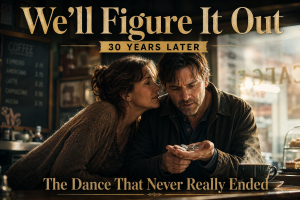
August arrived with its thick heat and its memory of the café and the coins. On the anniversary of the morning we found each other again, we returned to the same café. The barista was different. The tables had been rearranged. But the light through the window was the same, and the coffee still tasted of the city and the hour.
Marcus ordered two cups, black. We sat at a table near the window. For a while we did not speak. We simply occupied the space the way people do when the space itself has become part of the story.
Finally Marcus lifted his cup.
“To the boy who asked,” he said.
I lifted mine. “To the girl who said yes to the dance. And to every version of us that followed.”
We drank. Outside, the street continued its morning business. Inside, two people who had once been strangers connected by a single act of kindness sat in the quiet company of a life they had built from the ruins of earlier ones.
The coins, I thought, had been counted long ago. What remained was the spending.
Part 10
Years unspooled with the particular speed of happy time. June grew from solemn infant to serious toddler to a child who asked relentless questions about everything, including why Grandpa walked the way he did and why Grandma’s legs sometimes hurt when the weather changed. We answered truthfully, in language she could carry.
The clinic expanded by two treatment rooms. Marcus trained two younger support technicians so that the work would continue without him when the day came. Sophie remarried a quiet man who loved June and respected the complicated history that had brought her father back into her life. Elena softened toward all of us in the way that time sometimes softens people who have run out of reasons to stay hard.
Marcus’s limp worsened slowly, the way chronic things do. He began using a cane on the days when the weather turned. He hated the cane at first. Then he began to treat it the way he had once treated the parallel bars—as a tool rather than a verdict. Patients still asked for him. He still had the gift of making difficulty feel temporary.
One morning in the tenth year of our marriage I woke to find him already dressed and sitting on the edge of the bed, looking at me with an expression I recognized from the earliest days.
“I had a dream,” he said. “We were back in the gym. You were in the chair. I was walking toward you. Only this time I could see the rest of our lives already waiting on the other side of the dance. It didn’t scare me. It felt like arriving.”
I reached for his hand. The skin was thinner now, the veins more visible. I loved every evidence of the years.
“We’ve already arrived,” I said. “We just keep arriving in new ways.”
He smiled. We got up and made coffee the way we always had. The ordinary morning unfolded around us with its small demands and its larger grace.
That afternoon a new patient came in. A boy of seventeen, recently injured, angry at the chair and at the world that had put him in it. Marcus was the one who helped transfer him to the parallel bars for the first assessment. I watched from the doorway as my husband spoke quietly to the boy, saying things I could not hear. Whatever the words were, the boy’s shoulders dropped a fraction. The anger loosened its grip just enough for the work to begin.
After the session Marcus found me in the office. He closed the door and leaned against it.
“I told him the only true thing I know,” he said. “That the chair is not the end of the story. That someone will see him. That the seeing will matter more than he can currently imagine.”
I crossed the room and kissed him. Outside the office the clinic continued its steady work of helping people renegotiate their contracts with their own bodies. Inside, two people who had once needed the same renegotiation stood in the quiet center of a life that had exceeded every early prediction.
That night we walked the river path slowly. The cane tapped a soft rhythm against the pavement. June’s laughter carried from the playground farther along the bank where Sophie and her husband pushed her on a swing. The sky held the last of the light in a thin gold band.
Marcus stopped walking. He turned to me the way he had turned that morning in the café when the coins were still in his hand and the future was still undecided.
“Claire,” he said. “If I could go back to the boy I was at prom, I would tell him something.”
“What would you tell him?”
“That the ten minutes would last longer than he had any right to hope. That the girl in the chair would become the center of everything that mattered. That the debt he thought he owed would turn into the greatest gift he would ever receive.”
I took his free hand. The river moved beside us, dark and certain.
“And if I could go back to the girl,” I said, “I would tell her that the future she thought was stolen was only postponed. That the boy who asked her to dance would one day need someone to see him the way he had once seen her. That the seeing would go both directions for the rest of their lives.”
We stood like that until the light left the sky completely. Then we walked on, matching the pace of the cane, the sound of June’s laughter still reaching us through the trees.
Behind us the path continued toward the city and all its unfinished stories. Ahead of us the path continued toward home. We took the second direction, the way we had been choosing it for years—together, without hurry, certain that whatever waited around the next bend was something we already knew how to meet.
We’ll figure it out, the night seemed to say.
And we did.
We always had.