
Part 5
Lauren came the following afternoon. She arrived without Mark and without the twins. Her eyes were red. She carried a small paper bag from the bakery I liked.
“I brought the lemon scones you always order,” she said. “I know it doesn’t fix anything.”
I let her in. We sat at the kitchen table with the unopened bag between us.
She spoke first. “I keep replaying the caption. I thought I was being funny. I thought people would see how lucky we were to have you. I did not think about how the words would look to you. Or to strangers. I was wrong.”
I nodded once, waiting.
“Mark showed me the comments,” she continued. “Some of them were cruel. I should have taken the post down the moment the first mean one appeared. I left it up because I was defensive. That is on me.”
“Why did you write those exact words?” I asked. “Built-in free babysitter. Doing what she does best.”
Lauren looked down at her hands. “Because some days it feels like the only thing standing between us and complete collapse is you. And instead of saying thank you in a way that honored that, I turned it into a joke that made light of it. I see that now.”
The honesty in her voice was new. It did not erase the original hurt, but it made the conversation possible.
“I love those babies,” I said. “That has never been the question. The question is whether my love is allowed to include limits.”
“It is,” she said quickly. “It has to be. I just— we got so used to you saying yes that we stopped noticing what it cost you.”
I opened the bakery bag and took out one of the scones. The familiar scent of lemon and sugar filled the quiet kitchen. I broke a piece and set it on a napkin without eating it yet.
“I am not interested in a performance of apology,” I said. “I am interested in a different pattern. If that is possible, we can talk about what it looks like. If it is not, then I will still love Noah and Lily from a distance that protects me.”
Lauren’s eyes filled again, but she did not look away. “Tell me what the different pattern looks like.”
I took out the legal pad and turned it so she could see the list I had written. She read each line slowly. When she finished she sat back.
“Scheduled time,” she said. “No last-minute emergencies assumed. Overnight stays only if you offer. Respect when you say no.”
“Yes.”
“We can do that,” she said. “I want to do that. Mark wants to do that. We just need you to believe us enough to try.”
I considered her for a long moment. The woman sitting across from me was the same one who had written the caption, but something in her posture had changed. The defensiveness was gone. In its place was a tired, genuine desire to repair what had been broken.
“I will not promise to return to the old way,” I said. “I will agree to a conversation about a new way. That conversation will include Mark. And it will not happen today. I still need a few more days of quiet.”
Lauren nodded. “Take the time. We’ll wait.”
She stood to leave. At the door she hesitated. “The twins miss you. Noah keeps bringing your picture to me from the shelf. I tell him Nana is resting. I hope that is true.”
“It is,” I said.
After she left I finally ate the scone. It tasted the same as it always had. The difference was that I was eating it alone, at my own table, without watching the clock for the next crisis. The quiet no longer felt empty. It felt like ground I was reclaiming one ordinary hour at a time.
That evening I called Diane and told her I might still come for a visit, but not as a permanent escape. The decision to leave the city felt less urgent now that the possibility of change existed. I still wanted the visit. I simply no longer needed it to be a full retreat.
I went to bed early. For the first time in a year I did not set an alarm.
Part 6
A week passed. The silence from Mark and Lauren was deliberate this time, not panicked. They sent one short message each day: a photo of the twins, a brief note that they were managing, a quiet reminder that they were still thinking about the conversation we needed to have. I answered with simple acknowledgments. The space between us remained, but it no longer felt like a wound that was still opening.
I used the week to remember the shape of my own days. I returned to the garden and pulled the weeds that had taken over the flower beds. I called two friends I had neglected and met one of them for coffee. I finished a novel I had started months earlier and never completed because the twins’ needs had always come first. Small acts. Ordinary reclaiming.
On the eighth day Mark texted and asked if they could come over on Saturday afternoon. All four of them. I agreed.
They arrived at two o’clock. Noah and Lily were both in the double stroller, dressed in matching soft green outfits. When they saw me, Noah’s face lit with recognition and he reached both arms toward me. Lily kicked her feet and made the high, happy sound she reserved for people she trusted. I lifted Noah first. His small body settled against my shoulder with the same complete confidence he had always shown. The love that rose in me was as strong as it had ever been. The difference was that I no longer felt the old pressure to prove that love by disappearing inside their lives.
We sat in the living room. Lauren had brought a folder. Inside were printed pages—a simple calendar of the next month with proposed times they would like help, each one marked as a request rather than an expectation. Mark explained that they had already arranged for a neighbor’s teenage daughter to take two afternoons a week so the load would not fall only on me. They had also begun looking into a part-time nanny for a few hours on weekends.
“We should have done this months ago,” Lauren said. “We got comfortable. Comfortable turned into entitled. I see that.”
I looked at the calendar. The proposed times were reasonable. None of them assumed I would cancel my own plans. None of them arrived at midnight with an emergency tone.
“This is a start,” I said.
Mark cleared his throat. “There’s something else. We want you to know that the public apology is already written. Lauren is going to post it today if you are comfortable with that. It doesn’t try to explain the original caption away. It simply owns it and says the words were wrong.”
I considered the offer. Public repair was not something I required, but I understood why they wanted to offer it. “If you post it, post it because it is true for you. Not because you think it will buy my return.”
“It is true,” Lauren said. “I already wrote it that way.”
We spent the next hour with the twins on the floor. I built a small tower of soft blocks with Noah. Lily crawled into my lap and stayed there, content. The old ease was still present, but it no longer carried the invisible contract that I would always be the one who stayed longest and gave most.
When they prepared to leave, Mark paused at the door. “We’re not asking you to pretend the last two weeks didn’t happen. We’re asking for a chance to do better going forward.”
“I can give you that chance,” I said. “The boundaries stay. The love stays. Those two things are no longer in conflict for me.”
After they drove away I stood on the porch and watched the car until it turned the corner. The afternoon light was soft and gold. Inside the house the quiet returned, but it felt different now—less like isolation and more like the steady ground from which any future relationship would grow.
I returned to the kitchen, made a second cup of tea, and sat with the calendar they had left. I marked two of the proposed times in pencil. Not all of them. Enough to begin.
The decision I had made in the first sharp hours after seeing the post had not been reversed. It had simply found a clearer shape. I would remain in their lives. I would not return to being the free and endless version of myself they had once taken for granted.
That felt like the first honest middle ground we had reached.
Part 7
The public apology appeared the next morning. Lauren’s post was longer than the original caption and far more careful. She wrote that she had shared a photo of her mother-in-law without thinking about the weight of the words she placed beneath it. She wrote that calling someone a free babysitter, even in jest, reduced a relationship of love to a transaction. She wrote that she was sorry, that the comments had been painful to read, and that she was working to change the way she showed appreciation. She did not ask for sympathy. She did not try to soft-pedal the original harm.
I read it once and closed the app. The apology could not erase the original post, but it existed now as a public record of a different intention. That mattered more than I expected.
Over the following weeks the new pattern took root slowly. I visited the twins on the days we had agreed. I left when the scheduled time ended, even if one of them was still reaching for me. The first few times felt unnatural. The old habit of staying until everything was calm pulled at me. I resisted it. Mark and Lauren adjusted. They began to handle the transitions themselves. Sometimes the goodbyes were tearful. Sometimes they were easy. Either way, I kept the boundary.
One Thursday afternoon I arrived to find Lauren alone with the twins. Mark was still at work. She looked tired but not desperate. When Noah cried as I prepared to leave, she took him from my arms and said, “It’s okay, buddy. Nana will come back next week. We’ve got this.” The sentence was simple. The fact that she could say it without panic was new.
I drove home that day with a quieter mind. The fear that the twins would forget me had not disappeared entirely, but it no longer controlled my choices. They still ran to me when I walked through the door. They still settled against my shoulder with the same trust. Love, it turned out, did not require constant proof through exhaustion.
In the middle of the third week Diane called. “The guest room is still open,” she said. “But from the way you’re talking, it sounds like you might not need a long escape after all.”
“I still want to come,” I told her. “Just for a visit. Two weeks. Long enough to remember what it feels like to wake up without anyone needing me.”
We set dates. I told Mark and Lauren the same day. Their reaction was measured this time. They were disappointed, but they did not spiral. Lauren even offered to help me pack, an offer I declined gently. The independence of the planning felt important.
The night before my flight I sat on the floor with Noah and Lily for a longer visit than usual. I read them the same board book three times because they demanded it. I let Lily pull my hair out of its clip. I listened to Noah’s serious attempt to explain something in the private language only he understood. When it was time for them to go home, the goodbye carried a different weight. I would be gone for fourteen days. They would still be here when I returned. The knowledge felt both ordinary and profound.
Mark hugged me at the door. “Have a real rest,” he said. “We’ll be fine.”
Lauren added, “Send pictures of Portland. And thank you for trusting us to manage.”
I watched them drive away and felt something settle into place that had been missing for a long time: the sense that my life and theirs could exist side by side without one consuming the other.
The next morning I boarded the plane with a single suitcase and a book I had been meaning to finish. When the city dropped away beneath the wing, I did not feel the old guilt. I felt the quiet beginning of a different season.
Part 8
Portland smelled like rain and evergreens. Diane met me at the airport with the same practical warmth she had always carried. Her guest room looked out on a small backyard where a maple tree was just beginning to turn. For the first three days I did almost nothing. I slept late. I walked the neighborhood without checking my phone. I cooked simple meals and ate them without watching the clock.
On the fourth morning a video message arrived from Mark. Noah and Lily were sitting on the living room rug. Mark’s voice guided them. “Say hi to Nana.” Noah waved both hands. Lily blew a messy kiss and then laughed at her own effort. The message ended with Lauren’s voice saying they were doing all right and that the neighbor’s daughter had turned out to be excellent with the twins.
I watched the video twice. The ache of missing them was real. So was the relief that they were managing. Both feelings could exist at once without canceling each other.
Diane and I spent the afternoons talking the way we had not talked in years. She asked about the post. I told her the whole story without softening any part of it. She listened without rushing to fix or defend anyone. When I finished she said, “You did the hard thing. Most people stay in the role because leaving it feels like abandoning the people they love. You left the role and kept the love. That is rarer than it should be.”
Her words settled somewhere deep. I had not framed the decision that way before, but it felt true.
Halfway through the visit I received a longer message from Lauren. She wrote that the first week without me had been harder than she expected, not because of the twins’ needs alone, but because the absence forced her to see how much she had leaned on the old arrangement. She wrote that she and Mark had started a weekly check-in where they talked about what each of them needed so the load did not fall unevenly. She ended by saying the twins still looked for me at the window on the days I used to come, but the looking had become less frantic.
I answered with honesty. I told her I missed the twins. I told her I was glad they were building something more sustainable. I did not offer to cut the trip short.
On my last full day in Portland, Diane and I walked along the river. The air was cool and clean. We talked about our own mother, who had spent the final decade of her life giving everything to everyone else until there was almost nothing left for herself. “I don’t want that ending,” I said.
“You already changed the ending,” Diane answered. “The rest is just living it.”
That night I packed my suitcase again. The clothes still smelled faintly of the rain and the maple tree. I felt rested in a way I had not felt in more than a year. The rest was not the absence of love. It was the presence of a self that had been allowed to take up space again.
When the plane lifted off the next morning, I looked down at the city and felt no urgency to return to the old pattern. The life waiting for me at home would include the twins. It would also include mornings that belonged to me, evenings that were not automatically on call, and a version of grandmotherhood that did not require self-erasure.
I closed my eyes and let the hum of the engines carry me toward whatever came next.
Part 9
Home looked the same and felt different. The garden had continued growing in my absence. The house held the quiet I had begun to value. On the second day back I invited Mark, Lauren, and the twins for a short afternoon visit—my invitation, my timing.
They arrived with a small potted plant and a drawing Noah had made that was mostly scribbles and one determined circle he insisted was my face. Lily climbed into my lap immediately and stayed there for most of the hour, content to play with the buttons on my cardigan. Noah showed me every toy he had brought, narrating in the serious tone that always made me smile.
When the twins were occupied with a pile of soft blocks, Lauren sat beside me. “While you were gone we kept the schedule we had started. It worked better than I expected. There were hard days. We got through them without calling you in a panic. That felt like progress.”
Mark added, “We also talked about the original post with a counselor. One session so far. It helped us see how easy it was to slip into taking you for granted. We’re not done learning, but we’re trying.”
I listened. The words were not perfect. They did not need to be. What mattered was that the effort continued after the crisis had passed.
Before they left, Mark asked if I would still be willing to keep two regular afternoons a month with the twins—scheduled, not assumed. I agreed. Lauren asked if I would consider one overnight in the coming month so they could attend a friend’s wedding. I said I would think about it and let them know. The old automatic yes no longer lived in my mouth. The new answer, when it came, would be a choice rather than a reflex.
That evening I sat on the porch with a cup of tea and watched the light fade. The decision I had made in the first hours after seeing the Facebook post had led me through anger, grief, distance, and a careful return. None of it had been simple. All of it had been necessary.
I thought about the woman who had once believed that love without boundaries was the purest form of love. I had been that woman. I was no longer only that woman. The version of me who had packed a suitcase, boarded a plane, and allowed herself to rest was still here. She would stay.
A message arrived from Lauren just after dark. It was a photo of Noah and Lily already in their pajamas, both of them looking toward the camera with sleepy eyes. The caption was simple: “They asked for Nana’s story at bedtime. We told them you would be back soon. Thank you for still being in their lives.”
I answered with a heart and a quiet good night. Then I set the phone aside and finished my tea in the growing dark. The house behind me was still. The future in front of me held both the twins and the space I had reclaimed. For the first time in a long while, those two things did not feel like they were in competition.
I went inside, locked the door, and slept without setting an alarm.
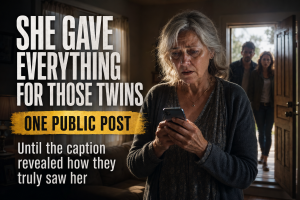
Part 10
Six months after the post that changed everything, the shape of our lives had settled into something I could finally recognize as sustainable.
Noah and Lily were walking with more confidence, talking in short clear sentences, and still running to me when I came through the door. The difference was that my arrivals were chosen. Two afternoons a month, sometimes an extra visit when I offered, occasionally an overnight when it fit my own plans. The old constant availability was gone. In its place was a steadier presence that no longer cost me myself.
Mark and Lauren had kept the counseling appointments. They still had hard days. Twins did not become easy simply because the adults around them had grown more intentional. But the panic that once sent them reaching for me as the automatic solution had quieted. They had built a small network of help—neighbors, a part-time sitter, Lauren’s mother when she visited. The load was shared. My role had become one part of that network rather than the entire foundation.
The public apology remained online. Occasionally someone still left a comment under the original post, but Lauren no longer engaged. She had learned that some mistakes do not require endless explanation. Ownership and changed behavior mattered more.
One Saturday in early spring I kept the twins for a full afternoon so Mark and Lauren could attend a friend’s wedding. When they returned, the house was calm. Noah was building a tower. Lily was paging through a board book. I was reading in the armchair with a cup of tea that was still warm. Lauren looked at the quiet scene and something in her face softened.
“This is what I didn’t know how to make before,” she said. “A version of the day that didn’t require you to disappear into it.”
I smiled. “It took all of us to get here.”
Mark carried the twins’ bags to the car. At the door he paused. “I’m glad you didn’t let us keep taking you for granted. It would have been easier for us if you had. It wouldn’t have been better.”
After they left I stood in the entryway for a moment and let the ordinary peace of the house settle around me. The legal pad with the original list of boundaries still lived in the kitchen drawer. I no longer needed to look at it every day. The boundaries had become part of the way we moved through the world together.
That evening I called Diane. We talked about the garden, about a book we had both finished, about the quiet satisfaction of a life that finally included rest. When we hung up I walked through the rooms of my house and felt the simple rightness of belonging to myself again.
The twins would grow. They would need less of the physical care that had once consumed my days. They would still need a grandmother who showed up with love. I intended to be that grandmother—present, steady, and no longer erased.
I turned off the lights one by one and went to bed. Outside, the night was quiet. Inside, the decision I had made months earlier had become a new way of living. It had cost me the old illusion that love required self-abandonment. What it gave me in return was the chance to keep loving without disappearing.
I slept easily. In the morning I would wake on my own time, make coffee for one, and later, when the scheduled hour arrived, open the door to two small faces that still lit up at the sight of me. Both things could be true at once. Both things, finally, were.
The story was finished. Not because every difficulty had vanished, but because the central conflict had found its resolution in changed patterns, clearer love, and a grandmother who had learned that the most lasting gift she could give her grandchildren was a self that remained whole.