“If you faint again just to get attention, you fail the project.”
That was the last thing I heard Ms. Patricia Collins say before the floor came up to meet me.
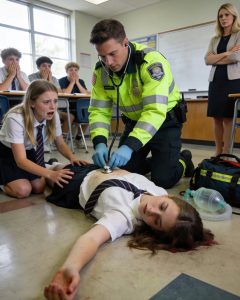
My cheek hit the cold tile of Room 203 at Roosevelt Middle School, a crowded public school on the west side of Chicago where everyone thought they knew everything about everyone else. From the ground, the world looked strange—backpacks dangling from chair legs, scuffed sneakers shifting nervously, desk legs scratched with years of boredom and anger.
I tried to move.
To speak.
To say, I told you something was wrong.
But my body didn’t answer.
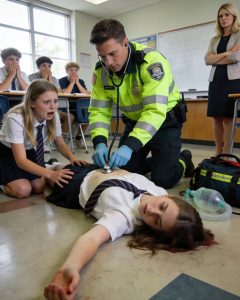
“She’s not responding,” a paramedic said somewhere above me, his voice sharp and controlled.
And from across the room, Ms. Collins replied, just as steady—as if she were correcting homework:
“She’s pretending.”
A few students let out nervous laughs. Others whispered my name—Marissa—like I was a problem they were tired of.
I’d been saying it for weeks.
That I felt dizzy.
That my chest tightened for no reason.
That sometimes my legs just… gave out.
My mom, who worked double shifts at a diner near Jackson Boulevard, thought it was stress. I wanted to believe that too.
But that day, it wasn’t stress.
Ten minutes before I collapsed, I had raised my hand.
“Ms. Collins, can I go to the nurse?”
She didn’t even look up from her tablet.
“Again, Marissa? Funny how you’re always sick when it’s presentation day.”
“I really don’t feel good.”
“Sit down. We’re not doing this today.”
So I sat.
I tried to breathe slowly.
The classroom noise started to fade, like it was sinking underwater. The whiteboard blurred, letters bending and stretching. My chest burned.
And then—
Nothing.
“How long was she down?” the paramedic asked.
No one answered at first.
“Maybe a minute,” Ms. Collins said.
“No,” came a voice from the back.
It was Jenna Morales, the girl who sat behind me.
“It was more like five. We told you she didn’t look okay.”
The silence turned heavy.
The paramedic clipped something onto my finger. A machine started beeping—uneven, wrong.
“Pulse is dropping… then spiking,” another paramedic muttered, opening a red medical bag.
“Any prior conditions?” the first one asked.
“She has a history of exaggerating,” Ms. Collins replied.
Jenna stood up.
“She’s not exaggerating! She asked for help twice.”
Every eye in the room shifted.
For the first time, Ms. Collins looked uncertain.
The paramedic turned to her, his expression hard.
“I’m going to have to report this.”
And something in her face cracked.
“Unconscious minor. Irregular pulse. Possible delay in response from supervising adult,” the paramedic said into his radio.
Delay.
The word hit the room like a dropped weight.
“I didn’t delay anything,” Ms. Collins snapped, stepping closer. “I made a judgment call based on her behavior. She does this to avoid participating.”
I wanted to scream.
No. I don’t.
But my body stayed silent.
“She’s not choosing not to respond,” the second paramedic said, not even looking at her. “Her body can’t.”
Phones started coming out.
One student. Then another.
Not to laugh.
To record.
Jenna moved closer to me, tears in her eyes.
“You told her if she got up again you’d write her up,” she said.
“Jenna, sit down,” Ms. Collins ordered.
But something had shifted.
No one obeyed the same way anymore.
“You also said you were tired of her ‘little performances,’” a boy added from the window.
“That’s not what I said,” Ms. Collins replied—but her voice trembled.
“It is,” someone else said quietly. “We all heard it.”
The paramedic placed an oxygen mask over my face. Cold air rushed in, but my chest still struggled.
“Blood pressure’s dropping,” he said.
That’s when the principal, Mr. Harris, rushed in, tie crooked, face pale.
“What’s going on?”
“Your student needs immediate transport,” the paramedic said. “We also need parent contact information—now.”
Mr. Harris turned sharply to Ms. Collins.
“Why wasn’t I notified earlier?”
She opened her mouth.
Nothing came out.
“I thought it was another attention episode.”
Jenna’s voice cut through the room:
“It wasn’t attention. It was her heart.”
That word reached me through the fog.
Heart.
As they lifted me onto the stretcher, I passed Ms. Collins’ desk. Her bag sat open, papers spilling out.
There was a folded sheet with my name on it.
Jenna saw it.
Grabbed it.
“That’s mine!” Ms. Collins snapped.
But Jenna had already opened it.
Her hands shook.
“It’s a notice… for Marissa’s mom,” she said.
Mr. Harris took it and read silently.
His jaw tightened.
“It says Marissa reported frequent dizziness and chest pain.”
Ms. Collins went pale.
“I was going to send it.”
“Two weeks ago?” he asked.
No one breathed.
As they wheeled me out, I heard Jenna’s voice one last time:
“You knew she was sick.”
And for the first time—
Ms. Collins didn’t deny it.
I woke up two days later at Mercy General Hospital.
My mom was asleep in a chair beside me, still in her work uniform, her apron wrinkled and stained. When I moved, she jolted awake.
“Baby…” she whispered, her voice breaking.
A doctor stepped in, calm but serious.
“You had a significant cardiac episode,” he said. “This wasn’t a simple faint. There were warning signs for weeks.”
My mom covered her mouth.
“I thought it was stress… school pressure…”
“The symptoms weren’t addressed in time,” he said gently. “The delay increased the risk.”
Delay.
That word again.
Later, I learned everything.
Jenna had turned over the videos. You could hear Ms. Collins clearly saying, “She’s pretending.” Several students confirmed I had asked for help. And the notice—the one meant for my mom—had never been sent.
Ms. Collins had kept it.
Because she believed I was lying.
The school tried to keep things quiet.
But quiet doesn’t last when a mother almost loses her child.
My mom walked into the principal’s office still smelling like coffee and grease, holding a folder full of medical reports.
“No one told me,” she said, her voice shaking with fury. “My daughter could have died in that classroom while you decided whether to believe her.”
Ms. Collins stared at the floor.
“I made a mistake.”
My mom cut her off.
“A mistake is forgetting homework. You ignored a child asking for help.”
Ms. Collins was suspended.
Then removed.
An investigation followed.
It didn’t give me back those minutes on the floor—but it made sure they couldn’t be erased.
When I returned to school, everything felt different.
Not pity.
Awareness.
Jenna hugged me so tight I almost cried.
“I’m sorry I didn’t speak up sooner,” she said.
“You did when it mattered,” I told her.
We had a new teacher.
On the first day, a boy raised his hand.
“My head hurts.”
No one laughed.
No one rolled their eyes.
The teacher set down her marker immediately.
“Go to the nurse,” she said. “Your health comes first.”
That’s when I understood something that hurt—but also healed:
Sometimes, not everyone believes you at first.
But it only takes one person brave enough to tell the truth when everyone else stays quiet.
Because cruelty can become habit.
But one voice—
can save a life.