
Part 1: The Secret Grandma Told Her to Keep
My seven-year-old daughter, Emma, begged me not to leave for my business trip to Boston. At first, I assumed she was simply upset about being separated from me for three days, but then she glanced nervously toward the hallway and lowered her voice.
“Daddy, when you leave, Grandma takes me somewhere.”
I set down my coffee and crouched beside her chair. Emma was normally unstoppable at breakfast, talking about school, friends, imaginary creatures, and her stuffed elephant, Mr. Noodle, but that morning she had barely touched her scrambled eggs.
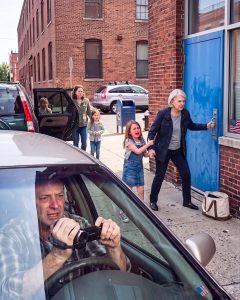
“Where does Grandma take you?”
“I don’t know what it’s called. It’s a big house with a blue door.”
Then she told me the part that changed everything.
“Grandma says not to tell you or Mommy. She says it’s our special secret.”
I had spent twelve years working as a documentary filmmaker, often investigating stories people wanted hidden. That experience had taught me to pay attention when frightened people struggled to explain something they didn’t fully understand, and the fear on Emma’s face told me this wasn’t an innocent outing.
“What happens at the house?”
Her eyes filled with tears.
“There are other kids sometimes.”
“And grown-ups?”
She nodded.
Emma explained that the adults took pictures, made the children change clothes, instructed them how to stand, and became angry when they didn’t smile correctly. Before she could say much more, she began crying.
I pulled her into my arms.
She was seven years old. Her hair still smelled like strawberry shampoo, one sock was sliding off her foot, and she still believed Mr. Noodle needed a blanket at night.
Yet someone had taught her to keep a secret that terrified her.
“You did exactly the right thing by telling me.”
“Grandma said if I tell, something bad will happen to you and Mommy.”
I kept my voice calm even as anger settled through me.
“Nothing bad is going to happen to us, and nothing bad is going to happen to you.”
Then I told her I wasn’t going to Boston.
“But Grandma will know.”
“No. Grandma won’t know anything until it’s too late.”
After settling Emma in the living room, I canceled my conference appearance and called my wife, Helen, asking her to come home immediately without telling her mother. Thirty minutes later, Helen arrived, and I explained everything Emma had told me.
At first, she struggled to believe it. Agnes was her mother, a recently widowed woman who had moved into the guest house behind our property six months earlier and appeared to adore Emma.
Then I showed Helen drawings Emma’s school counselor had sent us weeks before. We had assumed her recent anxiety came from family changes, but now the pictures looked very different.
One showed a blue door.
Another contained stick figures and something resembling a camera.
I had also recorded Emma’s account that morning. When Helen listened to our daughter’s frightened voice, she began crying.
“We should go to the police.”
“Yes. But I want to know where Agnes is taking her.”
Helen immediately understood what I was considering.
The next morning, we would pretend everything was normal. Helen would drive me to the airport while Agnes watched me leave, then I would secretly return and park nearby.
If Agnes came for Emma, I would follow her while contacting Detective Dennis Hatch, someone I trusted from a previous investigation.
Helen stared at me.
“This isn’t one of your documentaries.”
“No,” I said. “This is our daughter.”
The following morning, Agnes stood at her guest house window and smiled as I loaded my suitcase into Helen’s car.
She believed I was leaving town. And that was exactly what I needed her to believe.
Part 2: I Followed Her to the Blue Door
At 6:30 the next morning, I loaded my suitcase into Helen’s car while Agnes watched from the guest house window. Emma stood on the porch holding Mr. Noodle, and when I hugged her goodbye, she quietly asked whether I was really staying.
“I’m really staying.”
Helen drove me to the airport as planned, but I never boarded the flight. After she left, I took a rideshare back to our neighborhood and positioned myself several blocks from the house with a clear view of the driveway.
By 8:43, my long-lens camera was recording.
At exactly nine, Agnes entered our house using her key. Four minutes later, she emerged holding Emma’s hand.
My daughter was wearing a yellow dress I had never seen before.
Agnes helped her into the car and drove away. I waited long enough to avoid attracting attention, then followed several vehicles behind while recording their route and location.
She drove through familiar neighborhoods before turning toward the eastern side of the city, where warehouses and neglected storefronts replaced schools and suburban homes. At 9:23, her car slowed beside a two-story house surrounded by overgrown hedges.
The front door was blue.
I parked down the street and watched Agnes guide Emma along the walkway. The door opened before she could knock, and a gray-haired man in an expensive suit greeted her as though their arrival had been expected.
I photographed his face, the house number, and Agnes entering with Emma.
Then I called Detective Dennis Hatch.
“I need you at an address right now. I believe my daughter has been taken into an organized child exploitation operation.”
His voice immediately changed.
“Send me the address. Do not go inside.”
While police units moved toward us, I continued documenting the property from outside. Three additional adults arrived over the next fifteen minutes, and each appeared to have independent access to the house.
Whatever was happening there was organized.
From a position near the side of the property, I could see through a partially obscured basement window. Inside was a brightly lit room containing professional photography equipment, backdrops, several adults, and multiple children, including Emma.
I saw enough to understand that her description had been true.
The children were being directed and photographed in circumstances that clearly required immediate intervention.
For one terrifying moment, every instinct in me wanted to run inside myself. Then I heard approaching sirens.
The adults inside heard them too.
Panic erupted.