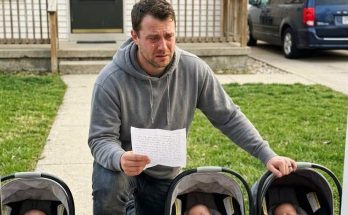
Daniel returned the first three unopened.
The fourth was addressed directly to Lily, so he allowed her to decide.
Lily read it at the kitchen table.
Patricia wrote that she had always loved her.
She said families should forgive mistakes.
She described the pain of being excluded and complained that strangers had treated her cruelly online.
She never mentioned Lily’s fear before surgery.
She never asked about her recovery.
She never wrote, “I was wrong.”
Lily folded the letter and returned it to the envelope.
“What do you want to do with it?” Daniel asked.
She considered the question.
“Keep it.”
“Why?”
“So if I ever start feeling guilty, I can read it again.”
Daniel placed the envelope inside a drawer.
Six months after the disaster had been prevented, Lily returned to Westbridge High for a ceremony marking the reopening of the gym.
The damaged gas line had been replaced, and the school had undergone extensive safety inspections.
Lily could walk without help, although she still moved carefully.
The eleven children stood behind her on the basketball court.
Owen held her hand.
The principal invited Lily to speak.
She approached the microphone and looked across the crowded gymnasium.
Daniel sat in the front row.
Senator Chase sat beside him.
Marcus Bell, Elena Ruiz, teachers, firefighters, nurses, and surgeons filled the seats around them.
Patricia and Scott had not been invited.
Lily unfolded a small sheet of paper.
“People keep calling me fearless,” she began. “But I was afraid the entire time.”
The gym became silent.
“I was afraid when I smelled gas. I was afraid when I pulled the alarm. I was afraid when I heard Owen crying. I was afraid when I woke up in the hospital.”
She looked toward Daniel.
“Being brave did not mean I stopped being afraid. It meant there was something more important than my fear.”
Daniel lowered his head, fighting tears.
Lily continued.
“I also learned that people reveal themselves when they think your pain is private. Some people care only after the world tells them they should. Other people show up before cameras arrive, before anyone praises them, and before they know how the story will end.”
She never named Patricia or Scott.
There was no need.
“When I woke up, I thought the worst thing was discovering who did not care. I was wrong. The most important thing was discovering who did.”
She turned toward the eleven children.
Then she looked at her father.
The audience rose before she finished.
Daniel stood with them, but he could not clap immediately.
He was overwhelmed by the sight of his daughter standing beneath the gymnasium lights, alive and steady.
Later that evening, they returned home and ordered pizza.
No reporters waited outside.
No cameras followed them.
Lily changed into sweatpants and complained that the ceremony had lasted too long.
Daniel placed her medal on a shelf.
His phone vibrated.
A message from an unfamiliar number appeared.
It was Patricia.
“Family should not treat family this way,” she wrote.
Daniel showed Lily.
She read the message, then looked at him.
“Are you going to answer?”
Daniel remembered the hospital photograph.
He remembered typing, “It’s okay,” when nothing about that night had been okay.
He deleted the message.
“No,” he said. “I already answered.”
Then he blocked the number and placed his phone face down.
Lily opened the pizza box.
Outside, rain touched the windows softly.
Inside, the house remained warm, quiet, and free of ringing phones.
For the first time, their family was smaller.
For the first time, it was also whole.