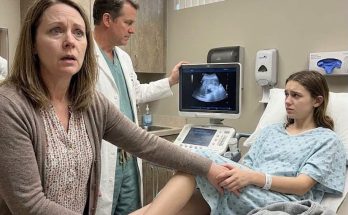
My 10-year-old daughter suddenly collapsed at school, and I rushed her to the hospital alone.
Then a pale nurse ran toward me and said, “Call your husband right now.”
When he arrived and the doctors told us the truth, neither of us could speak.
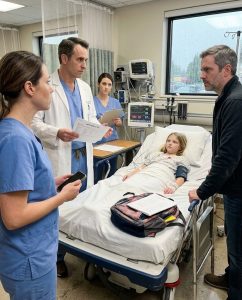
Spring had just reached our quiet Seattle suburb, although the morning still felt more like winter.
Rain tapped against the kitchen windows before sunrise, the coffee maker hissed on the counter, and the first cherry blossoms were beginning to open along our street.
From the outside, our life looked ordinary.
We had a house with a narrow driveway, two demanding jobs, a marriage that had lasted more than a decade, and one child who was supposed to be safe.
Emma was ten years old.
She was curious, kind, loud when she laughed, and constantly worried that she had forgotten something important.
She checked her backpack three times before school trips and asked me to reread every permission slip, even after I had already signed it.
That morning, I packed her lunch while she sat at the kitchen table staring at a math worksheet.
The paper was covered with careful pencil marks, several erased answers, and one problem she had circled twice.
I fixed the loose strap on her backpack and reminded her to button her uniform shirt properly before leaving the house.
She hurried down the stairs with one side still open and her hair only half brushed.
“Mom,” she asked, “what if I forget everything during my math test?”
I brushed a curl away from her face.
“You studied,” I told her. “You’ll do great.”
She smiled, but the smile was smaller than usual.
I noticed it.
I also noticed the pale skin beneath her eyes and the way she pushed most of her breakfast around the plate instead of eating it.
For several weeks, Emma had been eating less.
She complained about headaches, came home exhausted, and sometimes fell asleep on the couch before dinner.
Once, she said the hallway at school had looked blurry for a few seconds.
Another evening, she stood up from the kitchen table and grabbed the back of her chair because she felt dizzy.
Each time, I gave the symptom a harmless name.
Stress.
Growing pains.
Too much homework.
Not enough sleep.
I told myself that ten-year-olds went through strange phases and that the gray Seattle weather could make anyone tired.
The explanations sounded reasonable when I said them quickly.
I was a nurse, which should have made me more careful.
I knew what persistent fatigue, headaches, appetite changes, and dizziness could mean.
I had stood beside hospital beds while frightened parents described those exact symptoms, and I had watched doctors order tests because small details sometimes formed a dangerous pattern.
But medical knowledge feels different when the patient is your child.
Fear can make even trained people bargain for the simplest answer.
I did not want Emma to be sick, so I kept accepting explanations that allowed me to believe she was fine.
Michael had already left for work by the time she came downstairs.
His early meetings had become routine, along with the late nights and the phone calls he stepped outside to take.
Sometimes he answered messages at dinner with his phone tilted away from me.
Sometimes he said he was dealing with a difficult client and needed quiet.
I had stopped asking questions I was afraid to hear answered.
That morning, I watched Emma climb into the family SUV and pull her backpack onto her lap.
She gave me a quick wave through the window before Michael backed out of the driveway.
For one second, she looked as if she wanted to say something else.
Then the car turned onto our street and disappeared behind the rain.
I carried that image with me to work without knowing why.
My hospital shift began like dozens of others.
There were medication checks, chart updates, hurried conversations in the hallway, and families asking questions no one could answer quickly enough.
I moved from room to room with a paper coffee cup cooling beside the nurses’ station.
At 2:17 p.m., my phone rang.
The number belonged to Emma’s school.
I answered with one hand while scanning a patient chart with the other.
“Mrs. Johnson?” a woman asked.
“Yes.”
“This is Emma’s school. Your daughter collapsed in class.”
Everything after that became noise.
My chair scraped backward.
Someone called my name as I crossed the hallway.
My keys shook so badly that I dropped them once beside the elevator and had to crouch to pick them up.
I do not remember explaining where I was going.
I only remember the words collapsed in class repeating in my head.
The drive to the school could not have taken long, but every traffic light felt personal.
Cars moved too slowly.
Pedestrians stepped into crosswalks.
Rain blurred the windshield faster than the wipers could clear it.
I kept seeing Emma at the kitchen table, her pencil resting beside the circled math problem.
When I reached the school, the front office doors were already open.
A staff member led me down the hallway toward the nurse’s office.
Emma was lying on a narrow cot with a folded blanket beneath her head.
Her face was pale, and she could barely keep her eyes open.
Her fingers felt cold when I touched them.
Her backpack lay open on the floor beside the cot, with one math worksheet sticking halfway out.
“Mom,” she whispered.
That single word nearly broke me.
I knelt beside her and asked what hurt, but her answers came slowly.
Her head hurt.
Her stomach felt strange.
She was tired.
She wanted to go home.
I checked her breathing, her pulse, and the response of her pupils with the instincts I used every day at work.
The numbers and signs did not calm me.
They only confirmed that something was wrong.
The school nurse said Emma had been sitting at her desk when she suddenly slumped sideways.
Her teacher caught her before she hit the floor.
There had been no fall, no playground accident, and no obvious injury.
I lifted Emma carefully and carried her out.
She was ten, too old to be carried like a toddler, but she felt frighteningly light in my arms.
Her head rested against my shoulder while the school hallway stretched in front of us.
Outside, the rain had grown heavier.
I secured her in the passenger seat and drove toward the emergency department.
Every red light felt like an insult.