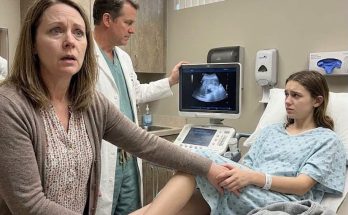
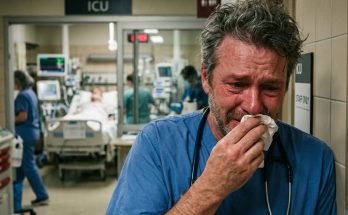
The entire city seemed determined to stand between me and my child.
Emma closed her eyes during the drive.
I kept speaking to her so she would answer me.
I asked about her teacher, her test, the lunch I had packed, and anything else that might keep her voice in the car.
Her replies became shorter.
By the time we arrived, I was leaning across the console at every stop, touching her wrist to reassure myself that I could still feel her pulse.
The emergency team moved quickly.
A blood-pressure cuff tightened around her arm.
Monitor leads crossed her chest.
One nurse checked her pupils while another drew blood.
A third asked when Emma had last eaten, whether she had taken any medication, whether she had allergies, and whether she might have swallowed something accidentally.
I answered, lost my place, and answered again.
For years, I had stood beside frightened families and told them to breathe.
Now I could barely remember how.
Emma looked impossibly small against the hospital sheets.
The white wristband around her arm seemed too large, sliding slightly whenever she moved her hand.
I tried to keep my expression steady because she was watching me.
“Am I in trouble?” she asked.
“No, sweetheart.”
“Did I fail my test?”
“The test doesn’t matter.”
Her eyes drifted closed again.
The monitor continued beeping with a cruel, steady rhythm.
I stood beside the bed and replayed the past few weeks.
The headaches.
The skipped meals.
The exhaustion.
The dizziness.
I wondered how many warning signs I had dismissed and whether my need for an ordinary explanation had cost us precious time.
Then a nurse rushed toward me from the hallway.
She was pale, tight around the mouth, and moving too quickly for anything routine.
“Ma’am,” she said, “call your husband right now. He needs to get here immediately.”
My stomach dropped.
“Why? What’s going on?”
“There’s no time to explain. Please—just call him.”
The way she said it made my hands go numb.
I pulled out my phone and nearly dropped it.
Michael did not answer the first call.
He did not answer the second.
On the fourth ring of my next attempt, he finally picked up.
“What is it?” he asked.
“It’s Emma.”
The words caught in my throat.
“She collapsed at school. We’re at the hospital. Come now.”
There was a pause.
Not a long one, but long enough for me to notice.
Then he said he was on his way.
While we waited, rain streaked the window beside Emma’s bed.
A doctor came in, examined her, reviewed the monitor, and left again without offering the reassurance I wanted.
I knew that silence.
It was the silence medical professionals used when they had information but needed confirmation before saying it aloud.
I tried to ask one of the nurses what they had found.
She told me the doctor would speak to both parents.
Both parents.
That phrase lodged in my chest.
Why did Michael need to be present before they explained what was happening inside our daughter’s body?
Emma stirred and asked for water.
The nurse allowed only a small amount.
I held the cup while Emma took two careful sips.
Her fingers trembled against mine.
“Is Dad coming?” she asked.
“Yes.”
She seemed relieved, but I was suddenly unsure whether I felt the same way.
Michael arrived breathless and gray-faced.
His coat was damp from the rain, and his hair was flattened at the temples.
He came through the doors quickly, but when he saw Emma, he stopped.
He looked at her first.
Then he looked at the nurses.
The expression on his face was not only fear.
It was as though he were trying to determine how much they already knew.
I told myself I was imagining it.
People behaved strangely when their children were sick.
Shock could look like guilt.
Fear could look like calculation.
A doctor followed him into the room carrying the first test results.
He closed the door behind him and stood near the foot of Emma’s bed.
“There are abnormal substances in your daughter’s system,” he said carefully.
For a second, I thought I had misunderstood him.
“What kind of substances?” I asked.
He explained that they were still confirming the details and assessing what treatment Emma needed.
His words were controlled, but his face was not casual.
Michael gripped the back of a chair.