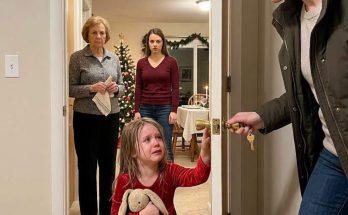
Barely.
But enough.
“I came home a few times.”
“A few?”
“I work ten minutes away.”
“That isn’t what I asked.”
He looked toward the house.
Then back at me.
“You’ve been talking to my mother.”
“I watched you.”
That stopped him.
I told him the recordings had saved automatically.
For the first time since I got out of the car, he looked at the camera differently.
Until then, he had been holding it like something he had successfully removed.
Now he understood that pulling it from the wall had not erased what it had already seen.
He lowered his hand.
“I never hurt her.”
I believed he understood how carefully he had chosen that sentence.
“You scared her.”
“She cries.”
“She freezes when men come near her.”
His eyes flicked away.
Dr. Lawson had noticed it in minutes.
I had lived beside it for two weeks and kept convincing myself there had to be a harmless explanation.
That realization hurt in a way I could not easily describe.
Brandon began telling me about articles he had read, about routines, about babies becoming dependent if adults reacted too quickly to every sound.
I stopped him.
“This isn’t about an article.”
“It is about parenting.”
“No. It’s about you knowing she was frightened and lying to me about it.”
He opened his mouth.
I kept going.
“You knew why she screamed when you entered the room.”
“She has to bond with me somehow.”
“By being afraid of you?”
“That’s not what I said.”
“It’s what happened.”
He stepped closer.
I stepped back.
Not because I believed he would hit me.
Because suddenly I did not want him deciding the physical distance between us.
He noticed.
His expression hardened.
“You’re acting like I’m dangerous.”
“I’m acting like I learned today that I don’t know what happens in my own house when I’m at work.”
That landed.
For several seconds neither of us spoke.
Then Brandon held out the camera.
“Here. Take it. Put ten more up if you want.”
I did not reach for it.
He moved closer and pushed it toward my hand.
This time I took it.
The little plastic camera felt absurdly light for something that had changed the way I saw my marriage.
I put it in my purse.
Then I went inside and packed a bag for Hannah.
Brandon followed me from room to room.
He kept talking.
He said we needed to calm down.
He said Florence had always undermined him.
He said Dr. Lawson had observed Hannah for only a few minutes.
He said every parent made mistakes.
That last sentence was the first one I agreed with.
Every parent does make mistakes.
But mistakes become something else when you recognize the harm, hide the behavior, and keep doing it while telling everyone else they are imagining the result.
I packed diapers, bottles, Hannah’s sleep sack, two onesies, wipes, formula, and the soft blanket she liked tucked around her legs.
Ordinary things.
That helped me think.
Brandon stood in the nursery doorway.
“You’re taking her away from me.”
“I’m taking her somewhere she feels safe tonight.”
“Where?”
“I’m not discussing that right now.”
His eyes widened.
I had never spoken to him that way before.
Neither of us missed it.
He tried another approach.
“I love her.”
I looked at him.
“I know you believe that.”
And I did.
That was part of what made everything so difficult.
Brandon did not see himself as cruel.
He saw himself as correcting a problem.
He believed Hannah’s crying challenged him, and once he accepted that idea, every attempt to comfort her became interference.
His intention did not erase what her body was telling us.
Before leaving, I called Dr. Lawson’s office.
I did not ask him to decide my marriage.
I told the staff what I had observed and asked what I should do for Hannah.
They told me to bring her back for an evaluation if I had concerns about her well-being or behavior.
So I did.
Florence met me there with Hannah.
When I walked into the room, my daughter turned toward my voice.
Her arms moved.
Her face softened.
I picked her up and pressed my cheek against her hair.
For the first time all day, I cried.
Florence stood a few feet away, twisting her car keys between her fingers.
“I am sorry,” she said.
I believed her.
I was not ready to forgive her.
Both things could be true.
Dr. Lawson did not make dramatic declarations.
He examined Hannah, asked questions, listened carefully, and documented what I told him.
What mattered most to me was that he treated her reactions as information rather than inconvenience.
He reminded me that babies communicate through behavior long before they have words.
I kept thinking about that on the drive away.