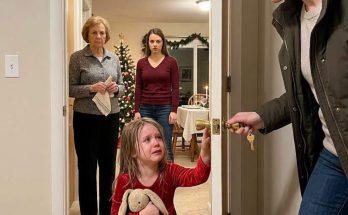
Hannah had been communicating.
Florence had seen it.
I had seen it.
Even Brandon had seen it.
The difference was what each of us had decided her fear meant.
That night Hannah slept beside me in a portable bassinet while I sat awake on the edge of the bed reviewing the saved footage.
There was no dramatic hidden recording of some monstrous act.
What I saw was quieter and, in its own way, more disturbing.
A father repeatedly approaching a frightened infant as though her distress were defiance.
A grandmother stepping between them, but then staying silent when the mother came home.
And me, absent from the frame because I was at work, trusting the people I loved to tell me what happened when I was not there.
The next morning Brandon called.
His anger was gone.
He sounded exhausted.
He admitted he had been coming home specifically to spend time with Hannah because he felt rejected by her.
He hated that she settled for Florence and me but screamed for him.
Instead of slowing down, he had taken it personally.
The more she cried, the more determined he became not to let her crying decide when he handed her back.
“I thought if I kept giving her to your mom every time she screamed, she’d never get used to me,” he said.
It was the first truthful explanation he had given me.
It did not repair anything.
But truth finally gave me something solid to respond to.
I told him he would not be alone with Hannah while we figured out what came next.
He argued at first.
Then I reminded him that the cameras had not created Hannah’s fear.
They had only allowed me to see the part everyone else already knew existed.
He became quiet.
Weeks later, the hallway camera was still in my purse.
I never put it back on the wall.
I did not need it there anymore.
The routines in our family had changed.
So had the boundaries.
Florence no longer kept uncomfortable information from me because she thought staying close was the same as keeping Hannah safe.
Brandon had to rebuild contact with his daughter slowly, around her comfort instead of his pride, and only under conditions I trusted.
Nothing became perfect overnight.
Some days Hannah still stiffened when she heard his voice.
Other days she watched him cautiously without crying.
Those small changes mattered more to me than any apology.
One afternoon, I found the camera while looking through my purse for a receipt.
The broken adhesive strip was still stuck underneath it.
For a moment I remembered Brandon standing in the driveway, holding it out like the camera itself had betrayed him.
But the camera had never taken sides.
Neither had Hannah.
She had simply reacted to what frightened her.
The adults were the ones who had turned that reaction into arguments, excuses, secrets, and competing explanations.
I placed the camera in a kitchen drawer and closed it.
Then I went into the living room where Hannah was lying on her play mat, kicking both legs and staring up at Florence.
Florence made a ridiculous sound with her lips.
Hannah smiled.
A few seconds later, I heard Brandon arrive for the visit we had agreed on.
He did not walk straight toward her this time.
He stopped across the room.
He sat down on the floor.
He waited.
Hannah noticed him.
Her legs stopped moving for a second.
Everyone saw it.
No one pretended otherwise.
Brandon stayed where he was.
After a while, Hannah turned back toward her toy.
It was not forgiveness.
It was not a miracle.
It was simply the first time I watched my husband understand that earning someone’s trust sometimes begins with respecting the distance they need.