My sister laughed at my Purple Heart in a room full of soldiers.
She did not whisper it.
She did not say it under her breath and hope the sound got swallowed by the chairs, the uniforms, the coughs, and the soft movement of people waiting for the ceremony to begin.
She leaned toward two friends in the row behind me, smiled like she was trading gossip over brunch, and said, “Please. Maeve probably bought that ribbon online.”
The hall went quiet at exactly the wrong second.
That was the part that stayed with me.
Not her cruelty.
Cruelty from Delia was familiar.
It had a shape by then.
It had a smell, too, something expensive and floral, the perfume she wore too heavily whenever she wanted a room to notice her before she had earned it.
What stayed with me was the silence.
The way the fluorescent lights buzzed overhead.
The way the pressed wool collar of my Army service uniform scratched the side of my neck.
The way one folding chair dragged faintly across the polished floor somewhere near the back, then stopped as if even the chair had realized it had interrupted something holy.
My name is Major Maeve Lassiter.
I was forty years old that morning.
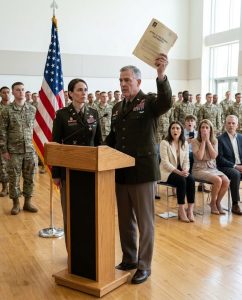
I was standing three rows from Major General Steven Cardwell, a two-star general who had come to pin a Bronze Star with Valor on my chest.
My Purple Heart was already there.
That was the ribbon my sister had mocked.
My sister Delia sat behind me in a cream blazer, sunglasses pushed up into her blonde hair, looking less like a family member at a military ceremony and more like a woman waiting for a valet to bring her car around.
Her husband Hayden sat beside her, legs spread, phone glowing in one hand.
He had been scrolling through contractor invoices since they arrived.
He looked up only when Delia’s joke landed.
Then he snorted.
“Let her have her little moment,” he muttered. “Everybody needs a hobby.”
I heard him clearly.
So did the row behind him.
So did three soldiers standing along the side wall.
So did my mother, who made a tiny sound and then swallowed it so quickly I almost imagined it.
My father did not make a sound at all.
He sat with his hands on his knees, staring forward with the same expression he had worn through my entire childhood.
Hard.
Blank.
Proud of nothing he could not control.
There was a time when that would have broken me.
At twenty, I would have turned around.
I would have explained what the Purple Heart meant.
I would have laughed too loudly, maybe, to make Delia comfortable after she humiliated me.
At thirty, I would have told myself she did not mean it.
I would have told myself Hayden was just arrogant because money had made him lazy.
At thirty-five, I would have shrunk the story down until it fit inside my family’s preferred version of me.
Paperwork.
Desk job.
The sister who did not have a husband, did not have children, did not have a house with a porch swing and seasonal wreaths, and therefore must have built her life out of leftovers.
But at forty, I did not turn around.
I sat still.
Because the ribbon she laughed at was not decoration.
It was not a souvenir.
It was not something I bought from a surplus shop to make myself feel important.
It was blood, fire, metal, smoke, and two men who made it home to their children because I made a decision on a road in Afghanistan that should have killed me.
Delia had never asked me about it.
Not once.
Not at Thanksgiving when the ribbon was on my chest and she told one of her friends I did logistics.
Not at my mother’s birthday dinner when she introduced me as “the sister who does paperwork for the Army.”
Not at our cousin’s wedding when a drunk groomsman asked if I was basically a security guard with better shoes.
Delia had looked at that ribbon for thirteen years and decided it meant nothing.
That was her special talent.
She could look straight at me and still miss the person standing there.
When we were girls, she did the same thing in smaller ways.
If I got an A, she said the teacher liked quiet kids.
If I won a track meet, she said nobody serious had shown up.
If I saved money from working at the grocery store, she said it was easy for me because I never had plans.
The world gave Delia attention easily.
She learned to treat it like oxygen.
I learned to live on less.
Our father helped teach that lesson.
He praised Delia with his whole face.
He praised me, when he did it at all, by not criticizing.
For years, I mistook that for strength.
Then I joined the Army and learned that silence can be discipline.
It can also be cowardice dressed in clean clothes.
General Cardwell stepped to the microphone.
He had gray at the temples and a calm face.
His voice, when it came through the speakers, sounded like gravel dragged over steel.
He had commanded the sector the night my convoy was hit.
I had not told my family that.
I had not told them much of anything.
There are people you brief because they need the facts.
There are people you stop briefing because they only want ammunition.
My family had spent years turning my life into something small enough to dismiss.
I had stopped handing them pieces of it.
The general unfolded the citation.
The paper cracked softly in his hands.
Behind me, Delia whispered something else.
This time I caught only two words.
“Drama queen.”
For one ugly second, something hot moved behind my ribs.
I pictured turning around.
I pictured saying all the things I had swallowed since childhood.
I pictured telling Hayden that men who confuse money with courage usually do so because money is the only shield they have ever held.
Then I breathed in.
I kept my eyes forward.
Rage can feel like power when it first enters the body.
Most of the time, it is just a door you do not have to open.
General Cardwell began to read.
“For extraordinary heroism and gallantry in action on the night of October nineteenth, two thousand twelve…”
The room changed.
It was not dramatic.
No one gasped.
No one shouted.
But Delia stopped moving behind me.
Hayden stopped scrolling.
Even my father’s stillness seemed to sharpen.
“Then Captain Maeve Lassiter, after her vehicle was struck by an improvised explosive device and engaged by small-arms fire, refused evacuation despite sustaining multiple wounds…”
My mother made a small sound.
This time she did not swallow it fast enough.
The general continued.
“Captain Lassiter returned twice to a burning vehicle to extract two trapped soldiers, organized a casualty collection point under enemy fire, and maintained command until all personnel had been moved to safety.”
The words did not feel like mine.
They felt like something sealed in a file.
A convoy contact report.
A medical evacuation record.
An award citation dated and signed by people who had no reason to flatter me.
October 19, 2012.
Initial strike.
Small-arms contact.
Casualty collection point established under fire.
Personnel accounted for.
The Army had documented what my family had spent thirteen years refusing to ask.
Proof has a way of arriving with paperwork when love refuses to arrive on its own.
Behind me, a chair scraped.
Then another.
Boots shifted on the floor.
I turned just enough to see Sergeant First Class Wyatt Coburn rise to his feet.
He had been twenty-two the night I dragged him through broken glass and burning canvas.
He was thirty-six now.
He had two kids.
He had a mortgage.
He had gray beginning at the edges of his hair.
I remembered his face younger and blackened with smoke.
I remembered his voice breaking when he called for a wife I had never met.
I remembered the heat so close it felt like someone had laid a hand against my skin and refused to lift it.
Wyatt stood at attention.
“She came back for me, sir,” he said.
His voice was not loud.
It did not need to be.
“She came back twice.”
Another soldier stood.
Then another.
Then the entire formation rose.
One by one, every uniform in the hall stood for me.
Not for the medal.
Not for the ceremony.
For the truth.
The sound of that many people standing together is hard to describe if you have never heard it.
It is fabric moving.
Boots finding the floor.
Breath tightening in disciplined chests.
It is not applause.
It is heavier than applause.
Applause asks the room to look at the performer.
This asked the room to recognize the witness.
My sister remained seated.
I saw her from the corner of my eye.
Her cream blazer suddenly looked too bright.
Her hands were folded in her lap, but the fingers were pressed so hard together that the knuckles had gone pale.
Her mouth was slightly open.
For the first time in my life, Delia Lassiter had nothing ready to say.
I wanted to enjoy that.
I did not.
Humiliation had not made me hungry for revenge.