It had made me tired.
I walked forward because the ceremony required it.
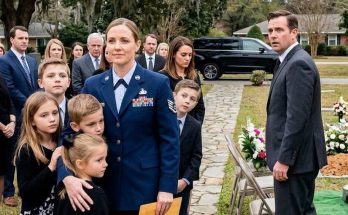
General Cardwell pinned the Bronze Star with Valor on my uniform.
The metal was colder than I expected.
When he shook my hand, he held it longer than protocol required.
Then he leaned close.
“I scrubbed that convoy,” he said quietly, just for me. “Weather was below minimums. I told the net to hold.”
I looked at him.
He nodded once.
“You made the call anyway. You brought my soldiers home. I’ve carried that for fourteen years.”
My mouth opened.
No words came.
That was the thing about recognition when it comes too late.
You think you will know how to receive it.
Then it arrives and finds the room inside you still arranged for disappointment.
General Cardwell squeezed my hand.
“It is the honor of my career to read your citation aloud, Major.”
I had waited my whole life for my family to see me.
Instead, a room full of soldiers stood first.
And it should have been enough.
Most of me knew that it was enough.
But a small, stubborn part of me still wanted to turn around and see my father looking proud.
So I turned.
My mother was crying openly now.
Delia looked frozen.
Hayden held his phone dark in his hand, no longer pretending he had somewhere more important to be.
My father stared forward, but his face had changed.
Not softened exactly.
Cracked.
Like something old inside him had shifted under pressure.
That was when General Cardwell lifted one more folded page from the podium.
“Major Lassiter,” he said, “before your father leaves this room, there is something in the original after-action file he needs to hear.”
Every eye returned to him.
My father looked up.
His eyes moved first, not his head.
Delia whispered, “Dad?”
He did not answer.
General Cardwell opened the second page.
The paper made the same small cracking sound.
“This supplemental witness statement was attached to the convoy file on October twenty-first, two thousand twelve,” he said. “It was signed at the field hospital before Sergeant Coburn was moved stateside.”
Wyatt’s face changed.
He knew the page.
My mother covered her mouth with both hands.
Hayden slid his phone into his pocket, suddenly careful, like any casual movement might count against him.
General Cardwell read the first line.
“Captain Lassiter was not ordered back to the vehicle. She returned after hearing one trapped soldier call for his wife and newborn daughter.”
The air left my father’s chest.
It was not a sob.
It was something worse because he tried to stop it.
Delia looked at him, then at me.
For one second, I think she understood that this was no longer about a ribbon.
It was no longer about a joke.
It was no longer about her need to make me smaller in public so she could feel large beside me.
This was about the daughter our father had spent decades refusing to praise.
General Cardwell lowered the page and looked directly at him.
“Mr. Lassiter,” he said, “your daughter carried men out of fire while wounded, and the first thing one of them asked me to document was that she kept saying, ‘Tell their families they are not alone.’”
My father’s mouth moved.
No sound came out.
Then Wyatt stepped forward.
Not far.
Just enough that the room felt him move.
“Sir,” he said to my father, “I don’t know what she was like as a kid. I don’t know what you saw when you looked at her. But I know what I saw when I thought I was dying.”
My father looked at him.
Wyatt’s voice held steady.
“I saw your daughter come through fire. Twice.”
Nobody moved.
Even Delia did not blink.
My father stood then.
Slowly.
He was not a tall man, but he had always made himself feel tall in a room by making everyone else smaller.
That morning, he looked like a man standing in the wreckage of his own choices.
He turned toward me.
For a moment I thought he would say the kind of thing he always said.
Something practical.
Something stripped of feeling.
Something like, “You did your job.”
Instead, his hands trembled.
I had never seen that before.
“Maeve,” he said.
My name sounded unfamiliar in his mouth.
Not because he had never said it.
Because he had never said it carefully.
He looked down at the medals on my chest, then up at my face.
“I didn’t know.”
The old me would have rushed to comfort him.
The old me would have said, “It’s okay.”
The old me would have given him a clean way out because I had been trained by my family to manage the feelings they created in me.
I did not do that.
I let the silence sit between us.
Then I said, “You didn’t ask.”
His face broke.
Not loudly.
Not theatrically.
But enough.
My mother began crying harder.
Delia stood too quickly, her chair bumping the row behind her.
“Maeve,” she said, and her voice had that thin public sweetness she used when she wanted witnesses to believe she was the reasonable one. “I was joking. You know how I talk.”
I turned to her.
For most of my life, Delia had counted on movement.
She would insult and move on.
Dismiss and move on.
Wound and move on.
This time nobody moved with her.
“I know exactly how you talk,” I said.
Her eyes flicked around the room.
There was no friendly face to land on.
Not in uniform.
Not in the family row.
Not even Hayden, who had developed a sudden fascination with the floor.
General Cardwell did not intervene.
That was its own mercy.
He allowed the truth to finish what the citation had started.
Delia’s voice dropped.
“I didn’t know it was real.”