
PART 2 — THE DOOR THOMAS MILLER NEVER WANTED OPEN
Daniel Harris reached the bedroom door first.
Thomas Miller grabbed his arm.
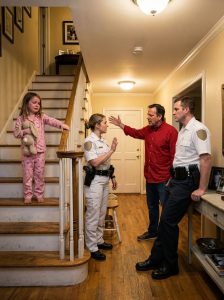
“Officer, you can’t just—”
Daniel spun so quickly Thomas stumbled backward.
“Take your hand off me.”
For one second, the pleasant suburban father vanished.
Thomas’s expression sharpened into something cold and calculating. His eyes flicked toward the staircase, toward the front door, then toward Emily standing frozen beside María.
It was the look of a man measuring exits.
María saw it too.
“Mr. Miller,” she said, lowering her voice, “step away from the child.”
Thomas didn’t.
Emily’s fingers tightened around the stuffed rabbit until her knuckles whitened.
“Daddy,” she whispered.
Thomas looked at her.
Whatever Emily saw in his face made her shrink backward.
That was enough.
María moved between them.
Daniel pushed open the bedroom door.
The room looked ordinary at first.
Too ordinary.
Pink curtains.
A white wooden bed.
Glow-in-the-dark stars scattered across the ceiling.
A bookshelf filled with picture books and school folders.
On the floor beside the bed was a purple backpack decorated with tiny silver butterflies.
Nothing about the room explained the terror in Emily’s voice.
Then Daniel noticed the closet.
The door was slightly open.
Someone was breathing inside.
Daniel drew his weapon.
“Police. Come out slowly with your hands visible.”
Silence.
Then movement.
A man stepped from the closet.
He appeared to be somewhere in his thirties, thin, unshaven, wearing dark jeans and a gray sweatshirt. His hands rose immediately.
“Don’t shoot.”
Daniel’s pulse hammered.
“On your knees.”
The stranger obeyed.
Behind Daniel, Thomas suddenly lunged toward the stairs.
María shouted.
“He’s running!”
Thomas made it three steps before Officer Grant, arriving through the front entrance, intercepted him.
They collided hard against the wall.
Thomas fought with a desperation that instantly destroyed any remaining illusion that this was a misunderstanding.
“Get off me!”
Grant forced him onto the carpet.
Daniel handcuffed the stranger inside Emily’s room while María pulled Emily farther down the hallway.
The little girl was trembling so violently that the rabbit shook in her hands.
María knelt.
“Emily, look at me.”
Emily’s swollen eyes slowly lifted.
“You’re safe with us.”
Emily stared at the gray-sweatshirt man being led from her room.
Then she whispered four words.
“That’s Daddy’s snake.”
María felt something cold move through her chest.
“What does that mean, sweetheart?”
Emily looked toward the staircase.
“Daddy says snakes bite people who tell secrets.”
María didn’t ask anything else.
Her training was clear.
A frightened child should not be repeatedly questioned by patrol officers. Her words mattered too much. Everything from that moment forward needed to be handled carefully by trained investigators.
María simply said, “You did the right thing calling us.”
Emily shook her head.
“No.”
Her voice was barely audible.
“Daddy said police would take me away forever.”
María swallowed.
“Your father was wrong.”
Downstairs, Thomas was still shouting.
“You have no idea what you’re doing! That man is my cousin! He was staying here!”
Daniel appeared at the hallway entrance.
“Your cousin was hiding inside your daughter’s closet?”
Thomas stopped talking.
Daniel descended slowly.
The man in the gray sweatshirt had identified himself as Caleb Ross.
His wallet showed an Indiana driver’s license.
He was not related to Thomas.
Not according to the identification police found.
Grant searched him and recovered two cellphones, more than two thousand dollars in cash, a hotel key card, and a folded sheet containing several addresses.
Daniel took one look at those addresses and felt the investigation change shape.
Maplewood Drive.
Cedar Avenue.
Fulton Street.
North Grand Avenue.
Six addresses in total.
Beside each address was a first name.
Some had times.
Some had dates.
Daniel didn’t know what the list meant.
But he knew enough not to dismiss it.
“Call detectives,” he told Grant.
“And get Crime Scene here.”
Paramedics arrived minutes later.
Emily initially refused to leave María.
“I’m coming with you,” María promised.
Only then did Emily allow a paramedic to examine her.
Thomas twisted against the officer holding him.
“Emily!”
She flinched.
“Baby, tell them this is a mistake!”
María immediately blocked his view.
“Do not speak to her.”
Thomas’s face changed again.
The desperation disappeared.
Something almost like resignation replaced it.
“You think you saved her?”
María stared at him.
Thomas smiled.
“You have no idea what you just opened.”
At 9:46 p.m., Emily Miller was transported to St. John’s Children’s Hospital.
María rode beside her.
Daniel stayed at the house.
By 10:05, detectives had obtained an emergency search authorization.
The quiet home at 1427 Maplewood Drive filled with evidence technicians.
Thomas sat handcuffed in the back of a patrol vehicle.
Caleb Ross sat in another.
Neither man spoke.
Inside the house, Detective Aaron Walsh examined the child’s bedroom.
Walsh had worked crimes against children for fourteen years.
He had learned never to assume the obvious object was the important one.
He started with the room itself.
Nothing was disturbed.
No signs of forced entry.
No damaged window.
Caleb had not broken into the home.
He had been allowed inside.
That mattered.
Then an evidence technician called from downstairs.
“Detective?”
Walsh found her beside a locked cabinet in Thomas’s home office.
The cabinet required a four-digit code.
The technician pointed toward the family photographs on the desk.
“Birthdays?”
Walsh studied them.
One picture showed Emily holding a cake.
Eight candles.
A handwritten date on the frame.
418.
He entered it.
The cabinet clicked open.
Walsh’s expression tightened.
Inside were prepaid phones.
Eleven of them.
Cash wrapped in rubber bands.
Hotel receipts.
A notebook.
And photographs.
But the photographs were not what Walsh expected.
They weren’t photographs of children.
They were photographs of houses.
Front doors.
Driveways.
Backyards.
Windows.
Family vehicles.
Every photograph had handwriting on the back.
WORK 7-3.
MOTHER NIGHT SHIFT.
DOG INSIDE.
CAMERA ABOVE GARAGE.
CHILD HOME 4:15.
Walsh stared at the last note.
This was bigger than one frightened child.
Much bigger.
He opened the notebook.
Names filled the pages.
Initials.
Dates.
Dollar amounts.
Some entries were crossed out.
Beside several names appeared the same symbol.
A small hand-drawn snake.
Walsh photographed every page before touching anything else.
Then Daniel entered.
“We found something upstairs.”
They returned to Emily’s room.
Behind the bookshelf, officers had discovered a square patch where the wall paint did not quite match.
The bookshelf was moved aside.
A small access panel appeared.
Behind it ran wires.
One cable connected to a miniature camera hidden inside a smoke detector.
Daniel stared upward.
“Thomas was recording the room?”
Walsh didn’t answer immediately.
Because the camera wasn’t pointed toward the bed.
It was pointed toward the doorway.
Anyone entering or leaving would be captured.
Walsh followed the cable.
It led through the wall into Thomas’s office.
There, technicians found a digital recorder.
Most files had been deleted.
But deleted did not mean gone.
The recorder was bagged for forensic recovery.
Walsh stood in the hallway afterward, looking toward the child’s empty bedroom.
Something bothered him.
If Thomas had installed the camera, why point it at the doorway instead of the room?
Unless Thomas wasn’t watching Emily.
Unless he was watching who visited.
At the hospital, María sat beside Emily’s bed.
A pediatric specialist and child advocate had taken over the examination process.
María stayed because Emily had asked her to.
The little girl held her rabbit against her chest.
“Is Daddy going to jail?”
María chose her words carefully.
“The detectives are figuring out what happened.”
Emily stared at the ceiling.
“Daddy said he needed money.”
María remained still.
She didn’t ask a leading question.
Emily continued on her own.
“He said bad people were angry with him.”
María’s heartbeat changed.
“What did he tell you about them?”
Emily hesitated.
“That they knew where Mommy was.”
María looked at her sharply.
Emily’s mother, Jennifer Miller, had supposedly died three years earlier in a car accident.
At least that was what the initial police database showed.
“Your mommy?”
Emily nodded.
“Daddy says she’s in heaven.”
A pause.
“But sometimes I hear her.”
María felt every hair on her arms rise.
“Where?”
Emily looked toward her.
“In Daddy’s office.”
Before María could respond, Emily’s eyes widened.
“I’m not supposed to say that.”
“You’re not in trouble.”
“He talks to her on the computer.”
María immediately stepped into the hallway and called Walsh.
He answered on the second ring.
“What is it?”
“Emily just said something important.”
Walsh listened without interrupting.
When María finished, there was silence.
Then Walsh said, “Jennifer Miller’s death record came back clean.”
“You confirmed it?”
“State database. Vehicle crash. October 2023.”
“Could there be another explanation?”
“Maybe.”
María looked through the doorway at Emily.
“But?”
Walsh lowered his voice.
“But the original accident happened outside Terre Haute, Indiana.”
María stopped breathing for a second.
Caleb Ross’s driver’s license was from Indiana.
“Send me everything,” she said.
Back at the house, Walsh returned to Thomas’s office computer.
The machine required a password.
A forensic technician bypassed the login using an evidence recovery system.
Several encrypted folders appeared.
One was labeled TAX.
Another HOME REPAIR.
A third folder was simply called J.
Inside J were hundreds of audio files.
Walsh selected the most recent.
A woman’s voice came through the speakers.
Distorted.
Quiet.
“Thomas, listen to me. You need to stop.”
Thomas answered.
“You think I have a choice?”
“You always have a choice.”
“They know about Emily.”
The woman inhaled sharply.
“If they touch my daughter—”
“They already sent someone.”
“Then call the police.”
Thomas laughed bitterly.
“And tell them what? That three years ago I lied about your death? That I took the money? That I helped them?”
Walsh froze.
The technician beside him looked up.
The recording continued.
The woman said, “I don’t care what happens to you anymore. Get Emily out.”
Thomas’s voice cracked.
“I’m trying.”
“No. You’re trying to save yourself.”
The file ended.
Walsh immediately checked the metadata.
Recorded six days earlier.
Jennifer Miller was alive.
And Thomas had falsified her death.
At 11:38 p.m., Thomas was taken to the Springfield Police Department.
He had stopped yelling.
Now he sat across from Walsh and another detective in Interview Room Three.
His hands rested on the table.
Walsh placed a photograph of Caleb Ross in front of him.
“Who is he?”
Thomas looked away.
“You already know.”
“No. I know his name. I want to know why he was in your daughter’s bedroom.”
Thomas said nothing.
Walsh placed the notebook beside the photograph.
Then the house photographs.
Then the prepaid phones.
Thomas’s face drained.
Walsh watched him carefully.
“You’re afraid.”
Thomas gave a humorless laugh.
“You should be too.”
“Who are you afraid of?”
Thomas leaned backward.
“You think Caleb is the monster?”
Walsh waited.
Thomas looked toward the mirrored glass.
“Caleb is a delivery boy.”
“What does he deliver?”
Thomas closed his eyes.
“Messages.”
“What kind of messages?”
“The kind people listen to.”
Walsh pushed the notebook forward.
“What does the snake mean?”
Thomas didn’t answer.
Walsh tried another direction.
“Jennifer is alive.”
Thomas’s eyes snapped open.
That reaction was enough.
“We recovered the recordings.”
Thomas leaned forward.
“You contacted her?”
“Not yet.”
“Don’t.”
“Why?”
“If they find out you know she’s alive, they’ll move her.”
“Who?”
Thomas rubbed his face.
For the first time that night, he looked less like a calculating father and more like an exhausted man approaching the edge of something he had spent years avoiding.
“I worked construction,” he said.
“Commercial sites. Renovations. Banks. Offices. Expensive houses.”
Walsh waited.
“Sometimes clients paid cash for side jobs. Sometimes they wanted things installed that weren’t on permits.”
“What things?”
“Cameras. Access panels. Hidden storage.”
Walsh’s gaze hardened.
“And eventually?”
“I realized one client wasn’t using me for construction.”
Thomas swallowed.
“He was using me to learn buildings.”
“Names.”
Thomas shook his head.
“You don’t understand.”
“Then explain it.”
Thomas stared directly at him.
“There’s a network. They identify vulnerable families, wealthy families, people with addictions, debts, secrets. They learn schedules. They create leverage.”
Walsh tapped the notebook.
“And you helped them.”
“At first I told myself it was surveillance.”
“At first?”
Thomas looked down.
“When I understood what they were really doing, I tried to leave.”