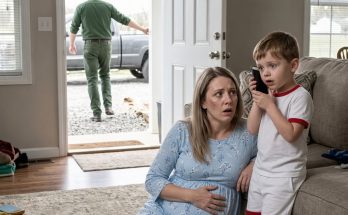
“Yes.”
Emily held the phone with both hands.
“Mom says being scared doesn’t mean you get to make other people scared.”
Thomas began crying.
“She’s right.”
Emily looked toward Jennifer, waiting several feet away.
Then back at Thomas.
“I don’t hate you.”
Thomas looked up.
Hope appeared too quickly.
Emily continued.
“But I’m not ready to forgive you.”
The hope changed.
Not vanished.
Just matured.
Thomas nodded.
“That’s fair.”
Emily placed the phone down.
The visit ended.
Outside, Jennifer took her hand.
“You okay?”
Emily nodded.
“Can we get ice cream?”
Jennifer laughed.
“Yes.”
That was healing too.
Not dramatic.
Not cinematic.
Just ice cream after a hard conversation.
Claire Johnson left dispatch for three months.
When she returned, the entire emergency communications system had been rebuilt with independent audits and multi-factor authentication.
Her brother Aaron remained in custody awaiting sentencing.
Claire visited him sometimes.
Not because she excused what he had done.
Because she had learned that love and accountability could occupy the same room.
Daniel Harris transferred to a state-level investigative unit.
María stayed.
She said Springfield needed officers who remembered what an eight-year-old whisper could uncover.
Walsh accepted a position leading a new public-integrity task force.
Lieutenant Price became its first director.
Safe Harbor Youth Alliance was dissolved.
Then rebuilt under a different name with external oversight and no connection to Eleanor’s financial structures.
Eleanor herself faced charges related to illegal financial concealment.
But she also became one of the prosecution’s most valuable witnesses.
Rebecca testified for nine days.
Her testimony dismantled what remained of Keene’s network.
Hundreds of cases were reviewed.
Some convictions overturned.
Some custody decisions reopened.
Some officials resigned.
Some people discovered that events they had blamed on bad luck had been engineered.
Others learned that not every tragedy had a villain.
That mattered too.
Not everything was connected.
Not every fear was evidence.
Not every coincidence was conspiracy.
Truth required restraint.
A year after Emily’s 911 call, Jennifer and Rebecca stood together outside a small farmhouse north of Springfield.
Emily ran through a field of wildflowers.
Hopper bounced beneath one arm.
The rabbit had been repaired.
New stitching.
Same bent ear.
Rebecca watched her.
“She looks like you.”
Jennifer laughed.
“She looks like herself.”
“That too.”
They stood in silence.
Eleanor approached slowly from behind.
Her legal case remained unresolved.
She wore no expensive suit.
Just jeans and a blue sweater.
Rebecca looked at her.
Their relationship was fragile.
Uneven.
Real.
Eleanor held out a small wooden box.
“What’s that?” Rebecca asked.
“Something I should have given you thirty years ago.”
Inside was a photograph.
Nineteen-year-old Eleanor holding baby Rebecca.
On the back were four words.
I was afraid too.
Rebecca stared at it.
Then shook her head.
“That doesn’t make everything okay.”
“I know.”
“You abandoned me.”
“I know.”
“You lied.”
“Yes.”
“You built systems that became dangerous.”
“Yes.”
Rebecca looked at her mother.
“Stop agreeing with me.”
Eleanor laughed unexpectedly.
Rebecca did too.
Then both cried.
Jennifer stepped away.
Some doors had to be opened privately.
Emily ran toward her.
“Aunt Rebecca says there’s a pond!”
“There is.”
“Can we get a boat?”
“No.”
“A tiny boat?”
“No.”
“A duck?”
Jennifer smiled.
“Maybe.”
Emily gasped.
“Really?”
“Maybe.”
Emily ran back toward the field shouting, “WE’RE GETTING A DUCK!”
Jennifer laughed so hard she had to cover her face.
That evening, everyone gathered on the porch.
María came.
Walsh.
Daniel.
Claire.
Price.
Rebecca.
Eleanor.
Even Thomas was present in a strange way.
Emily had brought a letter from him.
She did not read it aloud.
She kept it folded in her pocket.
Maybe one day she would answer.
Maybe not.
That choice belonged to her.
As the sun lowered, María sat beside Emily on the porch steps.
“Do you remember calling 911?”
Emily nodded.
“I thought you wouldn’t believe me.”
María’s smile faded.
“Why?”
“Daddy said grown-ups believe grown-ups.”
María looked toward the field.
“Sometimes they do.”
Emily leaned against her.
“But Claire believed me.”
“Yes.”
“And you believed me.”
“Yes.”
“And Officer Daniel.”
“Yes.”
Emily thought.
“Then maybe Daddy was wrong about grown-ups.”
María smiled.
“Some of them.”
Emily grinned.
Then she whispered:
“I know what I want to be when I grow up.”
“What?”
“A 911 lady.”
María laughed.
“Like Claire?”
Emily nodded.
“So when someone whispers, I can hear them.”
Across the porch, Claire heard.
She turned away because tears filled her eyes.
Jennifer watched her daughter.
For a long time, she had imagined happiness would arrive as some dramatic restoration.
A family repaired.
Years returned.
Every mistake corrected.
But life did not work that way.
Thomas would miss birthdays.
Rebecca could never recover twelve stolen years.
Eleanor could not erase what fear and secrecy had enabled.
Claire could not unknow what Aaron had done.
Emily would remember the night she called 911.
Healing was not forgetting.
It was learning that memory did not have to control the future.
Weeks later, a package arrived at Jennifer’s farmhouse.
No return address.
Inside was a hard drive.
Jennifer immediately called Walsh.
Federal technicians examined it.
Safe.
No malware.
No threat.
The drive contained one final video.
Rebecca sat with Jennifer while they watched.
The date stamp was twelve years old.
A young Rebecca appeared.
She looked nervous.
“If Jennifer ever sees this, then either I failed spectacularly or she ignored every warning I gave her.”
Jennifer laughed through tears.
Rebecca beside her whispered:
“I don’t remember recording this.”
On screen, younger Rebecca continued.
“There’s something nobody knows.”
Jennifer leaned forward.
“I found Keene because he was following someone.”
A photograph appeared.
Not Eleanor.
Not Thomas.
Not Harlan.
A young police cadet.
Name tag:
MARÍA LÓPEZ.
Jennifer’s heart stopped.
Rebecca continued.
“He was building files on future officers before they ever joined departments.”
María, when shown the video, stared in disbelief.
She had been nineteen.
A college student.
No police career yet.
Why would Keene watch her?
Walsh investigated.
The answer took three days.
María’s father had once been a city accountant.
In 2002, he discovered suspicious transfers connected to Keene’s earliest shell corporation.
He reported them.
Nothing happened.
Soon after, he lost his job.
The family moved.
María never knew why.
Her father had d/i/e/d believing he had failed.
But he hadn’t.
His report had been preserved in an archived municipal database.
That report was the first official document ever connecting Martin Keene to financial misconduct.
Rebecca had found it.
And because she had found it, she began following Keene.
Because she followed Keene, she uncovered Safe Harbor.
Because she uncovered Safe Harbor, Jennifer later recognized Thomas’s connection.
Because Jennifer recognized it, she hid the evidence.
Because she hid the evidence, Keene became afraid.
Because Keene became afraid, Thomas warned Emily about secrets.
And because Emily became frightened enough, one night at 9:15 p.m., she picked up a phone and called 911.
Everyone had believed the story began with Emily.
It hadn’t.
It began twenty-four years earlier with María’s father refusing to ignore numbers that did not make sense.
María sat at her kitchen table holding the archived report.
Her father’s signature was at the bottom.
She cried quietly.
Walsh sat across from her.
“He started this.”
“No.”
María wiped her eyes.
“He did his job.”
Walsh smiled.
“So did you.”
Months later, the city dedicated its new public-integrity office to civilian whistleblowers whose reports had been ignored.
María refused to let them name it after her father alone.
Instead, a plaque listed dozens of people.
Accountants.
Teachers.
Nurses.
Dispatchers.
Neighbors.
Children.
At the bottom was one sentence:
LISTEN WHEN SOMEONE IS BRAVE ENOUGH TO SPEAK.
Emily attended the ceremony.
She wore a yellow dress.
Hopper tucked beneath her arm.
Afterward, reporters surrounded Jennifer.
One asked:
“Do you believe your daughter saved Springfield?”
Jennifer looked at Emily.
Then shook her head.
“No.”
The reporter seemed surprised.
Jennifer smiled.
“She made one phone call.”
She looked toward Claire.
“Someone answered.”
Toward María.
“Someone listened.”
Toward Walsh and Daniel.
“People acted.”
Toward Rebecca and Eleanor.
“Others finally told the truth.”
Then she looked back at her daughter.
“People like simple heroes.”
Her voice softened.
“But real rescue is usually a chain.”
Emily tugged her sleeve.
“Mom?”
“Yes?”
“Can we go home now?”
Jennifer laughed.
“Yes.”
They drove back to the farmhouse.
A duck waited near the pond.
Because Jennifer had eventually surrendered.
Emily had named him Detective Quackers.
María hated the name.
Walsh loved it.
Rebecca claimed neutrality while secretly feeding him crackers.
That night, Jennifer tucked Emily into bed.
Hopper rested beside her pillow.
“Mommy?”
“Yes?”
“Do you ever get scared anymore?”
Jennifer thought carefully.
“Yes.”
Emily frowned.
“Even now?”
“Especially now.”
“Why?”
“Because when you love people, you always have something to lose.”
Emily considered that.
“Then how do you stop being scared?”
Jennifer brushed hair from her forehead.
“You don’t.”
Emily looked confused.
“You learn that being scared and being brave can happen at the same time.”
Emily smiled sleepily.
“Like calling 911?”
“Exactly.”
Jennifer kissed her forehead.
As she reached the doorway, Emily called:
“Mom?”
“Yes?”
“Leave the door open.”
Jennifer paused.
Once, an open door had meant danger.
A half-open bedroom door.
A secret.
A frightened child.
A man desperate to keep police away.
Now it meant something else.
Light from the hallway spilled gently across Emily’s room.
Jennifer smiled.
“Of course.”
She left it open.
Downstairs, Rebecca sat at the kitchen table sorting old photographs.
One showed them as children.
Jennifer sat beside her.
“Do you think we’re done?”
Rebecca laughed.
“With court?”
“No.”
“With secrets.”
Rebecca looked toward the ceiling where Emily slept.
Then toward the open front windows.
“I hope so.”
Jennifer raised an eyebrow.
“That sounded suspicious.”
Rebecca smiled.
“There is one thing.”
Jennifer groaned.
“Rebecca.”
“It’s not dangerous.”
“What?”
Rebecca slid a photograph across the table.
Their mother.
Not Eleanor.
Their adoptive mother.
Holding two babies.
Jennifer stared.
“Two?”
Rebecca nodded.
Jennifer’s eyes widened.
“You never told me.”
“I didn’t know until last week.”
On the back was a name.
Michael.
Jennifer looked up.
“We have a brother?”
Rebecca laughed.
“Apparently.”
Jennifer covered her face.
“No.”
“Yes.”
“No more mysteries.”
“This one lives in Wisconsin and teaches middle school science.”
Jennifer stared.
“That’s it?”
“That’s it.”
“No fake identity?”
“No.”
“No criminal network?”
“None.”
“No secret ledger?”
Rebecca grinned.
“He has three kids and coaches soccer.”
Jennifer leaned back.
“That might be the most shocking thing I’ve heard all year.”
They laughed.
Not because the past was funny.
Because the future finally could be.
Three weeks later, Michael arrived at the farmhouse.
He brought his wife.
Three loud children.
A casserole.
And absolutely no conspiracy.
Emily gained cousins.
Jennifer gained a brother.
Rebecca gained someone else to argue with.
Eleanor stood at the edge of the family gathering, uncertain whether she belonged.
Emily solved that problem by taking her hand.
“Come see Detective Quackers.”
Eleanor followed.
No speeches.
No grand forgiveness.
Just a duck.
Sometimes that was enough.
At sunset, Jennifer stood beneath the porch light.
María approached.
“You okay?”
Jennifer nodded.
“For the first time in years.”
Inside the house, Emily laughed.
Rebecca shouted at someone to stop feeding the duck bread.
Michael’s children ran through the hallway.
Claire had brought dessert.
Walsh was losing an argument about grilling.
Daniel insisted he had warned everyone.
Life filled every room.
Jennifer looked at María.
“You know what’s strange?”
“What?”
“That first night, I thought the worst thing that could happen was someone finding the truth.”
María nodded.
“And now?”
Jennifer looked through the open door.
“The truth is the reason we have any of this.”
María smiled.
Then Emily shouted from inside:
“Mom! Detective Quackers is in the kitchen!”
Jennifer closed her eyes.
“Of course he is.”
She ran inside.
And for the first time since the night her daughter whispered about Daddy’s snake, an open door did not reveal a monster.
It revealed home.
the end