My name is Riley Bennett, and I was eleven years old the night my father handed me two newborn babies and a secret emergency card while bleeding behind a warehouse in Manhattan.
Until then, my father had been more rumor than parent.
His name was Grant Whitmore.
Real estate billionaire.
Luxury hotel owner.
The kind of man whose face appeared on magazine covers beside words like empire, ruthless, and visionary.
To the world, he was powerful.
To me, he was the man who sent birthday gifts through assistants and missed every school recital I ever had.
My mother used to say, “Your father lives in a world that eats people alive.”
I never understood what she meant.
Not until the rain-soaked night everything changed.
I had taken the wrong subway after a late math club meeting and ended up near the old meatpacking district on the west side of Manhattan, three blocks from the women’s shelter where my mom volunteered.
It was cold.
I was angry.
And eleven-year-olds make stupid choices when they feel both.
So instead of waiting for another train, I cut through an alley behind an abandoned warehouse.
That’s when I heard a baby crying.
Not one baby.
Two.
The sound echoed through the rain.
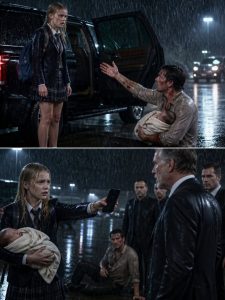
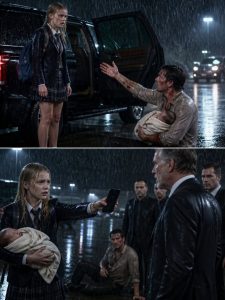
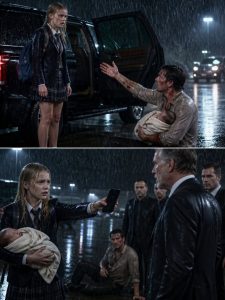
I followed it to a loading dock where a black SUV sat with its rear doors open and hazard lights blinking weakly against the storm.
A man lay on the pavement beside it.
One hand pressed against his side.
The other wrapped protectively around two screaming newborns bundled in hospital blankets.
At first, I didn’t recognize him.
Then he looked up.
“Riley,” he whispered.
I froze.
“Dad?”
He tried to stand and nearly collapsed.
His white dress shirt was soaked dark beneath his overcoat.
Blood mixed with rainwater beneath him.
The babies screamed louder, tiny red faces trembling in the cold.
Part of me wanted to run.
Part of me wanted to scream at him for knowing my name but never knowing my life.
Instead, I dropped to my knees beside him.
He shoved a black card into my hand.
No logo.
No company name.
Just a phone number engraved in silver.
“Call this number,” he said weakly. “Ask for Mara Ellis. Tell her the sparrows escaped the cage.”
It sounded insane.
But his eyes weren’t confused.
They were terrified.
“Who did this to you?” I asked.
He glanced toward the warehouse door.
“Someone from my company.”
Before I could ask another question, headlights flooded the alley.
Another car rolled slowly toward us.
My father grabbed my wrist hard enough to hurt.
“Don’t let them take the twins.”
The car door opened.
A man stepped into the rain wearing a charcoal coat and a calm smile, like he had finally found something valuable.
I recognized him instantly.
Charles Mercer.
Chairman of Whitmore International.
My father’s business partner.
Magazine photographers loved him because he always looked kind.
He looked kind now too.
That scared me more than if he’d been angry.
He stopped several feet away and smiled gently.
“Riley Bennett,” he said. “You’ve gotten so tall.”
Ice slid through my stomach.
How did he know my name?
My father tried to push himself upright.
“Stay away from them.”
Mercer ignored him.
His eyes stayed fixed on me.
“Those babies need medical care,” he said softly. “You don’t want to be standing in the rain holding them when the police arrive.”
One of the babies let out a weak cry.
I looked down.
They were tiny.
Smaller than dolls.
One had a pink hospital bracelet still attached.
The other’s blanket was spotted with blood.
My father coughed violently.
“Riley,” he whispered. “Run.”
Mercer sighed, almost sadly.
“You always make things difficult, Grant.”
Then three more men stepped from the second SUV.
Security.
Not police.
Too clean.
Too calm.
My heart started hammering so hard I thought I might faint.
I was eleven years old.
I had two newborns in my arms and a bleeding billionaire father telling me to run from his own company.
So I did.
I bolted into the rain before anyone expected it.
One baby pressed against each side of my chest beneath my soaked hoodie.
Behind me, men shouted.
I heard footsteps.
Then my father roared something so violently that everyone stopped for half a second.
That half second saved me.
I darted through a narrow service alley, slipped behind a chain-link fence, and sprinted toward the subway entrance two blocks away.
The babies cried the entire time.
People stared.
No one stopped me.
New York teaches people not to ask questions.
I reached a closed laundromat and crouched beneath the awning, shaking so hard my teeth clicked together.
Then I remembered the card.
My fingers trembled as I fed quarters into a payphone beside the laundromat.
The number rang once.
Twice.
Then a woman answered immediately.
“Status.”
I swallowed hard.
“Mara Ellis?”
Silence.
“Yes.”
I looked over my shoulder.
“The sparrows escaped the cage.”
Nothing happened for one terrifying second.
Then her voice changed completely.
“Where are you?”
I told her.
“Stay exactly where you are,” she ordered. “Do not trust anyone from Whitmore International. I’m coming.”
The line disconnected.
Ten minutes later, a dark blue sedan screeched to the curb.
A woman jumped out wearing jeans, boots, and a soaked FBI windbreaker.
I nearly cried from relief.
She showed me her badge before approaching.
“Mara Ellis,” she said. “You’re Riley.”
I nodded.
She looked at the babies first.
Then at the blood on my sleeves.
Then at me.
“Where’s your father?”
“I don’t know.”
That was the truth.
Her jaw tightened.
She ushered us into the car and drove fast through the rain while speaking urgently into her phone.
That was the night I learned my father hadn’t just been a billionaire developer.
He had been helping federal investigators build a case against his own board.
Whitmore International wasn’t only laundering money through construction projects.
According to Mara, several executives were involved in trafficking undocumented women through fake employment programs tied to luxury hotel developments overseas.
The twins in my arms belonged to one of the whistleblowers.
A woman named Elena Torres.
She had died six hours after giving birth.
My father had been trying to move the babies to protective custody when someone inside the company betrayed him.
Charles Mercer wanted the twins because they were evidence.
Living evidence.
Elena had recorded names, bank accounts, contracts.
And before she died, she gave everything to my father.
That’s why they tried to kill him.
We reached a secure federal building downtown just before midnight.
Doctors rushed the twins away.
Agents pulled me into a conference room and wrapped me in blankets while Mara made phone calls.
I kept asking the same question.
“Is my dad alive?”
No one answered directly.
Around three in the morning, Mara finally sat across from me with exhausted eyes.
“He survived surgery.”
I broke apart crying for the first time that night.
Not because we were close.
But because we weren’t.
And suddenly I realized how badly I still wanted him alive.
My father stayed under federal protection for months.
During that time, everything exploded publicly.
News channels covered raids on Whitmore International offices.
Executives disappeared.
Accounts were frozen.
Charles Mercer was arrested trying to board a private jet to Switzerland.
The smiling chairman from magazine covers became the face of one of the largest corporate crime scandals in New York history.
And somehow, in the middle of all that chaos, I became responsible for two babies.
Their names were Mateo and Mia.
Temporary foster care became permanent because there was no surviving family willing to take them.
My mother wanted to say no at first.
Not because she didn’t care.
Because we were barely surviving ourselves.
But then Mia wrapped her tiny hand around my mother’s finger during a supervised visit.
Three months later, they came home with us.
My father paid every expense anonymously through a protected trust.
At least, that’s what Mara told us.
He wasn’t allowed public contact while the investigation continued.
But birthday presents started arriving directly from him after that.
Not through assistants.
Handwritten notes too.
Awkward at first.
Then longer.
He asked about school.
About soccer.
About the twins.
It felt strange learning my father through paper.
Almost like meeting someone after reading a hundred articles about them.
When I was thirteen, I saw him in person again.
Federal agents brought him quietly to our apartment one Sunday morning.
He looked older.
Thinner.
Less polished.
For a long moment, neither of us spoke.
Then he noticed Mateo asleep on the couch clutching a stuffed dinosaur.
“You kept your promise,” he said softly.
I looked at him carefully.
“So did you.”
He frowned.
“You came back.”
Something in his face cracked at that.
Our relationship didn’t magically heal after that.
Real life doesn’t work that way.
You don’t erase eleven years of absence because of one terrifying night.
But he tried.
That mattered.
He came to school events afterward.
Sat through math competitions even when he clearly didn’t understand them.
Learned how to make grilled cheese because Mateo refused eating anyone else’s version.
Mia called him Grandpa Grant by accident once because she thought he looked too old to be a father.
He laughed so hard he cried.
Years later, after the trials ended and Mercer was sentenced to prison, I finally asked my father something that had haunted me since that night.
“Why did you trust me with the twins?”
He stared out the window for a long time before answering.
“Because everyone else in my world could be bought.”
“And me?”
He looked at me quietly.
“You were the only good thing I had never corrupted.”
I didn’t know what to say to that.
So I just sat beside him in silence.
Sometimes people ask me when I became an adult.
It wasn’t when I turned eighteen.
It wasn’t graduation.
It wasn’t even the first time the twins called me their sister.
It was the moment I stood in the rain at eleven years old holding two newborns while powerful men tried to take them away.
And despite being terrified, I said:
“No. You can’t have them.”
That was the first promise I ever made that truly mattered.
And keeping it changed all our lives forever.